
The Pulse
April 24, 2026

Here's what you need to know about Edmonton today.
Essentials
- -1°C: Flurries. Local amount 5 cm. Wind northwest 40 km/h gusting to 60. High minus 1. Wind chill near minus 11. UV index 2 or low. (forecast)
- Blue/Yellow: The High Level Bridge will be lit blue and yellow for Lights on Afterschool. (details)
- 8pm: The Edmonton Oilers (1-1) play the Anaheim Ducks (1-1) in Game 3 of Round 1 of the Stanley Cup playoffs at Honda Center. (details)
- 7:30pm, April 26: The Oilers play the Ducks in Game 4 of their Stanley Cup playoff series at Honda Center. (details)
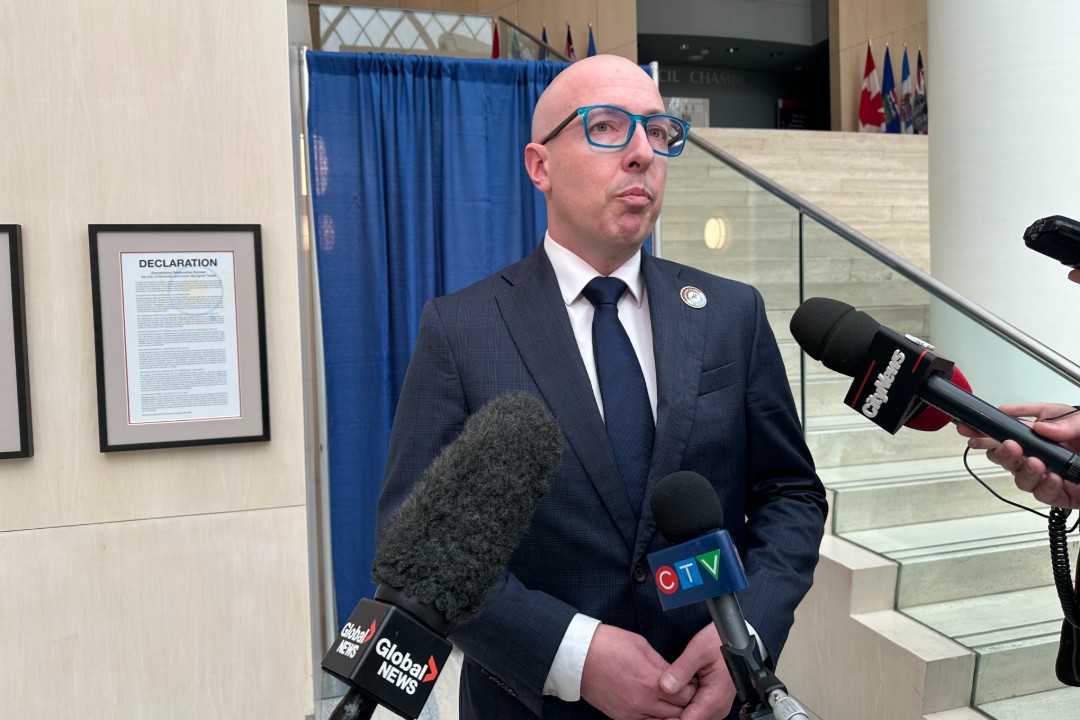
Edmonton city council sunsets seven advisory boards
Edmonton city council has moved to conclude the work of seven boards that advise it on issues ranging from climate change to military contributions to local history.
The change indicates a need to modernize how city council hears from diverse groups, not a desire to stop listening to them, Mayor Andrew Knack said.
"It's not that you're stopping hearing from those voices," he told reporters on April 23. "It's how you're doing it, because a lot of these systems have been in place for decades, and it is time that we … reimagine how we're doing this work."
On March 25, council met in private and decided to sunset the Anti-Racism Advisory Committee (which was paused in 2023), the Edmonton Historical Board, the Edmonton Salutes Committee, the Edmonton Transit Service Advisory Board, the Energy Transition Climate Resilience Committee, the Women's Advisory Voice of Edmonton Committee (WAVE), and the City of Edmonton Youth Council.
On April 28, council is slated to vote on bylaws that will officially conclude the tenure of these boards. If passed, the first six will wrap up on April 30, and the City of Edmonton Youth Council will finish up on Aug. 31. The reports accompanying the bylaws say the decision was made in private so administration could tell the committee members ahead of a public announcement.
The decision is "both short-sighted and ill-timed," members of WAVE said in an emailed statement. "Too often, women and gender-diverse people are silenced or sidelined in shaping policy. WAVE challenged that reality, and its removal reinforces these inequities and eliminates a safe, arm's-length space for equity-seeking communities to engage with council."
Some members of WAVE have formed an independent advocacy collective called People's Advocacy Voice of amiskwaciwâskahikan, or PAVA, to replace what has been lost. "We remain committed to making Edmonton a more equitable, safe, and vibrant city for women and gender-diverse people, and to ensuring those voices continue to shape municipal decisions," spokesperson Sarah Dharshi told Taproot.
Knack said he understands why some are unhappy with the decision, but expressed a desire to continue to hear from a diverse range of Edmontonians. "I think a lot of these voices are going to want to continue to be a part of shaping the city, providing policy recommendations, providing guidance on these pieces," he said. "We need those voices who have so much knowledge and so much to offer to be able to help shape the city in the most meaningful way possible."
Melanie Hoffman, former co-chair of the Energy Transition Climate Resilience Committee, told Taproot she was confused, shocked, and angry when she heard the committee would be shut down. She said the committee was useful because it allowed passionate volunteers to have direct input into administration at a level that the public does not typically have access to.
"The co-chairs of this committee spend hours reviewing 40 to 60 applications every year of people who are interested to be able to volunteer their expertise to council — council then gets to select those people, and then those people get access to administration," she said. "I'd love to hear how being on the outside of that machine is going to make administration better at bringing forward climate action."

Kappella Kyrie Slavic Chamber Choir presents Among Women
On May 8, Kappella Kyrie Slavic Chamber Choir of Edmonton will present Among Women, a concert honouring and acknowledging women in music. From the legacy of Ukraine's first female composer to the contemporary voices shaping today's choral world, this Mother's Day weekend performance celebrates women through sacred and secular soundscapes.
Headlines: April 24, 2026
- Environment and Climate Change Canada issued a special weather statement for Edmonton warning of heavy, blowing snow expected from the night of April 23 to the morning of April 25. The region could see rapid accumulations of up to 10 cm of snow and poor visibility. Temperatures will drop significantly from earlier this week, with wind chills making it feel as cold as -11°C on April 24. Drivers should prepare for quickly deteriorating travel conditions.
- The City of Edmonton will offer free horticultural compost to residents at the Ambleside and Kennedale Eco Stations from May 1 to June 28, while supplies last. Made from collected yard waste, the compost is intended to support home gardening and landscaping, with a limit of 100 litres per vehicle for personal use only. Residents must bring their own tools and protective gear to safely load the material.
- Edmonton Fire Rescue Services is warning residents to keep their pets leashed near bodies of water after rescuing a dog from the North Saskatchewan River on April 22. Crews responded after the dog was spotted drifting on an ice float near the Tawatinâ Bridge, successfully rescuing it near the Capilano Bridge. The City of Edmonton's Animal Care & Control team then took the dog into its care. Pet owners are urged to call 911 if a pet is in distress rather than attempting a rescue on their own.
- Edmonton is experiencing a renter's market as a building boom, fuelled by the city's revised zoning bylaw and federal loan programs, meets a drop in demand. In March, the average Edmonton rent was $1,589, a 2.4% decrease from the previous year, according to Rentals.ca, with some landlords offering rental incentives.
- Ward pihêsiwin Coun. Michael Elliott wants to revisit installing fare gates at Edmonton LRT stations, suggesting it could improve perceptions of safety and boost revenue. Previous discussions on fare gates were shelved due to an estimated $7.2 million cost. Elliott said that the current reliance on Arc could reduce the need for constant attendants. However, Emily Stremel of Edmonton Transit Riders argued that increased ridership, not infrastructure, is key to safety. Carrie Hotton-MacDonald of the Edmonton Transit Service cited LRT design, emergency egress, and costs, as implementation challenges.
- In an op-ed for Postmedia, Chelsey Jersak, founder of Situate, argued that Edmonton's proposed one-metre height reduction would limit viable infill housing. She wrote the current 10.5-metre limit allows functional four-level homes with two livable units. Cutting the height would force poorer designs, pushing space underground or shrinking upper floors, she said. Jersak warned renters would be most affected by the loss of better alternatives to basement suites.
- The Esquao Awards will honour 17 Indigenous women from across Alberta for their achievements and community contributions on May 7 at the River Cree Resort in Enoch. The event recognizes First Nations, Métis, and Inuit women, and typically draws 600 attendees, including government officials, Indigenous leaders, and supporters..
- Dutch YouTube creators are behind several channels that promote Alberta separatism using misleading content and hired actors, according to an investigation by CBC News and Radio-Canada's Décrypteurs. The Media Ecosystem Observatory identified 20 such channels, garnering 40 million views, which exploit political divisions for profit. Individuals in the Netherlands, linked to these channels, also teach others to create "faceless" YouTube content for passive income, despite denying their involvement.
- Premier Danielle Smith says Alberta will promote nine referendum questions ahead of an Oct. 19 vote on constitutional and immigration issues. The government has launched a website outlining proposals drawn from Alberta Next Panel consultations. The ballot includes ideas such as Senate reform and greater provincial control over immigration. NDP Leader Naheed Nenshi criticized the plan as a taxpayer-funded, one-sided campaign targeting newcomers. Additional questions on separation and coal mining could be added if petitions qualify.
- The Alberta government introduced Bill 31, the Red Tape Reduction Statutes Amendment Act, to formalize a switch to permanent daylight saving time and eliminate twice-yearly clock changes. The legislation, tabled by Service Alberta Minister Dale Nally, would place the province on year-round Mountain Daylight Time, branded as "Alberta Time." Officials say the move reflects public demand for consistency, though it follows a 2021 referendum in which a narrow majority opposed the change. The government also plans to coordinate with international time authorities and ensure devices do not automatically revert in the fall.
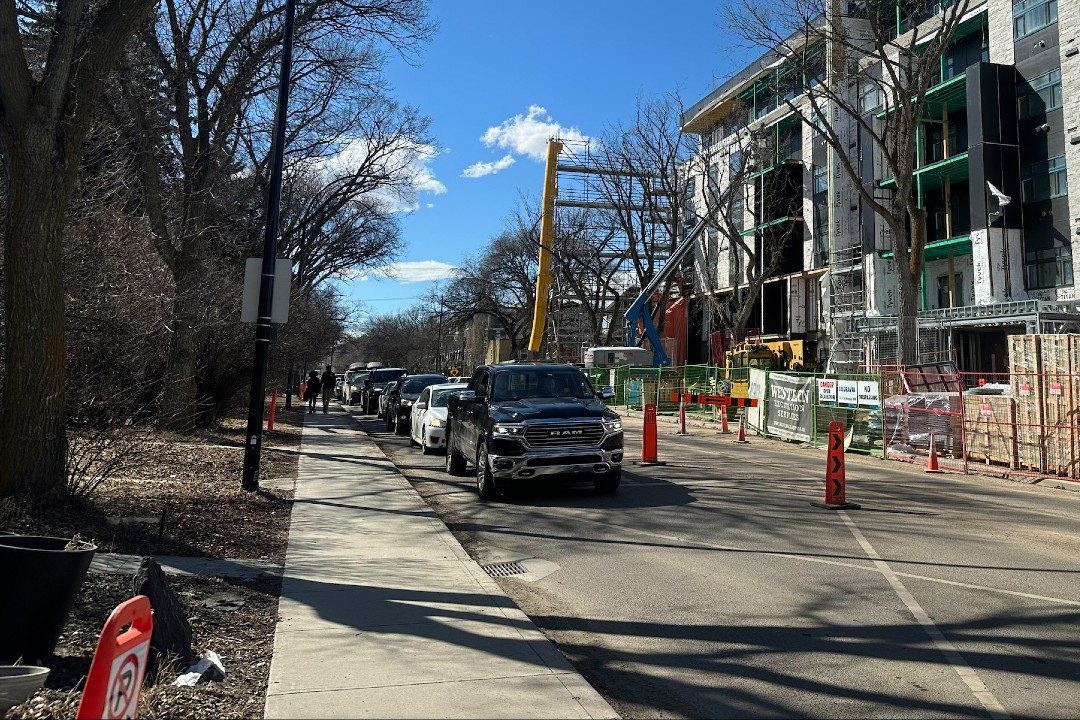
Your turn: Belgravia traffic, business, and budget
This week's batch of calls for public engagement includes in-person sessions discussing traffic congestion in Belgravia, an Edmonton Chamber of Commerce survey about the municipal budget, and a questionnaire for St. Albert businesses.
Edmonton's city administration will host engagement sessions in Belgravia until the end of April to talk about potential interventions to optimize the road network and reduce shortcutting. There is no online survey. In the first phase of engagement in 2025, residents were invited to share their experience with congestion and traffic flow, in a bid to understand the nuances of mobility in the neighbourhood, the city said.
The roadways that surround and bisect Belgravia are considerably congested during rush hour periods because of heavy use from drivers going to and from the University of Alberta and the Groat Road Bridge, as well as those waiting for the LRT on the line running along 114 Street NW. The $100,000 budget for the project comes from the priority growth area project, which proactively upzoned properties near the university to prepare for denser development.
The engagement sessions will be used to further refine the list of potential measures that were gathered in the first round. In the long term, administration will consider redesigning 114 Street where it intersects with 87 Avenue, University Avenue, and 72 Avenue, and increasing capacity for the westbound Whitemud Drive off-ramp at Fox Drive. Traffic at these intersections often backs up all the way to Belgravia, which is why some choose to shortcut through the neighbourhood, the city said. At 114 Street and 87 Avenue, administration proposed installing a scramble crosswalk and restricting left turns from westbound traffic.
In the shorter term, administration will also consider closing 76 Avenue west of the LRT tracks at 114 Street for three hours during weekday rush hour. Potential improvements also include several changes along University Avenue to better manage queueing and create safer crossings for pedestrians and drivers. Within the neighbourhood, administration will consider closing some segments of roads and converting some to one-way traffic in an effort to stop shortcutting.
Administration said it will consider public input alongside technical, budget, and policy requirements to come up with the final design, which will be a mix of potential solutions. Council would need to approve funding to implement any improvements. If the final design is approved, administration said construction would start on 76 Avenue and 114 Street first, and would then move on to University Avenue and the neighbourhood improvements only if necessary.
Residents can register to attend in-person sessions on April 25 or 29, or they can book a meeting with a project team member on April 28 or 30.
A moment in history: April 24, 1971
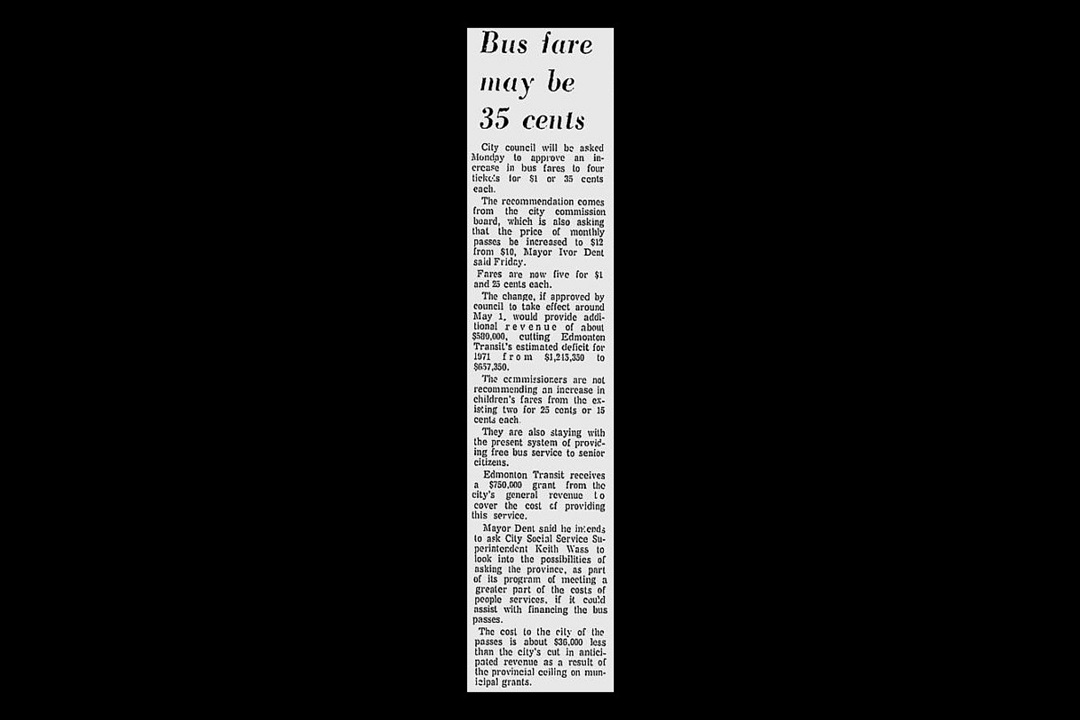
On this day in 1971, Edmonton city council was contemplating raising bus fare to 35 cents. Monthly bus passes were to rise to $12, though seniors' passes remained free, a subsidy that Mayor Ivor Dent hoped to get the province to chip in on.
There has been some form of bus service in Edmonton for at least 130 years. Privately owned horse-drawn omnibuses (a Latin word meaning "for everyone") would ferry riders between Edmonton and the railway station in Strathcona for 25 cents.
For the first 30 years of public transit in the city, the streetcars of the Edmonton Radial Railway were the main way of getting around. By the late 1930s, the streetcar system was struggling. The rail lines and other equipment were in poor condition due to a lack of funding after the Great Depression. Starting in 1938, the city began phasing out the streetcar system in favour of electric trolley buses. It spent over $250,000 on vehicles, paving and installing the electrical lines along the routes that would power the buses. In 1939, the service opened to the public, charging a 10-cent cash fare. Diesel buses were also added to the fleet to service areas where the trolleys weren't practical.
The transition away from the streetcars didn't go smoothly. While the public strongly supported the trolley, expanding the fleet proved to be difficult. Edmonton was ordering most of the buses from England at the time, but the outbreak of the Second World War slowed that process. Despite the plan to phase out the streetcars, the rails were expanded to address increased demand until the trolley system could grow.
In 1946, the Edmonton Radial Railway changed its name to the Edmonton Transportation System (and, a year later, to the Edmonton Transit System). Five years later, the streetcar system was fully retired, making buses the backbone of the system. The system continued to grow, both in vehicles and in ridership. In 1962, changes were made to the bus system to make commutes faster and easier. This was when the first dedicated bus lanes and express routes were added. It also saw the arrival of the monthly bus pass for regular riders.
The trolleys remained part of ETS for decades, even as the LRT system reintroduced rail to the public transit system in the 1970s. Eventually, though, they fell out of favour. The trolley buses were quiet and clean, but didn't have the flexibility of those with diesel engines. Trolley bus lines began to disappear, and in 2008, the city council voted to scrap the system entirely to save on costs. The next year, the last trolley bus route ran for the final time.
These days, ETS's fleet of buses numbers around 1,000, most of them being conventional engines, with 60 all-electric vehicles. The city is currently debating further changes to Edmonton's bus system, including the introduction of new rapid bus routes.
This clipping was found on Vintage Edmonton, a daily look at Edmonton's history from armchair archivist Rev Recluse of Vintage Edmonton.
Happenings: April 24-26, 2026
Here are some events happening this weekend in the Edmonton area.
- April 24: Experience A Taste Of Ukraine starting at 5pm at Cask and Barrel
- April 24: Love Pro Wrestling 47 starting at 7pm at The Rec Room (South Common)
- April 24: ambient ch0ir, presented by hundredmillionthousand starting at 7pm at St. Basil's Cultural Centre
- April 25: Women's Health Symposium starting at 10am at Holiday Inn Conference Ctr Edmonton South by IHG
- April 25: Spring Show & Sale starting at 10am at Edmonton Potters' Guild Studio
- April 25: Naturecore Expo starting at 11am at North East River Valley Park
- April 25: ᜑᜒᜎᜓᜋ᜔ HILOM: A Showcase of Grief, Gratitude & Glory starting at 6:30pm at Edmonton Public Library (Stanley A. Milner)
- April 25-26: Edmonton Indie Bookstore Extravaganza at various bookstores
- April 26: Moretime's First Ever Dog Social starting at 11am at Edmonton Humane Society
- April 26: Earth Day Block Party and Eco Market starting at 11am at Earth's Refillery Coop
- April 26: At the Court of Frederick the Great starting at 3pm at Robertson-Wesley United Church
And here are some upcoming events to keep in mind:
- May 3: Ballad, Blues, and Boogie at Fringe Theatre Arts Barns
- May 9: 2026 Edmonton Bike-A-Thon at Ebike Edmonton
- May 12: Caregivers Alberta's 25th Anniversary Celebration at Jerry Forbes Centre
Visit the Taproot Edmonton Calendar for many more events in the Edmonton region.

The Taproot Mini - No. 195
Test your crossword prowess and deploy a little of your Edmonton knowledge. Complete the puzzle.
Did you know you can buy a Taproot membership as a gift? Mother's Day is coming…
The Taproot Mini is brought to you by ATB, your homegrown source of good advice to help conquer life's tougher puzzles. Learn how.
