The Pulse
April 22, 2026

Here's what you need to know about Edmonton today.
Essentials
- 8°C: Mainly cloudy. 60% chance of showers in the afternoon. Wind becoming northwest 30 km/h gusting to 50 early in the afternoon. High 8. UV index 4 or moderate. (forecast)
- 8pm: The Edmonton Oilers (1-0) host the Anaheim Ducks (0-1) at Rogers Place for Game 2 of the first round of the Stanley Cup playoffs. (details)
Region pledges to help Kawasaki build supply chain for liquefied hydrogen
A global leader in the hydrogen supply chain is partnering with economic development organizations in the Edmonton region to unlock liquefied hydrogen exports.
"Liquefied hydrogen is moving from demonstration to reality," Kei Nomura, general manager of hydrogen strategy for Kawasaki Heavy Industries, said on stage at the Canadian Hydrogen Convention on April 21. "We think Canada, and especially Alberta, (has) strong potential — not only for domestic use, but for export."
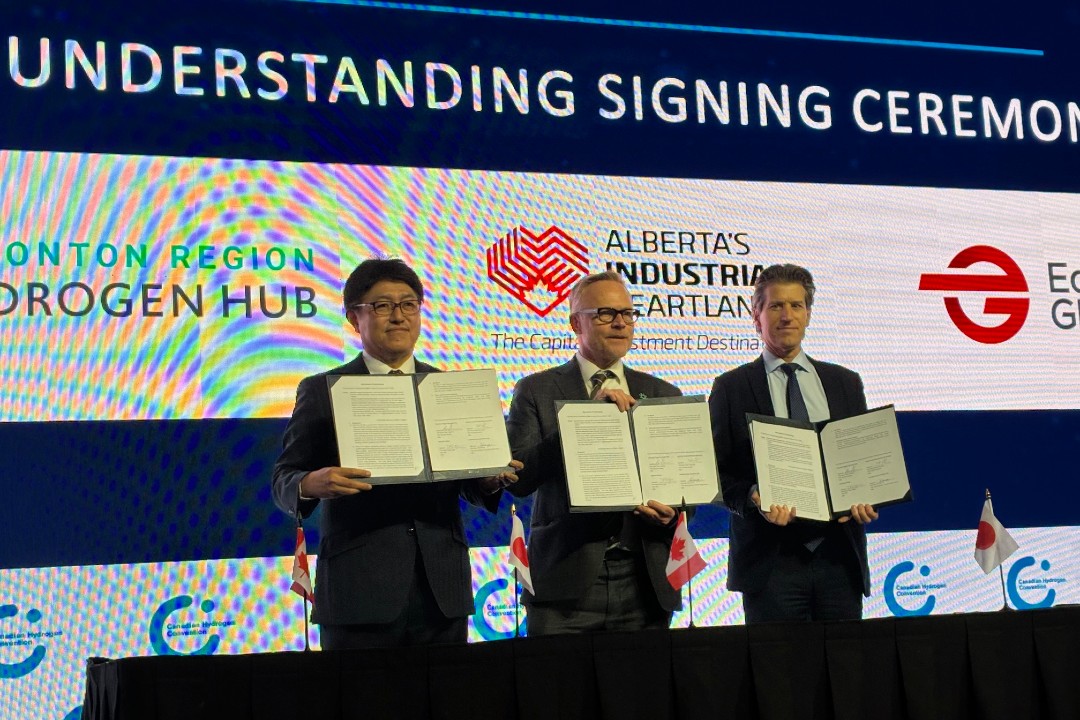
Kawasaki signed a memorandum of understanding with Edmonton Global, Alberta's Industrial Heartland Association, and the Edmonton Region Hydrogen HUB to build a supply chain for liquefied hydrogen in Canada. The agreement could lead to billions in domestic and international value, suggested Brent Lakeman, executive director of the hydrogen hub.
"We're thinking of the long term," he told Taproot. "This is about a market that's developing now, but certainly growing exponentially after 2030 or 2035."
The Edmonton region is already "Canada's largest hydrogen production cluster with the world's largest low carbon hydrogen production facilities currently under construction," the partners said in a press release. The plan now is to partner with industry, researchers, government, and public organizations to take the steps needed before a projected hike in demand for liquefied hydrogen by 2035. By then, the goal is to send liquefied hydrogen by rail to the West Coast and then onto ships across the Pacific.
To get it across the ocean, Kawasaki is building a 40,000-cubic-metre liquefied hydrogen carrier that could transport the fuel to a busy industrial port near Tokyo. Kawasaki said it built the world's first liquefied hydrogen carrier in 2019.
Why all the fuss about liquid hydrogen? Hydrogen is a volatile gas that is notoriously challenging to contain and transport. Its liquefied form has been critiqued for "boil-off" (wherein hydrogen escapes via evaporation), Lakeman said, but Kawasaki is developing technology that aims to reduce the average boil-off rate of 30% to 40% down to 0.3%. Plus, the optimism for hydrogen stored in ammonia has dimmed in recent years as rail operators priced the risk of its transport too highly to be viable.
"People aren't prepared to take on those costs, (but) there are other ways. How do those compare economically?" Lakeman said. "What this project will do is bring all those costs and those studies together."
Stakeholders in the local hydrogen economy have been laying the groundwork for its viability for years. The Alberta government unveiled its hydrogen roadmap and the Edmonton Region Hydrogen HUB launched in 2021, a year after Alberta's government prioritized hydrogen in the natural gas vision and strategy.
"(Hydrogen) truly allows us to unlock new value from our natural gas resources and expand our already amazing petrochemical sector," Brian Jean, the minister of energy and minerals, said at the convention. "It allows us to reduce emissions in hard-to-abate industries, which are so important, and open new domestic and export markets, which we need to do in order to grow our energy production."

Ballet Edmonton presents LUMEN – May 8, 9, and 10
LUMEN spotlights Ballet Edmonton's newly announced Artistic Director, Diego Ramalho, featuring two of his works: Valei-me and Indelible Stain. This powerful double bill highlights his distinct choreographic voice, blending intensity, musicality, and emotional depth, offering audiences a compelling glimpse into the company's next artistic chapter.
Tickets available at balletedmonton.ca
Headlines: April 22, 2026
- The City of Edmonton is exploring options for the Exhibition Lands development after a report presented to city council's urban planning committee indicated that housing plans would reduce space for large events like KDays from 55 to 16 hectares over 20 years. Mayor Andrew Knack said he prefers a hybrid plan that sets aside 21 hectares for events, which would reduce planned housing by 505 units but preserve the ability to host major gatherings. Explore Edmonton President Traci Bednard said events and residential development can coexist, noting that the 6.4-hectare Coliseum site, slated for demolition this summer, could provide additional event space.
- A 12-storey tower in downtown Edmonton was awarded the Guinness World Record in July 2025 for the largest solar-panel artwork, spanning 379 square metres. The mural, titled The Land We Share, by local Indigenous artist Lance Cardinal, adorns the 56-year-old SunRise tower's north facade, embracing both local Chinese and Indigenous cultures. The $28-million deep-energy retrofit, undertaken by Avenue Living, Chandos, and other partners, modernized the building, achieving a 64% emission reduction and offering 179 rental suites and new amenities to support downtown Edmonton's renewal.
- The Canadian Association of Journalists has announced the finalists for its 2025 CAJ Awards. Judges selected finalists from a record 561 submissions, highlighting work that showed persistence, accountability and public-interest reporting. Edmonton journalist Jana Pruden earned a nomination in the Written Feature category for The matriarchy with muscles in The Globe and Mail. The Edmonton Journal and MacEwan University collaboration Risky restaurants was shortlisted in the Data Journalism category. The winners will be revealed during an event on June 13 at the Carleton University School of Journalism and Communications.
- The Edmonton Oilers rallied to win 4-3 against the Anaheim Ducks in Game 1 of the Stanley Cup playoffs on April 20 at Rogers Place. After blowing a two-goal lead in the second period, Kasperi Kapanen scored his second goal late in the third period to secure the victory, with Jason Dickinson also scoring twice. Leon Draisaitl returned from injury with two assists, while captain Connor McDavid was effective despite not scoring any goals. The Oilers expressed confidence heading into Game 2.
- As the Edmonton Oilers continue their first-round playoff series against the Anaheim Ducks, Oilers fans are showing low interest in travelling to Southern California for Games 3 and 4. Kari-Lynn Stanners, associate-manager of NewWest Travel, said the weak Canadian dollar, high travel costs, and "playoff fatigue" from recent extended runs are likely factors discouraging travel. U.S. President Donald Trump's political rhetoric is also deterring some people.
Happenings: April 22, 2026
Here are some events happening today in the Edmonton area.
- Powering Alberta's Future: A Conversation on Energy with Minister Brian Jean starting at 9am at World Trade Centre Edmonton
- MARIOS - Advanced Mechanical Testing to Address Mine Site Challenges starting at 12pm online
- Ward Anirniq In-Person Engagement for 2027-2030 Budget starting at 5:30pm at St. Lucy Catholic Elementary School
- Buco Windermere Wine Dinner: Bold & Aromatic starting at 6:30pm at Buco Pizzeria + Vino Bar
- Listen to This! starting at 7pm at Audio Ark
- Irrational Trivia with Helluva Thing starting at 7pm at Irrational Brewing Company
- Waiting for the Parade starting at 7:30pm at Walterdale Theatre
- Casey and Diana starting at 7:30pm at Citadel Theatre
- New Standards Music ft. Chanel Klein starting at 8pm at The Common
And here are some upcoming events to keep in mind:
- April 25-26: Edmonton Indie Bookstore Extravaganza at various bookstores
- April 30: Nerd Nite Edmonton #92: Hypnotism, Insect Moms, and Space Travel at Fringe Theatre Arts Barns
- May 4: 2026 Edmonton Arts Prize Presentation at Garneau Theatre
Visit the Taproot Edmonton Calendar for many more events in the Edmonton region.

The Taproot Mini - No. 193
Test your crossword prowess and deploy a little of your Edmonton knowledge. Complete the puzzle.
Know someone who would love the Mini? Encourage them to subscribe to The Pulse.
The Taproot Mini is brought to you by ATB, your homegrown source of good advice to help conquer life's tougher puzzles. Learn how.
