
Region pledges to help Kawasaki build supply chain for liquefied hydrogen
A global leader in the hydrogen supply chain is partnering with economic development organizations in the Edmonton region to unlock liquefied hydrogen exports.
"Liquefied hydrogen is moving from demonstration to reality," Kei Nomura, general manager of hydrogen strategy for Kawasaki Heavy Industries, said on stage at the Canadian Hydrogen Convention on April 21. "We think Canada, and especially Alberta, (has) strong potential — not only for domestic use, but for export."
Kawasaki signed a memorandum of understanding with Edmonton Global, Alberta's Industrial Heartland Association, and the Edmonton Region Hydrogen HUB to build a supply chain for liquefied hydrogen in Canada. The agreement could lead to billions in domestic and international value, suggested Brent Lakeman, executive director of the hydrogen hub.
"We're thinking of the long term," he told Taproot. "This is about a market that's developing now, but certainly growing exponentially after 2030 or 2035."
The Edmonton region is already "Canada's largest hydrogen production cluster with the world's largest low carbon hydrogen production facilities currently under construction," the partners said in a press release. The plan now is to partner with industry, researchers, government, and public organizations to take the steps needed before a projected hike in demand for liquefied hydrogen by 2035. By then, the goal is to send liquefied hydrogen by rail to the West Coast and then onto ships across the Pacific.
To get it across the ocean, Kawasaki is building a 40,000-cubic-metre liquefied hydrogen carrier that could transport the fuel to a busy industrial port near Tokyo. Kawasaki said it built the world's first liquefied hydrogen carrier in 2019.
Why all the fuss about liquid hydrogen? Hydrogen is a volatile gas that is notoriously challenging to contain and transport. Its liquefied form has been critiqued for "boil-off" (wherein hydrogen escapes via evaporation), Lakeman said, but Kawasaki is developing technology that aims to reduce the average boil-off rate of 30% to 40% down to 0.3%. Plus, the optimism for hydrogen stored in ammonia has dimmed in recent years as rail operators priced the risk of its transport too highly to be viable.
"People aren't prepared to take on those costs, (but) there are other ways. How do those compare economically?" Lakeman said. "What this project will do is bring all those costs and those studies together."
Stakeholders in the local hydrogen economy have been laying the groundwork for its viability for years. The Alberta government unveiled its hydrogen roadmap and the Edmonton Region Hydrogen HUB launched in 2021, a year after Alberta's government prioritized hydrogen in the natural gas vision and strategy.
"(Hydrogen) truly allows us to unlock new value from our natural gas resources and expand our already amazing petrochemical sector," Brian Jean, the minister of energy and minerals, said at the convention. "It allows us to reduce emissions in hard-to-abate industries, which are so important, and open new domestic and export markets, which we need to do in order to grow our energy production."
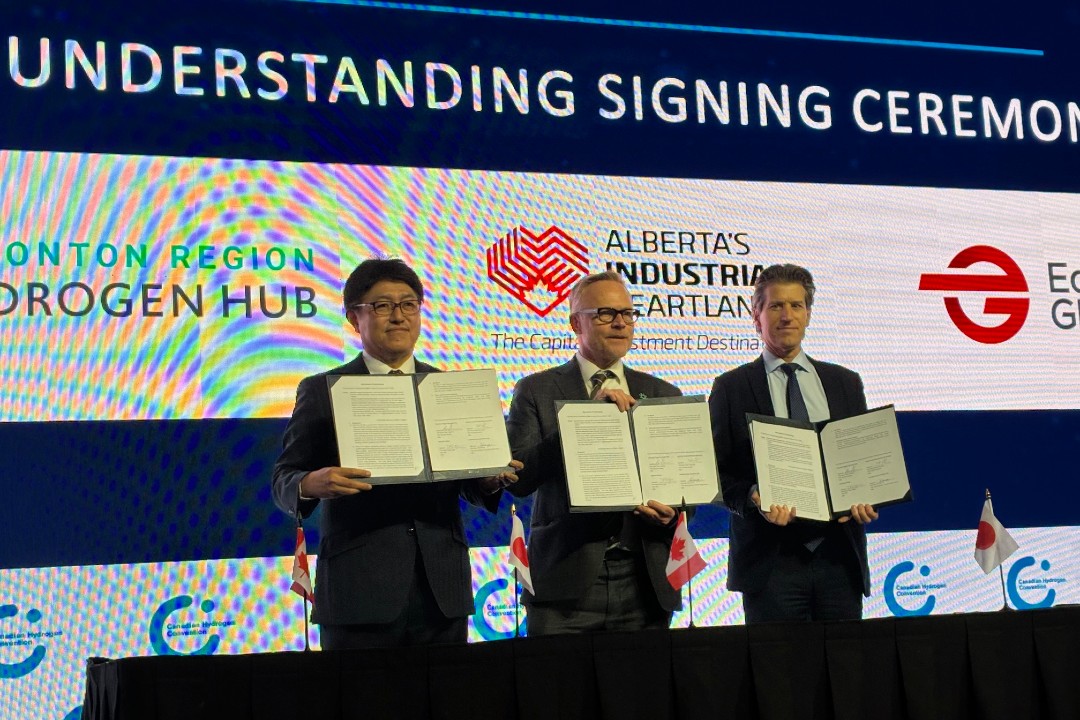
Kei Nomura of Kawasaki Heavy Industries, Brent Lakeman of the Edmonton Region Hydrogen HUB, and Mark Plamondon of Alberta's Industrial Heartland Association signed a memorandum of understanding at the Canadian Hydrogen Convention on April 21. (Colin Gallant)
While much of the MOU is focused on future economic returns, there is already momentum in the ecosystem. Air Products, ATCO, Dow, Linde, and others are building hydrogen infrastructure in the region. The Edmonton Transit Service is piloting hydrogen-powered buses. The Alberta Motor Transport Association will continue its trial of hydrogen-powered commercial trucks for another six months, it announced during the convention. Mayor Andrew Knack celebrated innovators Diesel Tech Industries and Dark Matter Materials during a proclamation of Hydrogen Week on April 20. The list goes on, despite the death of Alberta's first commercial hydrogen refuelling station in 2025.
Looking ahead, the purpose of the Kawasaki MOU is largely to determine the viability of the entire supply chain for liquefied hydrogen, from production to implementation. Its liquefied form came into sharper focus during the 2025 hydrogen convention.
"Last year, we discussed what needed to be done," Nomura said. "This year, we agreed on what we will do together."
The clock is ticking, as Kawasaki may be ready to mobilize as early as 2029, Lakeman said.
"Japan is building this technology today — that's not stopping," he said. "We want to make sure that there's a case for that technology to support our environmental and economic goals here."
The Canadian Hydrogen Convention continues this week. The Canadian Hydrogen Convention Awards will take place at the Edmonton Convention Centre on April 22, and site tours will happen on April 23.
Share