
The Pulse
Feb. 13, 2026

The Pulse will be off on Monday, Feb. 16, for the Family Day holiday. We'll be back in your inbox on Tuesday, Feb. 17.

Your turn: Sober-living village, snow storage, Wîhkwêntôwin extension
This week's batch of calls for public engagement includes a request for feedback on supportive housing in Blatchford, a call for input on snow storage sites in Edmonton, and an extended deadline for responses to the draft design for neighbourhood renewal in Wîhkwêntôwin, along with several surveys in the region.
The Métis Urban and Capital Housing Corporation is asking for community feedback on Pakoshayimooh Village, an affordable sober-living housing development in Blatchford. The survey is open until Feb. 28.
Pakoshayimooh Village, whose name comes from the Cree-Michif word for hope, seeks to provide stable housing to Indigenous residents recovering from addiction, with support from Otipemisiwak Métis Government's health department. It is expected to have 55 apartment units, with shared outdoor spaces, a rooftop patio, and a community kitchen.
"Securing stable housing after completing addiction treatment is one of the most significant challenges individuals face following treatment," the development's web page reads. "For Indigenous people, this challenge is often compounded by long-standing systemic barriers and the impacts of historical and intergenerational trauma."
The survey seeks feedback to inform design considerations as well as thoughtful integration of the project into the surrounding community. Everyone's input is welcome, but the organization is particularly keen on hearing from residents in Blatchford, Prince Charles, Prince Rupert, Westwood, and Spruce Avenue.
Blatchford is a sustainable community built on renewable energy, and the project will follow the neighbourhood's green building standards set by the city.
Métis Urban and Capital Housing is behind similar properties, such as the Renaissance Tower at 9505 105 Avenue NW. The accessible and affordable housing complex for Indigenous seniors over the age of 55 is part of the city's Boyle Renaissance development.

Let's Find Out about the Whale Society of Edmonton
Did you know Edmonton once had a save-the-whales club, and it made a big splash? Learn more at a live recording of Let's Find Out, a podcast about history. Chris Chang-Yen Phillips will speak to Candas Jane Dorsey and Kathryn Ivany about this moment in Edmonton's past and other treasures in the city archives. Join us on March 3!
Headlines: Feb. 13, 2026
- The Alberta government is rolling out $143 million in classroom complexity funding to establish 476 "complexity teams" across the province. These teams will hire 1,428 educational staff, with each receiving $300,000 to support students with complex needs. Education Minister Demetrios Nicolaides said the hires are part of the government's promise of 3,000 new teachers by 2028. Edmonton Public Schools will receive funding for 101 teams and Edmonton Catholic Schools for 42.
- The Grey Nuns Community Hospital postpartum department in Edmonton became the first in the city to offer donated breast milk to patients, effective Feb. 13. Parents who need an alternative to formula or who cannot breastfeed can purchase 120 mL of breast milk for $19.
- Nearly a month after Hospitals Minister Matt Jones announced triage liaison physicians (TLPs) would "immediately" start on Feb. 1, the Alberta government will not confirm if any are on duty in busy Edmonton and Calgary emergency departments. This initiative was announced after the December death of Prashant Sreekumar at Edmonton's Grey Nuns Community Hospital. The Alberta Medical Association (AMA) has not reached an agreement on TLP employment conditions. AMA section president and physician Warren Thirsk advised emergency department doctors against individual contracts due to liability concerns, calling the government's announcement "more of a communications exercise."
- Edmonton-based Zero Point Cryogenics (ZPC) is a key global player in quantum computing infrastructure, and is one of six companies worldwide that commercially manufacture dilution refrigerators, BetaKit reported. Founded by John P. Davis, a professor at the University of Alberta, and led by CEO Chris Cassin, the company builds systems that reach near-absolute zero temperatures, which is crucial for quantum research. Cassin credits Edmonton's unique combination of university research, NAIT skilled trades programs, and low manufacturing costs for the company's success.
- Edmonton's innovative manufacturing industry, contributing nearly 40% of Alberta's total output, develops cutting-edge technologies in biotechnology, energy, and medical devices, according to a post on the City of Edmonton's blog, Transforming Edmonton. The City of Edmonton's Edge Fund supports these advancements, awarding $5 million to 17 businesses in 2024. Recipients include NGT Energy, which is developing safer oil and gas measurement devices; Zero Point Cryogenics, the sole North American manufacturer of quantum dilution refrigerators; and Millennium Three Technologies, enhancing industrial pre-fabricated assembly with computer-vision technology.
- Following a mass shooting at a school in Tumbler Ridge, B.C., Alberta RCMP responded to several gun-related calls at schools on Feb. 11 and 12. This included a false alarm in Sherwood Park, where Bev Facey Community High went into lockdown and F.R. Haythorne Junior High into hold and secure after a reported gun sighting at Strathcona Athletic Park. "There's been a lot of distress and anguish with what's gone on in Tumbler Ridge, which is understandable," Alberta RCMP Cpl. Mathew Howell told Postmedia. Other incidents occurred in High River and Fort McMurray, where a replica firearm was later seized and an 18-year-old was charged. In Edson, a man fired a cap gun at a principal. Premier Danielle Smith and Education Minister Demetrios Nicolaides will ask school boards to audit security measures.
- Edmonton Oilers captain Connor McDavid was a major factor in Team Canada's 5-0 Olympic win against Czechia on Feb. 12, during the Milano Cortina 2026 Winter Olympic Games. McDavid, leading all forwards with 18:04 ice time, recorded three assists and a team-high six shots on net. He set up goals for Macklin Celebrini, Nathan MacKinnon, and Nick Suzuki.
- The Edmonton Elks made an operations and coaching staff announcement for 2026 on Feb. 12. Ed Hervey remains VP of football operations and general manager, with Nic Cross joining as football operations assistant, and Danelle Tucker as strength & conditioning specialist. New coaching staff include Jabari Arthur as running backs coach, Cedric Douglas as defensive line coach, and Des Catellier as special teams coach. Trysten Dyce and Demetrious Maxie are departing.

Elliott's story: It's life-changing
A message from Accessible Acupuncture:
Finally, a local doctor of acupuncture is helping cancer survivors find relief from the constant pain and suffering associated with peripheral neuropathy.
"Irreversible" is not a word anyone wants to hear from their doctor, yet it is commonly used when someone is diagnosed with chemotherapy-induced peripheral neuropathy (CIPN).
Elliott S. of Edmonton survived testicular cancer, only to find himself living with relentless nerve pain. "It felt like I was walking on pins and needles," he recalls. "I was getting weaker every day and started worrying that I might end up in a wheelchair."
Nearly half of patients who undergo chemotherapy develop CIPN. While chemotherapy medications are effective at destroying cancer cells, they can also damage healthy nerves. Symptoms may begin within weeks of treatment and often worsen over time. For many patients, these symptoms can persist for months or even years after chemotherapy ends.
For Elliott, CIPN affected nearly every aspect of daily life. "It was difficult to walk up and down stairs or do the things we usually take for granted," he says.
Common symptoms of CIPN include pain, tingling, burning, weakness, or numbness in the hands and feet, sharp or stabbing nerve pain, loss of touch sensation, clumsiness, balance problems, and an increased risk of falling.
While some nerves may recover on their own, many patients are told the damage is permanent. Elliott heard this repeatedly from doctors and specialists. His cancer was cured, but the nerve damage caused by treatment was considered untreatable.
Everything changed when Elliott contacted Dr. Melanie Morrill, Dr. Ac., founder of Accessible Acupuncture in Edmonton.
Melanie uses the time-tested science of acupuncture alongside advanced technology originally developed by NASA to help increase circulation and support nerve recovery and healing. This non-invasive approach has helped many patients experiencing the long-term effects of CIPN.
After a series of treatments, Elliott noticed a dramatic difference. "I started taking the stairs with ease," he says. "We live in a split-level house with lots of stairs. One morning, I walked downstairs, made breakfast, and realized I didn't even need the handrail. It was life-changing to have my mobility back."
Stories like Elliott's are not uncommon at Accessible Acupuncture. Melanie has spent over five years helping patients with CIPN and other forms of peripheral neuropathy, including diabetic neuropathy, often after they have been told nothing more can be done.
If you have beaten cancer but are still living with nerve pain, weakness, or numbness, or if peripheral neuropathy is limiting your life, help may be available.
Melanie is currently accepting new chemotherapy-induced neuropathy patients. Call 587-879-7122 to schedule your consultation today.
A moment in history: Feb. 13, 1905
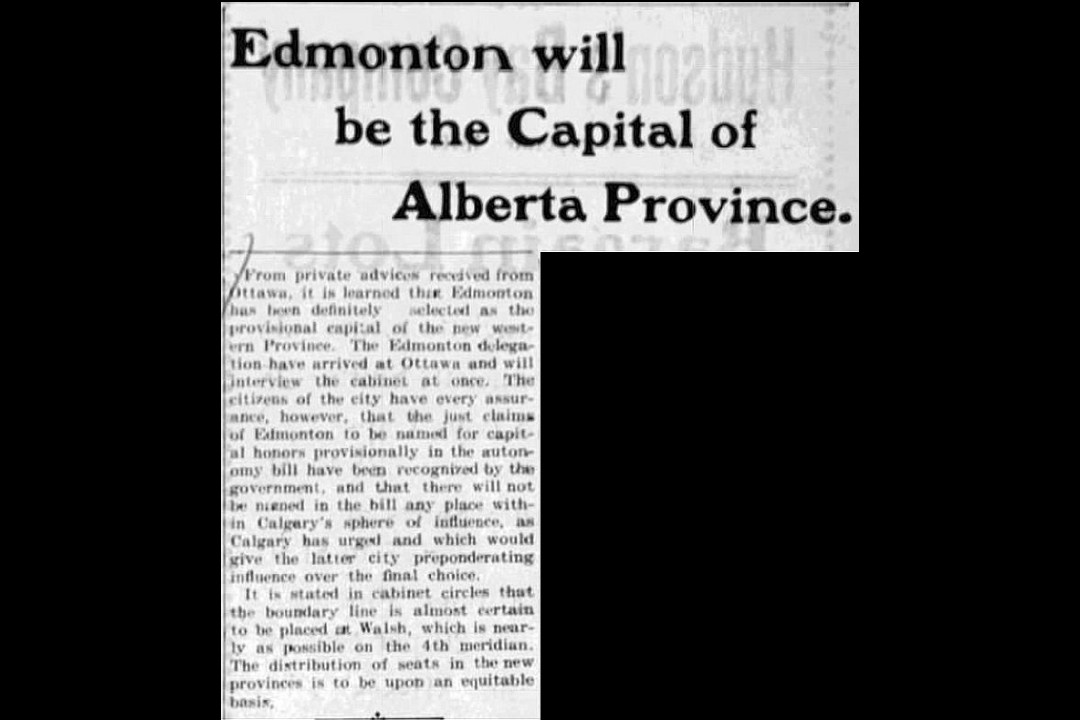
On this day in 1905, Edmonton was announced as the future capital of the new province of Alberta.
It wasn't official yet, but a newspaper report at the time noted that Edmonton "has been definitely selected" as the seat of government for the new province, based on leaked info from Ottawa. A delegation from the city was there, meeting with the federal government to secure the city's status as the capital. But they weren't the only ones pushing for the title — the report notes that Calgary wanted it, too.

Edmonton won that debate, but it wasn't a certain victory. On Sept. 1, 1905, the Alberta Act came into effect, which established the province of Alberta and set out the structure of its government. Written into the act was a section that declared Edmonton the presumptive capital of the infant province "unless and until the Lieutenant Governor in Council of the said province otherwise directs." That left the door open to those who wanted to have the capital moved.
The capital question was a major issue in the province's first election in November 1905. The Liberals campaigned on keeping Edmonton as the capital, while the Conservative Party favoured moving the seat to Calgary. That said, it wasn't a clean split down party lines. Candidates of both parties often supported one or the other, depending on which was closer to their constituency.
After the Liberals won, Premier Alexander Rutherford decided to put the decision on the capital to a vote in the legislature.
The question came up during the first session of the Alberta Legislature. There was no Legislature Building at the time, so the province's first leaders gathered at the old Thistle Rink arena, the largest building in Edmonton at the time. During that session, several motions called for the capital to be moved to other parts of the province. Calgary, obviously, was the top alternative, but arguments were also made for places like Red Deer and Banff. Those proposals were voted down.
A little over a month later, Liberal MLA William Cushing made a motion again proposing to move the capital to Calgary. Part of the argument was about the future legislature building — Edmonton was in the midst of a real estate boom and rising land prices, and hadn't yet decided on a site for the government building. Calgary, on the other hand, was offering 25 acres of free land. Despite the offer, legislators voted the motion down 16-8, and Edmonton's status as Alberta's capital was secured.
Of course, the Assembly would eventually get a permanent home in Edmonton when the Legislature Building opened in 1912. And over the next 114 years, the government's footprint expanded, with government workers working in offices all across the city, mostly downtown, until COVID-19 made working from home an option. Last week, almost 12,000 workers returned to the office full-time, as the province ended the hybrid work model it had adopted during the pandemic.
This clipping was found on Vintage Edmonton, a daily look at Edmonton's history from armchair archivist Rev Recluse of Vintage Edmonton.

Happenings: Feb. 13-16, 2026
Here are some events happening this Family Day long weekend in the Edmonton area.
- Feb. 13: BCW in Action presents: Celebrate Black Voices in Arts and Film starting at 4:30pm at The Orange Hub
- Feb. 14: Art Gallery of St. Albert Family Day Weekend Activities starting at 12pm at Art Gallery of St. Albert
- Feb. 14: All Black Wear Gallery Affair starting at 6pm at Art Gallery of Alberta
- Feb. 15: Bridgerton High Tea starting at 1pm at Lady Bea's English Tea House
- Feb. 15: Stroll of Poets Haven Reading Series starting at 2pm at Audreys Books
- Feb. 15: Grindstone Comedy Theatre Fundraiser Show starting at 6pm at Grindstone Theatre
- Feb. 15: Afflatus Hijab Fashion Show starting at 6:30pm at Pendennis Building
- Feb. 16: Fire and Ice Family Day Festival starting at 12pm at Lacombe Lake Park
- Feb. 16: Family Day in the Arts District starting at 12pm
- Feb. 16: Doomscrollers Anonymous: Love Letters and Break Up Post-Its starting at 6:30pm at Climate Justice Edmonton Office
- Until Feb. 16: World's Longest Hockey Game at Saiker's Acres
- Until Feb. 16: Silver Skate Festival at Sir Wilfrid Laurier Park
And here are some upcoming events to keep in mind:
- Feb. 24: Mental Health Foundation Annual Fundraising Breakfast at Edmonton Convention Centre
- Feb. 24: Lean Derisking: Taking Your Proof of Concept to the Clinic online
- Feb. 25: Screams & Shenanigans: Celebrating 10 Years of Social VR at Edmonton Unlimited
Visit the Taproot Edmonton Calendar for many more events in the Edmonton region.

The Taproot Mini - No. 148
Test your crossword prowess and deploy a little of your Edmonton knowledge. Complete the puzzle.
Did you miss a Mini this week? Catch up in the archive.
The Taproot Mini is brought to you by ATB, your homegrown source of good advice to help conquer life's tougher puzzles. Learn how.
