
The Pulse
Feb. 11, 2026

Help us better serve you by filling out the Taproot audience survey!
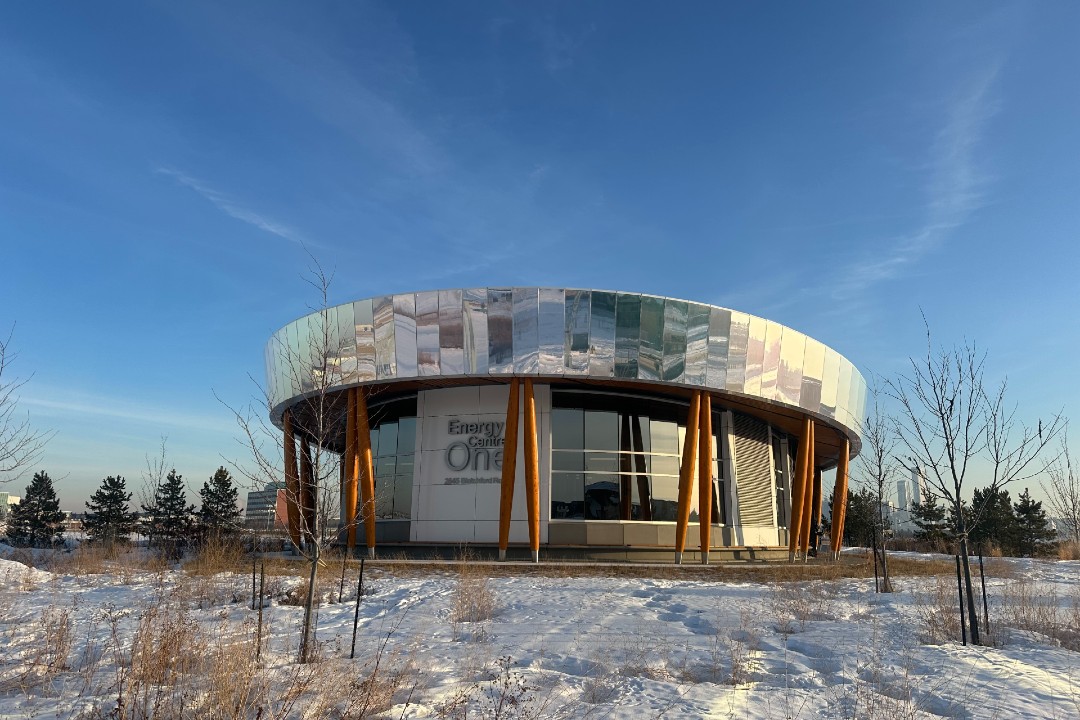
Carbon tax removal throws wrench into Blatchford utility's financial sustainability
The Blatchford renewable energy utility's path to financial sustainability is more complicated now that the federal government has axed the consumer-facing carbon tax.
City administration is consulting external experts to reassess the impact of the policy change, said Christian Felske, the manager of the Blatchford renewable utility. "We have to do more work to really see this through, to develop some scenarios or some principles for council to tell what the range of results are."
Blatchford is powered by renewable energy through a district energy sharing system. Thermal energy is extracted from a geoexchange field under the community's stormwater pond. Heat is drawn up through 570 boreholes drilled 150 metres into the earth, sent to the Blatchford Energy Centre, and then pushed to a network of underground pipes to homes and buildings, where it is used to heat and cool air and water.
When the utility was approved in 2017, it required an upfront, non‑refundable cash infusion of $98 million because user fees are not expected to cover the cost of providing the utility. Edmonton's utilities are generally set up so that user fees fully cover the cost of provision. Blatchford is governed by a separate Business As Usual (BAU) policy requiring that its residents pay roughly the same amount for utilities as households elsewhere in the city. But if Blatchford users were charged enough to cover the actual operating and capital costs of the renewable utility, their bills would be far higher than a typical Edmonton household. "We were basically given the go-ahead, fully knowing that there was a funding gap in the overall business case," Felske told Taproot.
The city has been covering the difference by issuing a loan to its own utility, with the expectation that Blatchford users will eventually pay it back. The utility also still requires the cash infusion, which is now closer to $69 million. The amount fluctuates with changing utility rates, and has also been partially covered by a $23.7-million grant from Natural Resources Canada. Administration said it needs to secure the majority of the non-refundable cash infusion by 2029, when the next energy centre is forecast to be operational.
Here's where the end of the consumer-facing carbon tax comes in. In April 2025, shortly after Mark Carney replaced Justin Trudeau as Liberal leader and prime minister, Ottawa removed the federal fuel charge and requirements for provinces to have a consumer-facing carbon price. The result was lower utility bills for most Canadians. Since utility bills outside Blatchford have dropped, Blatchford rates must follow suit, even though utility costs in the redevelopment haven't decreased. The cash infusion amount is likely to increase because utility rates are now even further from covering costs.
While the carbon tax removal has disrupted the utility's financial outlook, Felske cautioned that utilities are long-term projects. "Keep in mind that we are modelling this for 30, 40, 50 years out," he said. "Federal policies and provincial policies will change. A one-time change today doesn't mean necessarily it will stay the same, but we need to have a closer look on that."

Where music meets mischief
Opera Pub is where soaring arias, show tunes, and surprise guests collide with pints and midweek shenanigans at Blue Chair Café. Join Edmonton Opera for free, no-tickets-needed Opera Pub nights on Feb. 18, March 18, April 15, and May 13.
Headlines: Feb. 11, 2026
- Edmonton city council's urban planning committee heard overwhelming support for a private tree protection bylaw aimed at preserving mature trees. Advocates, including Jan Hardstaff of the Residential Infill Working Group and Kristine Kowalchuk of the Edmonton River Valley Conservation Coalition, said the bylaw is overdue to prevent clear-cutting and boost the city's 13% canopy cover, which lags behind other major Canadian cities. They highlighted trees' vital role in climate resilience, reducing heat, and improving public health, though some opponents expressed concerns about increased red tape.
- Alberta schools are facing increased pressure from overcrowded classrooms and a significant rise in special education needs, with 133,703 students identified in the 2024-25 school year, marking a 17% increase since 2019. Education Minister Demetrios Nicolaides acknowledged the rising complexity, pointing to federal immigration policies for contributing to more than 80,000 new students in three years. The province is building more schools, allocating targeted resources, and formed a class size and complexity cabinet committee. Jason Schilling of the Alberta Teachers' Association said that government funding has not kept up with enrolment growth.
- The Edmonton Blues Festival has been permanently cancelled after running for 25 years. The announcement on Feb. 10 marked the end of the long-standing annual event in Edmonton. "Escalating production costs, weather uncertainties, changing of venues and declining attendance have all conspired to make it impossible to host another event," the festival wrote on its website.
- A new report from the Canadian Mortgage and Housing Corporation (CMHC) says that Edmonton's rental market is expected to soften this year due to rising vacancy rates, increasing rental supply, and slowing population growth. CMHC predicts the vacancy rate will reach 4.5% in 2026, up from 3.8% in 2025, providing renters with more choice. Housing starts are also projected to decline as supply catches up to demand.
- A fireball seen over Edmonton on Feb. 10 likely landed hundreds of kilometres away, according to Frank Florian of the TELUS World of Science - Edmonton. "It's most likely just a little black rock," Florian said.
- The Alberta Council of Women's Shelters is urging the province to keep independent oversight of domestic violence deaths or reinvest the funding into frontline services after Alberta's family violence death review committee ended its work in 2025. The council also called on the province to release the committee's latest report, expected this spring. The Ministry of Children and Family Services said resources will shift to "integrated, forward-looking prevention efforts" and frontline programs.
- The Alberta government wrongly withheld hundreds of pages of its Alberta Next survey results from Postmedia, an adjudicator with the Office of the Information and Privacy Commissioner ruled last week. Adjudicator Teresa Cunningham rejected the province's argument that legislative exemptions allowed it to withhold early responses and post-survey written replies related to a provincial pension plan, police service, and immigration, Postmedia reported. The government, which released a summary of multiple-choice results in late December 2025, must now release the remaining records, including 213 pages of written replies, by April 20.

Happenings: Feb. 11, 2026
Here are some events happening today in the Edmonton area.
- From Vision to Action: Harnessing the Healthy Aging Framework for Strategic Planning starting at 12pm online
- Communications: Big Deal or Little Deal? Issue or Crisis? starting at 1pm at Edmonton Chamber of Voluntary Organizations
- Move Slowly and Build Bridges: Mastodon, the Fediverse, and the Struggle for Democratic Social Media starting at 1pm at MacEwan University
- Quantum Materials as a Platform for Next-Gen Biomedical Applications starting at 5pm at MKT Fresh Food | Beer Market
- Sex and Sexuality in Later Life starting at 5:30pm at Royal Glenora Club
- Lean In Network Edmonton: Connection Over Competition starting at 5:30pm at Sorrentino's (Century Park)
- Valentine's Day: Recipes To Win Their Heart starting at 6pm at L'OCA Quality Market
- CHCP & EPL + The Kitchen: Beef and Vegetable Macaroni starting at 6pm at Edmonton Public Library (Stanley A. Milner)
- Book Launch with José Teodoro starting at 7pm at Audreys Books
- SMARTstart Program Information Sessions starting at 7pm at Greater Parkland Regional Chamber
- Spreading Your Story: Pitching to Media starting at 7pm online
- ACE Ad Auction online (until Feb. 13)
And here are some upcoming events to keep in mind:
- Feb. 16: Labo Spelling Bee at Labo Coffee YEG
- Feb. 20: Peggy Baker/Canadian Dance Icon at Timms Centre for the Arts
- March 3: Let's Find Out: About The Whale Society of Edmonton at the City of Edmonton Archives
Visit the Taproot Edmonton Calendar for many more events in the Edmonton region.

The Taproot Mini - No. 146
Test your crossword prowess and deploy a little of your Edmonton knowledge. Complete the puzzle.
Know someone who would love the Mini? Encourage them to subscribe to The Pulse. You've got your own referral code at the bottom of this email.
The Taproot Mini is brought to you by ATB, your homegrown source of good advice to help conquer life's tougher puzzles. Learn how.
