
Carbon tax removal throws wrench into Blatchford utility's financial sustainability
The Blatchford renewable energy utility's path to financial sustainability is more complicated now that the federal government has axed the consumer-facing carbon tax.
City administration is consulting external experts to reassess the impact of the policy change, said Christian Felske, the manager of the Blatchford renewable utility. "We have to do more work to really see this through, to develop some scenarios or some principles for council to tell what the range of results are."
Blatchford is powered by renewable energy through a district energy sharing system. Thermal energy is extracted from a geoexchange field under the community's stormwater pond. Heat is drawn up through 570 boreholes drilled 150 metres into the earth, sent to the Blatchford Energy Centre, and then pushed to a network of underground pipes to homes and buildings, where it is used to heat and cool air and water.
When the utility was approved in 2017, it required an upfront, non‑refundable cash infusion of $98 million because user fees are not expected to cover the cost of providing the utility. Edmonton's utilities are generally set up so that user fees fully cover the cost of provision. Blatchford is governed by a separate Business As Usual (BAU) policy requiring that its residents pay roughly the same amount for utilities as households elsewhere in the city. But if Blatchford users were charged enough to cover the actual operating and capital costs of the renewable utility, their bills would be far higher than a typical Edmonton household. "We were basically given the go-ahead, fully knowing that there was a funding gap in the overall business case," Felske told Taproot.
The city has been covering the difference by issuing a loan to its own utility, with the expectation that Blatchford users will eventually pay it back. The utility also still requires the cash infusion, which is now closer to $69 million. The amount fluctuates with changing utility rates, and has also been partially covered by a $23.7-million grant from Natural Resources Canada. Administration said it needs to secure the majority of the non-refundable cash infusion by 2029, when the next energy centre is forecast to be operational.
Here's where the end of the consumer-facing carbon tax comes in. In April 2025, shortly after Mark Carney replaced Justin Trudeau as Liberal leader and prime minister, Ottawa removed the federal fuel charge and requirements for provinces to have a consumer-facing carbon price. The result was lower utility bills for most Canadians. Since utility bills outside Blatchford have dropped, Blatchford rates must follow suit, even though utility costs in the redevelopment haven't decreased. The cash infusion amount is likely to increase because utility rates are now even further from covering costs.
While the carbon tax removal has disrupted the utility's financial outlook, Felske cautioned that utilities are long-term projects. "Keep in mind that we are modelling this for 30, 40, 50 years out," he said. "Federal policies and provincial policies will change. A one-time change today doesn't mean necessarily it will stay the same, but we need to have a closer look on that."
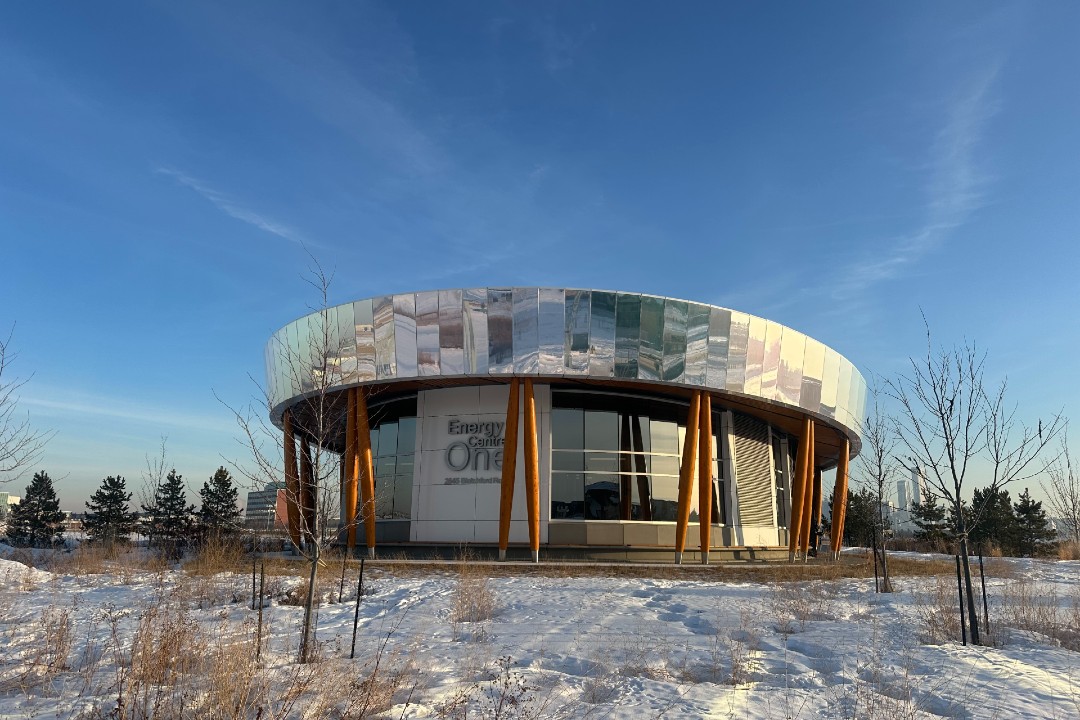
Energy Centre One supplies Blatchford with renewable energy. The utility is facing a financial crunch. (Stephanie Swensrude)
Ideally, the infusion would be covered by grants from other levels of government, Felske said. When the utility was approved, council and administration assumed they would be able to secure grants to cover the non-refundable cash infusion. But to date, the city has only secured the one grant from Natural Resources Canada.
"The non-refundable cash infusion, that's something that sort of hangs over the utility as a bit of a cloud," Coun. Anne Stevenson said during a budget meeting on Dec. 1, at which council set the utility rate for 2026 and received an update on the financial issues.
Felske said administration will continue to pursue grants from other levels of government. Council could also amend the BAU policy to no longer require Blatchford users to pay the same for utilities as the rest of the city, or explore public-private partnerships with utility providers. The last option, Felske said, would be to fund the infusion through property taxes.
Council is expected to get another update on the status of the non-refundable cash infusion by the end of 2026.
The Blatchford Redevelopment Office said that as of the end of 2025, 57% of the site's developable land was either ready for home construction, had utilities and infrastructure underway, or was in the planning and development stage.
The first apartment-style building in the neighbourhood has broken ground, and sale agreements are signed or underway for six more four- to six-storey towers, including an affordable housing development. The city said Blatchford is 56% below its unit density target of up to 190 units per hectare, as so far developers have been more interested in building townhouses than apartments.
Share