
The Pulse
Sept. 18, 2026

Here's what you need to know about Edmonton today.
Essentials
- 22°C: Clearing in the morning. High 22. UV index 4 or moderate. (forecast)
- Purple: The High Level Bridge will be lit purple for the Kaleido Family Arts Festival. (details)
- 6pm, Sept. 19: The Edmonton Oilers host the Winnipeg Jets for a preseason game at Rogers Place. (details)
- 1pm, Sept. 19: The Edmonton Elks play the Toronto Argonauts at BMO Field. (details)
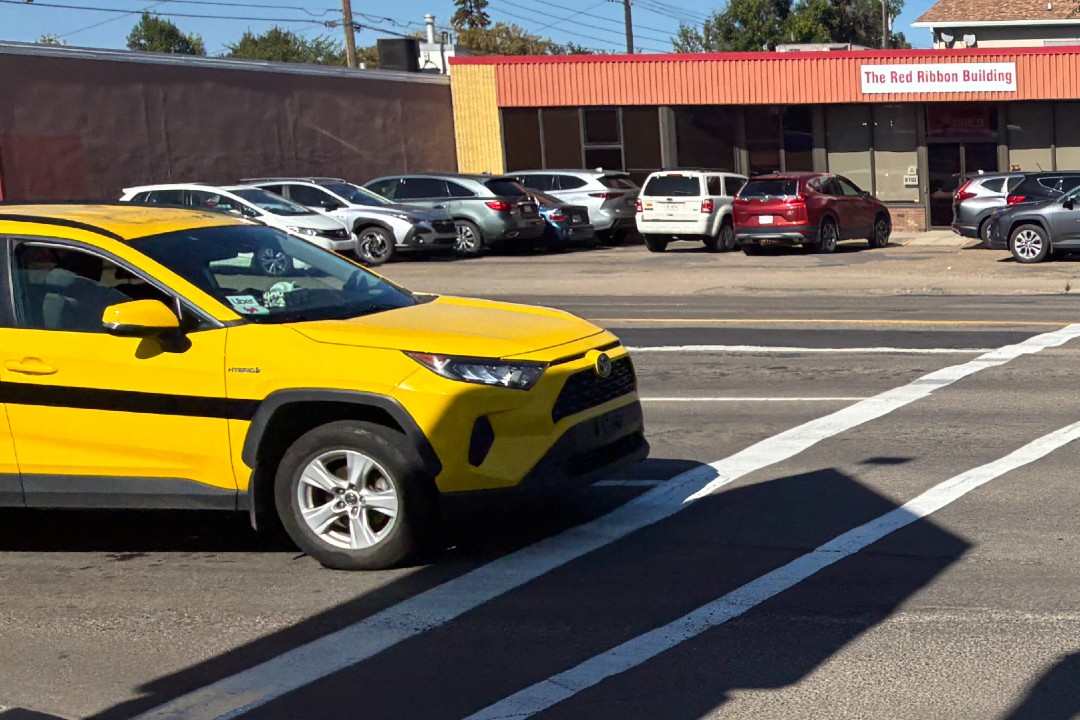
Your turn: Vehicles for hire, transit-related art, reconciliation
This week's roundup of calls for public engagement includes a City of Edmonton survey about rideshare services and other vehicles for hire, as well as a couple of invitations to inspire some transit-related art and an opportunity in Sturgeon County to pledge action on reconciliation with Indigenous people.
Edmonton is surveying users and non-users alike about vehicles for hire until Sept. 24. That description includes taxis, limousines, and shuttles, but most of the questions are about rideshare services such as Uber and Lyft, gauging satisfaction, safety, accessibility, and desired improvements. The information will inform updates to the Vehicle for Hire program and Bylaw 17400.
The vehicle-for-hire team is working on a comprehensive review, due in the first half of 2027. The last time the bylaw changed was in April 2025, when mandatory training was introduced. This survey is to gauge whether change is desired by riders and drivers alike, city spokesperson Aisha Siddiqui told Taproot by email.
In 2016, Edmonton became the first Canadian municipality to legalize Uber after more than a year of illegal operation.
This new survey notably cites Uber, Lyft, and R-Hero as examples of rideshare services in the city. Founded by Uday Kumar Anumanchineni, a former CEO of Alberta Co-op Taxis, R-Hero is locally owned and operated, as is RYDE.
Ayomikun Kayode of Atadel wanted to start his own rideshare service, but he told Taproot that the city makes it too hard and expensive for his company to do so. "We support strong safety standards, appropriate driver training, and proper regulation," he wrote in a Sept. 17 email. "What we were asking for was not an exemption from those responsibilities, but a more proportionate path for smaller operators to enter the market, prove themselves, and grow."
For now, he's focused on Atadel's other features, such as grocery, restaurant, retail, and package delivery — plus something new coming soon, he teased.
Fleets of one to 15 must pay an annual fee of $1,056, plus extra for rideshare-specific driver and vehicle licences, as well as a surcharge on each fare. For fleets of 51 or more, the base annual fee is $20,706.

Everyone needs a will — even you
Whether you're creating your first will or updating an existing one, Wills Week offers expert advice in a welcoming, easy-to-understand way.
Join free online or in-person sessions to learn about wills, executorship, and estate planning essentials.
Presented by Edmonton Community Foundation
Headlines: Sept. 18, 2026
- Edmonton Police Service Chief Warren Driechel said Alberta's process for releasing former detainees needs better coordination with shelters and other social services. His comments follow two recent videos showing former detainees being dropped off in Edmonton's Chinatown, prompting calls from community members and city officials for clearer release protocols. Driechel said police are not directly notified of releases and must search a database to find information about statutory releases. He suggested the province improve communication, map available service providers and ensure people being released are directly connected with appropriate supports. He said the police service will continue working with organizations such as Hope Mission to support people after their release.
- Edmonton Coun. Michael Janz wants the city to revisit its street parking system in high-demand neighbourhoods, including Garneau, and consider charging drivers to park on residential streets. Janz says some of the revenue, currently directed to general city revenue, could instead be returned to homeowners in affected areas. Students and residents say parking near the University of Alberta is difficult, with some students saying they would be willing to pay for more street-parking options. Councillors are expected to receive an update on parking revenue and costs in early 2027, with further discussions planned during the city's December budget process.
- The Edmonton Transit Service will hold open houses at D.L. MacDonald Garage on Sept. 26 and Ferrier Garage on Oct. 3. Visitors are encouraged to take transit or use shuttle service because there is no public parking on site.
- The Edmonton Police Service is asking the public to help identify a man seen in surveillance footage near the former El Cortez restaurant on Whyte Avenue around the time of a June 25 fire. Investigators determined that two fires were deliberately set between 7:40pm and 9:45pm, with the second causing extensive damage to the building. No injuries or damage to neighbouring buildings were reported. Police are also seeking witnesses and anyone with photos or video of the fires.
- About 30 people protested against a planned 68-unit affordable housing development at a surplus school site in Mill Woods, saying residents were not adequately informed or consulted about the project. More than 800 residents have signed a petition calling for construction to be paused while concerns about the development are addressed. Marisa Redmond of the Right at Home Housing Society said the project was always intended as affordable housing and that an earlier proposal for seniors' housing was abandoned in 2012. The City of Edmonton said residents were notified at several stages beginning in 2024 and that the developer held a community open house and survey in September 2025. A counter-protester said there had been ample consultation and welcomed future residents to the neighbourhood.
- The Alberta NDP nominated Trisha Estabrooks as its candidate in Edmonton-Strathcona for the next provincial election.
- More than 509,000 Albertans have applied to vote by mail in the Oct. 19 referendum, according to Elections Alberta. The agency said it had also received nearly 48,000 applications for referendum-day jobs but still needs more workers in a dozen ridings.
A moment in history: Sept. 18, 1915
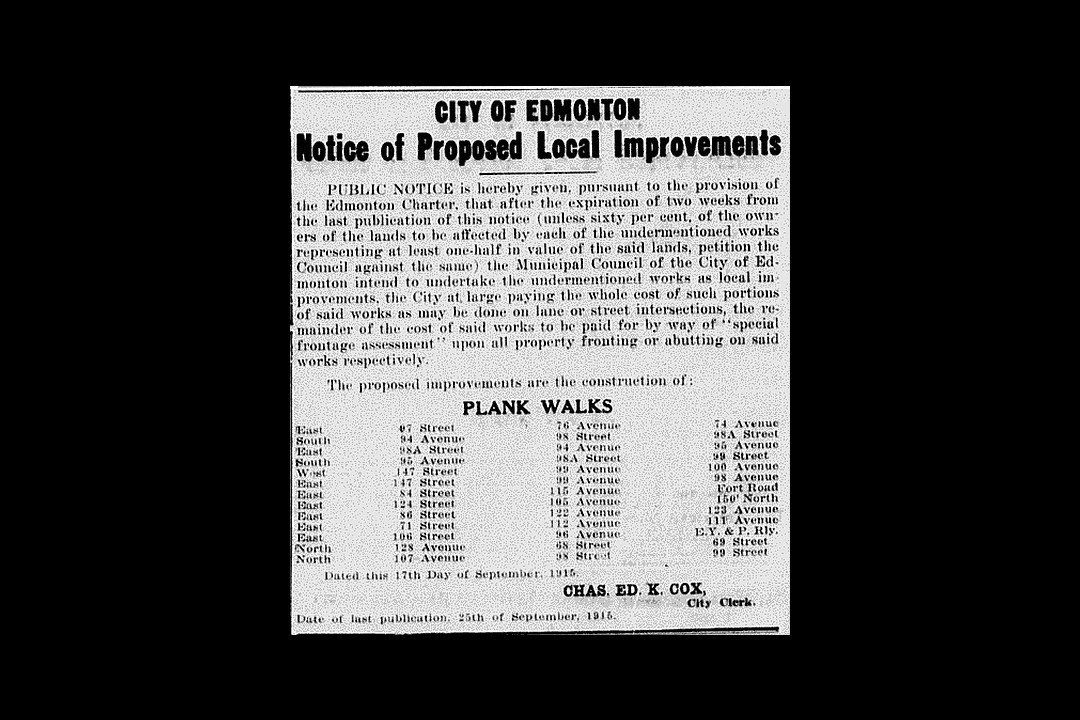
On this day in 1915, the City of Edmonton gave notice that it would be laying some new wooden sidewalks.
In the city's early years. Edmontonians had a few options for getting around the growing city. There were horses and horse-drawn vehicles, automobiles first hit the streets in 1904, and the Edmonton Radial Railway was established in 1908. But most people had to rely on their own feet.
It could be a hard trek. Before the 1890s, people just had to put up with walking in the dirt, which sometimes meant trudging through thick mud as rainstorms and spring thaws left water pooled on the clay-loam streets. Around 1892, the city saw its first actual sidewalk built from wooden planks along Jasper Avenue. The planks sat on large ties to keep them elevated and out of the dirt.
Over the next decade, Edmonton's population exploded tenfold. New streets were added, with new plank sidewalks running along them.
In 1905, Edmonton was enjoying its new status as a city. And a city needed actual sidewalks. Following petitions from business owners who found the old wooden plank sidewalks too crowded and narrow, the city upgraded the wooden planks along Jasper to new granolithic sidewalks: a type of artificial stone made from cement and crushed rock. The gravel and sand from the process were local, mostly taken from the river when water levels dropped. The Jasper Avenue upgrade cost the equivalent of about $1 million.
Wooden plank sidewalks continued to be installed on less-travelled streets, such as those listed in the 1915 announcement, but granolithic sidewalks became more common over time. However, Edmonton's rapid expansion sometimes left newer areas of the city without solid sidewalks. Windsor Park became part of Edmonton in 1910, but the economic hardships following World War I and the Great Depression left it largely undeveloped, and residents had to do without sidewalks or streetlights. Eventually, that infrastructure would come to the area in the 1940s.

The post-war period in Edmonton saw a shift toward more suburban, car-centric design, and planners paid less attention to sidewalks. As the city itself noted in a 2008 sidewalk strategy report, neighbourhood planning in the 1970s and '80s didn't have much to say about sidewalks or walkability. This would leave the city with a rash of missing sidewalks along non-arterial roads. That would start to change in the late '80s and early '90s, leading to the completion of many of those missing sidewalks.
Walkability remains a major consideration in modern city planning. Still, there are calls for more attention to improving pedestrian options, and better maintenance and snow-clearing on those that already exist. This summer has also proven to be a particularly hard one on Edmonton's sidewalks. The pedestrian route along the High Level Bridge had to be closed for days because of wet weather. And in August, a section of sidewalk in north Edmonton was struck by lightning. The charred concrete became a neighbourhood landmark before the city removed it, with plans to send it to the University of Alberta for research.
This clipping was found on Vintage Edmonton, a daily look at Edmonton's history from armchair archivist Rev Recluse of Vintage Edmonton.
Happenings: Sept. 18-20, 2026
Here are some events happening this weekend in the Edmonton area.
- Sept. 18-19: Khinkali Eating Contest at Waffle Bird
- Sept. 18-20: Edmonton Expo at Edmonton EXPO Centre
- Sept. 18-20: Down by the River at Louise McKinney Riverfront Park
- Sept. 18-20: Kaleido Family Arts Festival at Alberta Avenue Arts District
- Sept. 19: Stitch a Postcard Scene with Darcy Hoover starting at 10am at Downtown Farmers' Market
- Sept. 19: Annual Sport Central Bike Drive at various locations
- Sept. 19: Pandas Hockey vs. Mount Royal Cougars starting at 7pm at Silent Ice Centre
- Sept. 19-20: Artist Home Studio Tour at various locations
- Sept. 19-20: Alberta Culture Days at Art Gallery of Alberta
- Sept. 20: Edmonton Terry Fox Run starting at 9:30am at Kinsmen Park
- Sept. 20: Sundays at the 124 Grand Market starting at 11am at 124 Grand Market
- Sept. 20: Litter Pickers Community Cleanup starting at 2pm at Royal Glenora Stairs
- Until Sept. 20: The Mosquers Film Festival at various locations
And here are some upcoming events to keep in mind:
- Sept. 24-Oct. 3: Edmonton International Film Festival at various locations
- Oct. 1: Top 20 Pitch Night must register for address
- Oct. 3-4: Harvest Art + Book Fair at ArtsHub Ortona
Visit the Taproot Edmonton Calendar for many more events in the Edmonton region.
From Sept. 21 to 25, Life Sciences Week brings together industry leaders, policymakers, researchers, innovators, and students for free, community-led events across Alberta. Help shape the future of Alberta's life sciences sector. Register today!


The Taproot Mini - No. 288
Test your crossword prowess and deploy a little of your Edmonton knowledge. Complete the puzzle.
If you love Taproot's daily crossword, become a Taproot member to help us continue to provide this little bit of delight.
The Taproot Mini is brought to you by ATB, your homegrown source of good advice to help conquer life's tougher puzzles. Learn how.
