
The Pulse
May 15, 2026
The Pulse will be off on Monday, May 18, for the Victoria Day holiday. We will be back in your inbox on Tuesday, May 19.
Essentials
- 8°C: Mainly cloudy. 30% chance of showers late in the morning and in the afternoon. Wind northwest 30 km/h gusting to 50. High 8. UV index 5 or moderate. (forecast)
- Purple/Blue: The High Level Bridge will be lit purple and blue for the Huntington Society of Canada's Light it Up 4 HD campaign. (details)
Your turn: Downtown, snow maps, and Fort Sask
This week's batch of calls for public engagement includes a survey on Edmonton's updated downtown policy and another to improve snow and ice clearing maps, as well as the last chance to comment on a couple of initiatives in Fort Saskatchewan.
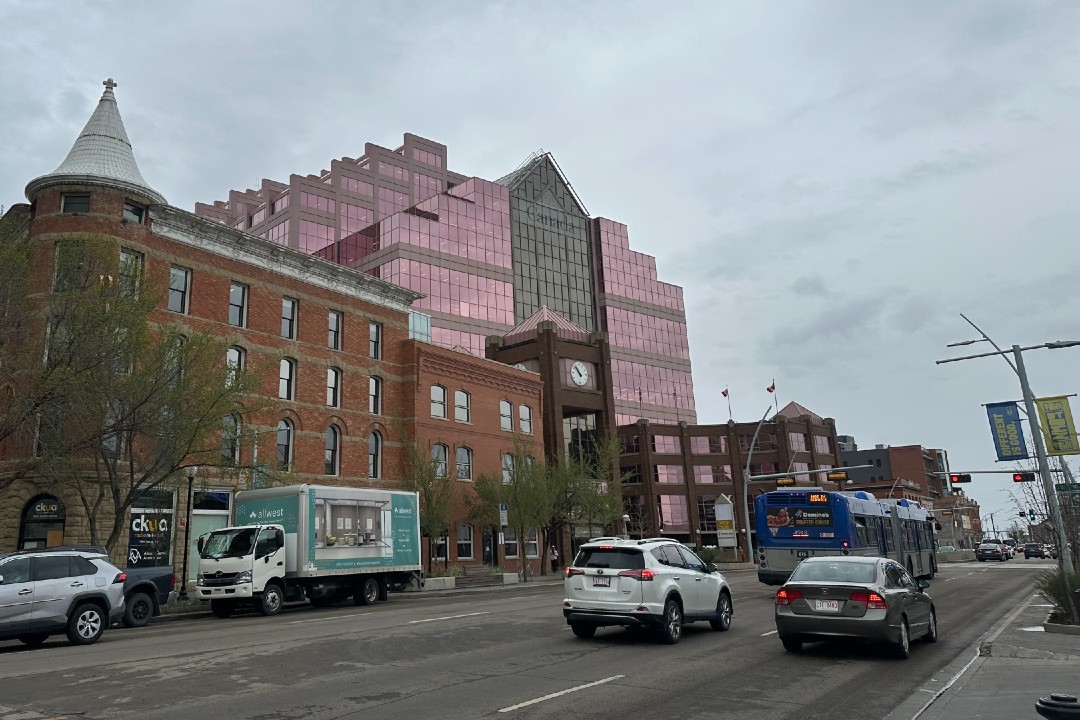
The City of Edmonton is collecting feedback until June 21 on a downtown policy update that will bring together two area redevelopment plans: The Quarters Downtown Area Redevelopment Plan and the Capital City Downtown Plan, which were adopted in 2009 and 2010, respectively. The city said this will establish a dedicated, comprehensive downtown policy chapter in the district policy that better aligns with the City Plan and supports housing growth, walkability, inclusive public spaces, and everyday amenities.
A main goal of this work is to increase the residential population downtown, which most of the council members elected in 2025 said they supported. An area redevelopment plan guides land use, mobility, and urban design direction within established neighbourhoods, and is meant to provide more fine-grained direction than the overarching district policy.
Downtown and The Quarters, also sometimes known as Chinatown South, have typically been separated, both in city-planning documents and geographically. The construction of Canada Place in the 1970s resulted in Chinatown being scooted over a few blocks, no longer directly adjacent to downtown. Downtown and The Quarters have since been served by different policies, initiatives, and plans.
However, the two areas are both within the boundaries of the Edmonton Downtown Business Association, making it one of the largest business improvement areas in Canada. Puneeta McBryan, the association's former CEO, told Taproot that the geographic mass made it tough at times to serve its members. "We already have an area that is way too big, and we're a tiny, tiny organization," she said in her last weeks as CEO. "Obviously, I believe the work that we do is invaluable, and really high impact and necessary, to create a vibrant downtown or a commercial district. You can't really do that well when you're trying to spread yourself over such a huge area."
Outside of land use and urban design, there have been numerous initiatives aimed at increasing downtown's livability, especially in the aftermath of the pandemic, when many office buildings emptied out as employees switched to remote work. The city allocated $15 million through the student housing incentive earlier this year, and it plans to give out $30 million through the attainable housing incentive. The city has allocated $22.9 million for the downtown economic construction grant since 2021.
The attainable housing incentive is funded through the downtown community revitalization levy, which allows the city to borrow against future tax revenue to fund infrastructure improvements. The downtown CRL was extended last summer, and to some consternation, as it involved Edmonton pitching in $69 million for an event park next to Rogers Place. Before its extension, the CRL funded initiatives such as O-day'min Park, which developers consider a catalyst for more than 1,800 housing units under development on adjacent lots.
Meanwhile, the CRL in The Quarters is facing a shortfall of nearly $64 million, because there hasn't been enough private development and subsequent tax uplift in the area to recoup the city's investment.
Administration said it will use the survey feedback to build upon previous engagement downtown and in The Quarters. It will also conduct targeted conversations with residents, businesses, and community organizations until August. Policy recommendations are to go to council in the fall. The finalized policy is set to be presented to council for approval by mid-2027.
Headlines: May 15, 2026
- Mayor Andrew Knack rebuffed calls from Edmonton's business community to end hybrid work for city employees, saying it would cost $5 million to $10 million and the money is better spent on the Downtown Action Plan. The Edmonton Chamber of Commerce had sent a letter on May 11 calling for a phased return to in-person work, following provincial and federal return-to-office mandates.
- Edmonton's $3.8-billion investment portfolio outperformed benchmarks over one, four, and 10 years in 2025, according to the City's annual Investment Committee Report. The Ed Tel Endowment Fund paid $48 million in dividends to the city last year and reached an all-time high valuation of $1.2 billion.
- The Edmonton Oilers have fired head coach Kris Knoblauch and assistant coach Mark Stuart following a first-round playoff exit to the Anaheim Ducks. Knoblauch had a 135-77-21 regular-season record with Edmonton and led the team to back-to-back Stanley Cup Final appearances. General manager Stan Bowman accepted some responsibility for this season's disappointing results. "There's blame to be had by all of us, myself included," he said. "We had players that didn't perform to the level we should. We had players that I brought in that didn't perform to the level that we expected them to."
- Community members gathered at Edmonton City Hall for the fifth annual Moose Hide Day gathering, standing against gender-based violence affecting Indigenous women, girls, and Two-Spirit people. The City co-hosted the event with the Indigenous Sport Council of Alberta as part of the national Moose Hide Campaign.
- Edmonton's 78 spray parks begin opening this week, starting with district parks on May 15 and all others by June 5. Five outdoor pools are scheduled to open between May 20 and June 20, with a new requirement for advance payment before reserved swims and no concessions available this season.
- The Coalition of Alberta Public Libraries expressed disappointment after Bill 28 passed third reading, warning that unfunded implementation costs could force some libraries to close. Edmonton Public Library CEO Pilar Martinez, speaking on behalf of CAP Libraries, urged the government to consult with libraries before setting new regulations under the amended Libraries Act.
- The University of Alberta has retained Robert Summerby-Murray to help find a new home for the 1978 Casavant organ from Convocation Hall. Summerby-Murray, a pipe organist and former university president, will advise on the organ's technical specifications and engage with the organ and veterans' communities to guide its transition.
- Evacuation orders began to lift near Whitecourt on May 14 after a wildfire that displaced more than 150 families was classified as being held, meaning it is not expected to grow beyond its current boundaries. One home was lost to the flames. Officials released a map of the areas now considered safe.
- A new Probe Research poll found most Albertans have negative feelings about the nine fall referendum questions, with respondents using words like "wasteful" and "pointless" to describe the process. About 51% disapprove of the referendum and seven in 10 would vote against separating from Canada, according to the survey of nearly 1,500 Albertans.
A moment in history: May 15, 1926
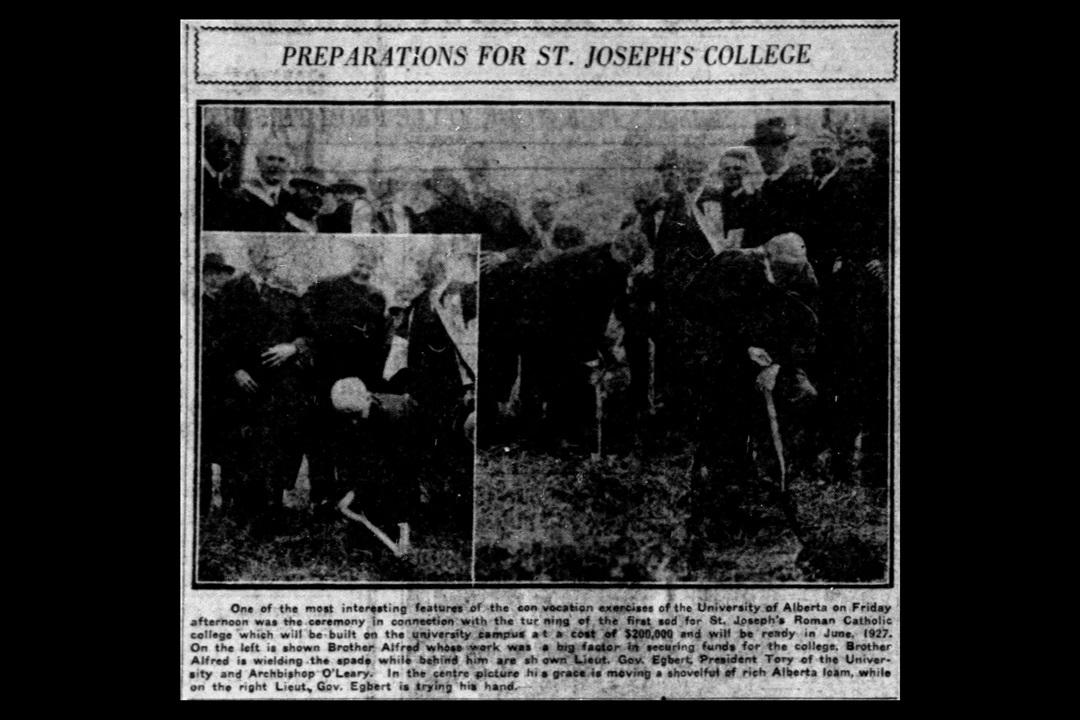
On this day in 1926, ground was broken for the construction of St. Joseph's College on the University of Alberta campus.
The official sod-turning for the new Catholic college was held as part of the university's convocation celebrations. But plans for the college had been in the works for a while, based on the efforts of the Archbishop of Edmonton, John Joseph O'Leary. Catholic schools had been a part of education in Alberta since the 1880s, but O'Leary wanted to see that expanded into post-secondary education.
.jpg)
That fit well with the vision of Henry Marshall Tory, the first president of the U of A. Tory, a Methodist minister himself, wanted to keep the institution non-denominational, but he was willing to offer land on campus to denominational colleges. A deal was struck, and construction began in 1926.
When the college was opened to students in 1927, it included classrooms, a dining hall, a chapel, and a notoriously crowded men's dorm for about 70 students. In addition to other subjects, the college would teach Catholic ethics and philosophy. While the red-brick building, guarded by mature trees, is one of the most recognizable places on campus, it wasn't always easy to keep it warm. The chapel in particular was known to be quite cold, leading students to attend mass in toques and gloves.
Although it is a separate college on campus, St. Joseph's has shared its space over the years. In the 1930s, the college offered some of its classrooms to the U of A's growing School of Education. St. Joe's students and the young teachers would get together at "Little Tuck," one of two coffee rooms. And they got along well — apparently, the celebrations at the Little Tuck became so wild that the college received a letter from the Pope's office requesting that it stop the "cabaret."
In the 1940s, St. Joseph's had another kind of visitor: pilots. The Royal Canadian Air Force took over the dorms during the Second World War, packing 140 people into the residences that had been considered crowded at half that number.
Kateri House, a women's residence, was added to the college, with space for just 14 at first; it was expanded in 2015 to accommodate up to 284. As is the case for the classes taught at St. Joseph's, the dorms are open to all U of A students, regardless of whether they are Catholic.
The ground was broken for St. Joseph's on convocation day 100 years ago, and we are on the cusp of another spring convocation season at the U of A. The ceremony no longer takes place at Convocation Hall, but that building has been in the news lately as the university pursues its plan to remove the Casavant organ over the objections of many music lovers and history buffs. The U of A has retained the services of Robert Summerby-Murray, a pipe organ consultant and past president of Saint Mary's University, to "help find a new and appropriate home for the organ."
This clipping was found on Vintage Edmonton, a daily look at Edmonton's history from armchair archivist Rev Recluse of Vintage Edmonton.
Happenings: May 15-18, 2026
Here are some events happening this long weekend in the Edmonton area.
- May 15: The Carrot Friday Nite Live presents Loud in the Pines starting at 7pm at The Carrot Community Arts Coffeehouse
- May 15-16: Molly McDermott: In and Out of Dark at Timms Centre for the Arts
- May 16: Edmonton Downtown Farmers' Market starting at 10am on 104 Street
- May 16: Book Signing with Alvin Finkel starting at 12pm at Audreys Books
- May 16: Jaunt to the Countryside: Exclusive Anohka Whisky Tasting starting at 6pm at Anohka Distillery
- May 16: Ticket to Hollywood starting at 7:30pm at Artshub Ortona
- May 16-18: St. Albert Heritage Sites: Season Opening Weekend at Arts and Heritage St. Albert locations
- May 17: Cranky's Bike Shop X Patricia Street Deli Ride starting at 11am at Cranky's Bike Shop
- May 17: May Long Weekend Drag Show: EVOcares starting at 6pm at Evolution Wonderlounge
- May 18: Sauna & Soul: Befriend Your Fire starting at 1pm
- May 18: Rough Cut Comedy - Weekly Comedy Showcase! starting at 8:30pm at River City Revival House
And here are some upcoming events to keep in mind:
- May 26: Voices of Hope at ATB Entrepreneur Centre
- May 29-31: Edmonton Drag Festival at Churchill Square
- May 31: Edmonton International Cat Festival Finale (Our Big Pawty!) starting at 10am at MacEwan University (Robbins Health Learning Centre)
Visit the Taproot Edmonton Calendar for many more events in the Edmonton region.

The Taproot Mini - No. 210
Test your crossword prowess and deploy a little of your Edmonton knowledge. Complete the puzzle.
Did you miss a Mini this week? You can find them all in the archive.
The Taproot Mini is brought to you by ATB, your homegrown source of good advice to help conquer life's tougher puzzles. Learn how.
