
The Pulse
Sept. 11, 2024

Here's what you need to know about Edmonton today.
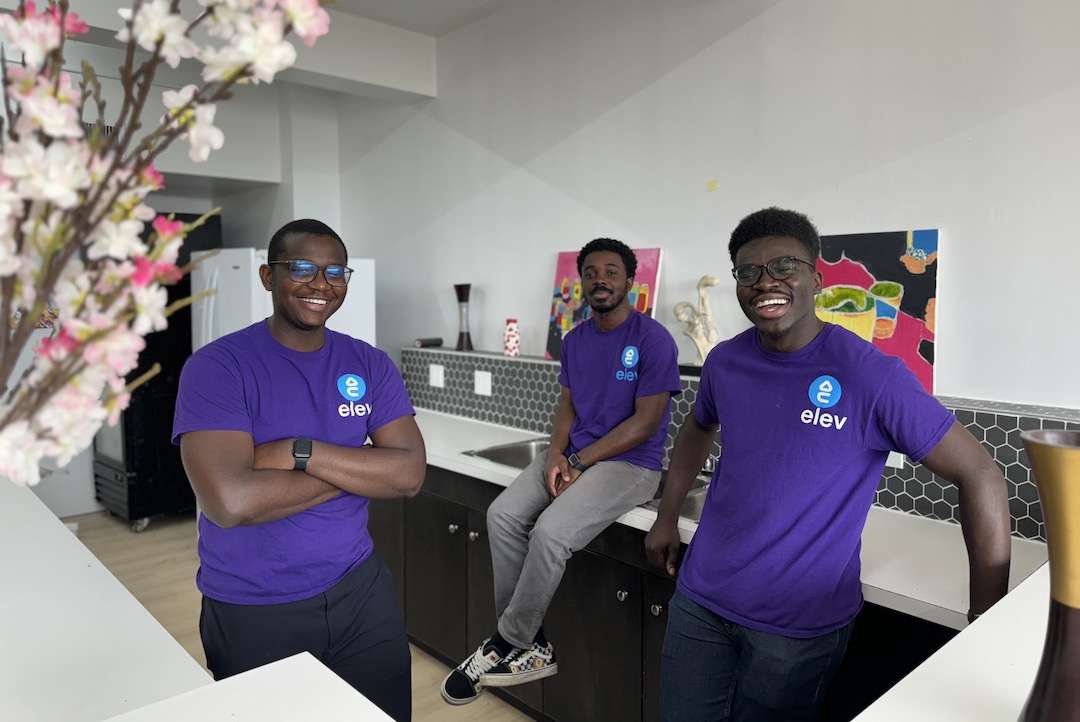
Elev and Five Oaks launch student housing project called The Hive
Student-housing matchmaker Elev has teamed with renowned architect Gene Dub's Five Oaks Inc. to open a housing development for students in the Quarters called The Hive.
Elev's team met Dub through mutual connections and successfully pitched him a concept for communal student living. Dub's Five Oaks owns The Hive, and Elev manages rentals for the building, which used to be the Salvation Army Centre of Hope. It's located at 9611 102 Avenue NW, directly adjacent to the Quarters stop on the Valley Line LRT. The building has 120 single-occupant units, of which 64 should be available for move-in by Oct. 1. Students across Edmonton's post-secondary landscape are eligible for tenancy, and rent starts at $588 per month.
Five Oaks invested about $1.2 million to convert the building from its former role as supportive housing to a student dormitory as of late August, Jean Bruce Koua, a co-founder of Elev and its COO told Taproot. "When it comes to the work that's been done, it has been very much guided by us, and when I say 'us,' it's actually been the feedback that we have received from students," Koua said. "We had multiple focus groups … the three things that (stood out were) the design of the rooms, the safety and, of course, the community."
Koua and others with Elev worked to address these concerns. The rooms in The Hive are small and don't have en suite bathrooms — much like dorms. But the rooms are furnished, so the project partners worked to maximize the space. Security was improved by installing new lighting and consulting with Edmonton Transit Service about the system's safety resources to educate residents on their options. Meanwhile, the design of the communal kitchens, lounge spaces, and study areas focused on allowing students to intermingle.
The communal living at the development differs from other on-campus dorms. At The Hive, students from the University of Alberta, MacEwan University, NAIT, and beyond are more likely to meet people from outside their own institution. Koua described this as part of a long-term dream he has to create a student village.
"(It's) essentially having an extra space downtown here in Edmonton where not only do you have access to housing, but you also have access to other professional services that are beneficial to students," he said. "We really want to have students come and live in that area to generate more traffic and movement, and just have people rejuvenate the space."
Koua didn't outline what professional services he has in mind, but said Dub is on the same page about overall rejuvenation in the Quarters.
Dub, one of two principals at Dub Architects, the firm with projects that include Edmonton City Hall, owns several properties in the Quarters, including the City Market Apartments and the Great Western Garment Building. In March, he spoke about how challenging it's been to energize development in the Quarters. "It's going to take a large development (to) change the character of the area or several projects in concert with each other," Dub said to The Globe and Mail.

Celebrate Alberta's Life Sciences Week
Celebrate Alberta's thriving Life Sciences sector from Sept. 23 to 27! Join us to explore cutting-edge research, network with industry leaders, and witness groundbreaking innovations. Whether you're a student, entrepreneur, or investor, there's something for everyone.
Headlines: Sept. 11, 2024
- City council received a financial update on Sept. 10 showing that Edmonton is projecting a $34-million deficit this year. Among the factors contributing to the financial pressures are increased overtime costs for firefighters and transit operators, declining transit revenue, and rising expenses for fuel, maintenance, and construction. Councillors are looking for ways to avoid a projected 13% tax increase next year, with the potential to halt spending on new major projects. Mayor Amarjeet Sohi has publicly called on the provincial government to contribute more towards property taxes and infrastructure, but said so far there's been "no movement."
- Coun. Andrew Knack appeared on Real Talk with Ryan Jespersen to discuss a variety of topics, including his decision to not seek re-election in next year's municipal election. Knack also addressed Edmonton's financial challenges, saying that while there will be a tax increase next year, it won't be double-digit. "There's just no way people can handle a double-digit tax increase," Knack said in the interview.
- Edmonton is gearing up to host the 42nd annual Canadian Country Music Association (CCMA) Awards at Rogers Place on Sept. 14. A weeklong celebration kicks off on Sept. 11, featuring more than 90 performances, and various free family-friendly events across the city, including 'Country in the Square,' a car show, and movie screenings at Sir Winston Churchill Square. The events are supported by the City of Edmonton's Downtown Vibrancy Fund.
- Postmedia columnist Keith Gerein wrote that Edmonton could be in for a long fight against Dutch elm disease. The City of Edmonton recently announced it has detected the fungus for the first time, identifying it in four trees in the Killarney and Yellowhead Corridor East neighbourhoods. While the City has begun a response plan to contain the spread, Gerein wrote that residents should accept the likelihood that Edmonton is "merely at the beginning of a long-term fight that could see us lose a large number of our mature elms."
- Brian Peel, a homeowner in Edmonton's Garneau neighbourhood, told CTV News that his property value will significantly drop because of the City of Edmonton's plan to build a 34-unit supportive housing development on lots next to his home. Recent zoning changes have allowed the City to proceed with the development, which Peel argues will leave his home sandwiched between two tall buildings. Peel said he attempted to sell his lot to the City for a fair market price, but negotiations ultimately failed. The City's head of real estate told CTV the rezoning gives Peel more options to redevelop his own lot.
- The University of Alberta has renamed its dental school to the Mike Petryk School of Dentistry in honour of alumnus Mike Petryk and his family's $10-million donation. The funding will create an endowment to enhance dental education and provide pediatric dental care for underserved populations. Petryk, who graduated in 1960, had a 40-year career as a dentist in Calgary before retiring.
- Postmedia published an interview with John Carter, a broker/owner at RE/MAX River City, to discuss Edmonton's housing market in the wake of the Bank of Canada cutting its interest rate to 4.25%. With Edmonton in a seller's market, Carter advised potential buyers not to wait for further rate drops, as property values are increasing faster than the savings from lower interest rates. The market is particularly competitive for homes under $500,000, with high demand driven by buyers from Ontario, he said.
- No injuries were reported following a collision between a Capital Line LRT train and a vehicle at 112 Avenue and 82 Street on the morning of Sept. 10. Edmonton Transit Service said the crash happened when the driver of the vehicle tried to cross the tracks while the crossing arms were down. The collision caused delays on the Capital Line for several hours.
- Edmonton woman Erin Rempel ignited an online debate about airplane etiquette after sharing a TikTok video showing her struggle with two "manspreaders" encroaching on her space during a Flair Airlines flight from Winnipeg to Edmonton. The video received mixed reactions, with some viewers justifying the men's actions and others sharing Rempel's frustration. In a statement sent to Fox News, Flair said it doesn't believe it should be "stepping into this disagreement between two customers."
- Many Edmonton Oilers, including star players Leon Draisaitl and Connor McDavid, are already in the city ahead of the team's training camp, eager to start the new season and build on last year's journey to the Stanley Cup final. McDavid, who is entering the seventh season of his eight-year contract, told reporters he is focused on the upcoming season rather than his future contract negotiations.
- Alberta Premier Danielle Smith promoted carbon capture technology as a solution to balance the province's energy needs and emission reductions during a speech at the Carbon Capture Canada Conference in Edmonton. Despite criticism over its high costs and mixed results, Smith emphasized Alberta's efforts to lead in carbon capture and highlighted government incentives to attract investments. Critics argue the technology is inefficient and heavily reliant on taxpayer subsidies.
A moment in history: Sept. 11, 1982
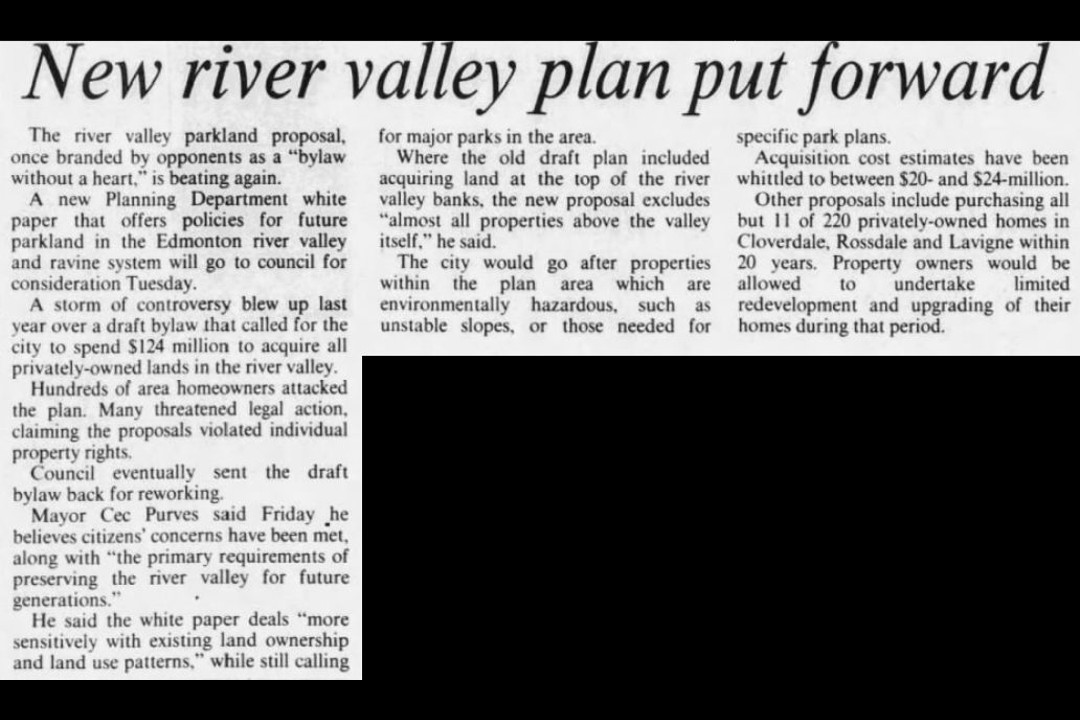
On this day in 1982, Edmonton was debating something called the river valley parkland proposal.
The proposal, which called for major parks to be developed in the valley following a city purchase of land, was itself a response to the controversy that had exploded a year before. That controversy erupted when city officials floated the idea of purchasing all privately owned properties along the river valley. That $124-million dollar idea didn't go over well with many of the people who owned properties within the valley, some of whom branded the idea "the bylaw without a heart," according to the Edmonton Journal. It was a dramatic reaction, but not surprising given Edmonton's unique and sometimes fervid relationship with its river valley.

The river valley we have today is quite different from the one that existed at the beginning of the 1900s. Like most cities at the time, the North Saskatchewan River functioned as the industrial heart of early Edmonton. The banks of the river offered wood for lumber mills, coal for mines, clay for bricks, and even a small gold industry. The river also provided a fast, cheap way to move products and people to and from the city before the rail lines arrived.
But there were people even then who called for the river valley to be preserved as a natural space. In 1907, Frederick Gage Todd created a report for the city about how to provide park space for Edmonton's rapidly growing population. Todd, one of the country's first landscape architects, advocated for much of the valley to be preserved as a park for the public good.
While Todd's influence was important, it was the North Saskatchewan itself that changed the course of development in the valley. The worst flood in the city's history hit in 1915. River water eventually reached 10 metres above its normal level. The flood wiped out more than 700 homes and 50 buildings, washing away much of the industry centred on the river. Understandably, many were reluctant to rebuild what was lost to the water. Following the flood, both the city and provincial governments adopted many of the principles from Todd's preservation proposal. The City of Edmonton acquired more than 100 properties along the river over the following decades. Those, along with more land the city purchased in the decades following the Second World War, created what is now the largest urban park in Canada.
Of course, that didn't mean that the river valley was off limits for development, especially those that catered to drivers. The 1969 Metropolitan Edmonton Transportation Study (METS) plan was one of the most dramatic plans to involve the valley. The massive plan envisioned covering much of the natural areas near the river with freeways. Fierce opposition put the brakes on METS, but only after the construction of the James Macdonald Bridge and accompanying freeway infrastructure in the Cloverdale and Rossdale neighbourhoods. The METS sparked another wave of preservationist sentiment into the 1970s.
In 1985, shortly after the "bylaw without a heart" debate, Edmonton passed the North Saskatchewan River Valley Area Redevelopment Plan, which defined the boundaries of the river valley and created development policies to protect it as both a recreational and natural space. Still, the plan noted that as the city grew, the debate over its relationship with the river valley would, too.
That's still true in 2024. The city is now modernizing that 1985 plan, which will define the future of the river valley. It released a draft of its report this summer, which emphasizes principles such as ecological integrity, access, and Indigenous engagement. The results of the latest round of public consultation on the plan are set to be released this fall.
This clipping was found on Vintage Edmonton, a daily look at Edmonton's history from armchair archivist @revRecluse of @VintageEdmonton.

Happenings: Sept. 11, 2024
Here are some events happening today in the Edmonton area.
- Building a Lean, Cost-Effective Business starting at 11am online
- Municipal Protection of Indigenous Heritage Sites starting at 12pm online
- CCMA Prairie West Pop-Up Market starting at 3pm at EPIC Market (until Sept. 12)
- Block Party starting at 4pm at The Parks
- Prairie BioEconomy Guild: Bio-Conversion Data Bank starting at 5pm at Brewsters (Unity Square)
- Business and Government starting at 5:30pm at Bar Oro Caffe & Roastery
- Mushroom Harvest Wine Dinner starting at 6pm at Sorrentino's (Century Park)
- The Olive Reading Series Season Kick Off starting at 7pm at Rooster Kitchen
- Comedy Night starting at 7:30pm at Lone Pine Distilling Inc.
And here are some upcoming events to keep in mind:
- Sept. 20: 6th Annual Innovative Canadians for Change Gala at the Edmonton Convention Centre
- Sept. 21: Call and Response: the 2024 Anne Szumigalski Lecture at Allard Hall
- Sept. 24: Iona Wishaw and Genevieve Graham in Conversation at Audreys Books
Visit the beta version of the Taproot Edmonton Calendar for many more events in the Edmonton region.