
The Pulse
Oct. 18, 2023

Here's what you need to know about Edmonton today.
Essentials
- 18°C: Clearing late in the morning. High 18. UV index 2 or low. (forecast)
- Green/White/Purple: The High Level Bridge will be lit green, white, and purple for Person's Day. (details)
- 179: The number of consecutive days without frost in Edmonton this year. The current record of 184 was set in 1980. (details)
- 6-1: The Edmonton Oilers (1-2-0) defeated the Nashville Predators (1-3-0) on Oct. 17. (details)
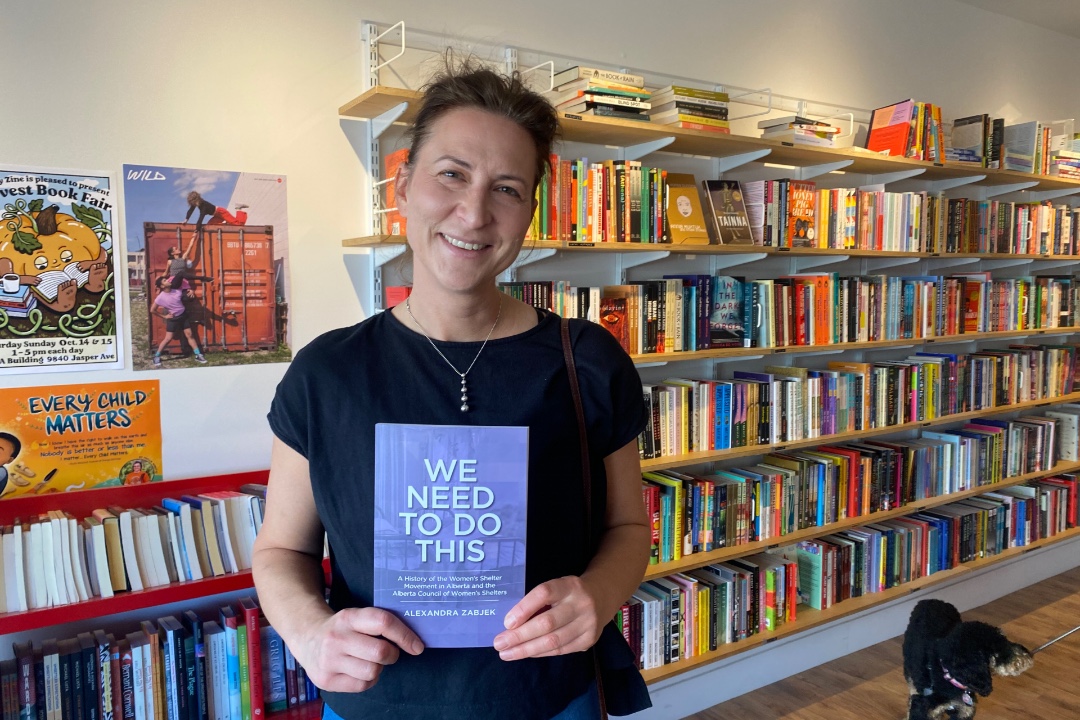
New book maps history of women's shelter movement in Alberta
The Alberta Council of Women's Shelters has published a book that shares the previously untold stories of those who created refuges for women and children escaping abuse.
We Need to Do This: A History of the Women's Shelter Movement in Alberta and the Alberta Council of Women's Shelters is available now and will be officially launched at LitFest on Oct. 21. The event will feature a discussion with the book's author, Alexandra Zabjek.
"First of all, I just hope that this book offers recognition and insight into the efforts of women who have shaped this province for the better," Zabjek told Taproot.
The ACWS commissioned the book to give voice to a relatively unknown part of Alberta's past: the development of women's shelters as they evolved into an official social service.
"That's an important part of Alberta history and Alberta women's history," said Zabjek.
ACWS executive director Jan Reimer had been discussing the idea of collecting these stories with colleagues for more than a decade. The age of some sources meant that these stories had to be told now or never.
"If we don't get their stories and they die, their stories will never be told, and it'll be lost history," Reimer said in an interview. "So, we thought it was really important to hear their voices because they're the voices that often aren't heard or are not heeded."

The ASTech Awards salute Alberta's innovators — join us!
The ASTech Awards bring industry, government, entrepreneurs, and academia together to celebrate innovation in Alberta. Meet alumni from the past 30 years and this year's finalists at the opening ceremonies in Edmonton on Oct. 27, followed by the awards gala in Calgary on Nov. 3.
Headlines: Oct. 18, 2023
- Councillors heard feedback about the city's proposed zoning renewal bylaw on the second day of a multi-day public hearing that at times became heated. Among the concerns raised was the potential impact on the environment, housing affordability, traffic, parking, and property values. Some who spoke against the proposed bylaw said it mainly benefits developers and needs more public input. Speakers in support of the bylaw said it would create more density and encourage a variety of housing types, leading to more affordability. The public hearing is scheduled to continue through Oct. 19.
- The Association of Academic Staff at the University of Alberta is raising concerns about the University of Alberta's strategic plan, which aims to increase student enrolment to 60,000 within 10 years. The union, which represents more than 4,000 staff, is calling for an end to precarious work for instructors, many of whom are on short-term contracts without benefits. About 900 of the university's 2,800 academic staff are not employed full-time, said union president Gordon Swaters. "We're growing the wrong way," he said.
- The Edmonton Police Service arrested a 50-year-old man in connection with a "threat-related incident" after officers were called to a north side grocery store where a man was yelling racial slurs and making threats directed at the Muslim community. The police hate crimes unit has recommended Section 718.2 of the Criminal Code of Canada be applied to the case, which allows courts to consider increased sentences if a crime is motivated by hate. "These events hurt not only the victim, but the vicarious trauma has an impact on entire communities," police said in a release.
- A giant pumpkin head and a pair of skeleton arms were stolen from a vandalized Halloween display at a home in the Homestead neighbourhood. The Holman family is known for its elaborate displays each year, attracting dozens of trick-or-treaters. "I'm going to put a little sign up saying, 'We're not decorating this year because someone destroyed it,'" said Kevin Holman. The Edmonton Police Service advised homeowners to install lights and home security signs to help deter would-be thieves.
- Alberta Health Services issued an alert on Oct. 17 after it confirmed a case of hepatitis A in a food worker at the Edmonton International Airport. The health authority said that anyone who ate or drank at the Belgian Beer Café or the Boston Pizza at the airport may have been exposed and should contact Health Link.
- On the latest episode of her podcast, Alberta Unbound, Senator Paula Simons spoke to University of Alberta Law professor Eric Adams and Economics and Law professor Andrew Leach on the recent Supreme Court of Canada reference judgment that found the Impact Assessment Act unconstitutional. The court ruled that parts of the law, which establishes the process to determine the environmental impact of major development projects, gave the federal government powers that were too broad. The law has been criticized by politicians and industry leaders in Alberta.
- The Métis Nation of Alberta has made history with the swearing-in of its first Otipemisiwak Métis Government on Oct. 15. President Andrea Sandmaier called it a "monumental milestone in our continued journey to Métis self-government."

Tabletop fundraiser World Builders YEG makes a play
Fans of indie role-playing games are organizing a tabletop gaming day to raise money for a good cause and promote local creations.
World Builders YEG, organized under the auspices of the Canadian Library of Roleplaying Games, will take place at Pe Metawe Games on Oct. 21.
Games such as Coyote and Crow, Blazing Hymn, Brindlewood Bay, and Slugblaster will be played at the event. The emphasis is on smaller games, not blockbusters like Dungeons & Dragons, with a particular interest in the work of Indigenous creators.
"A lot of folks don't know that there's a creator pool here in Edmonton — people who actually make tabletop role-playing games," co-organizer Brent Jans told Taproot. "So we wanted to create an event that sort of showcased some of that work, but also did something to help give back to the community that we all live in."
All proceeds from the event will be donated to Nék̓em, a charity whose name means "to change something," which serves some of Edmonton's most vulnerable people. "It seemed appropriate that if we really want to help somebody, that we try and help the people who need it the most," Jans said.
Each game will run in a two- to three-hour block, with breaks. Participants can buy a seat to join a session for $5, and for a donation of at least $1, they can get a helpful power-up from the "Buy a Boon!" jar.
"We just want to get players in seats — we want people to come out and play some games. We have a silent auction going on, so we're hoping people will come out and bid on items," Jans said. "There are some wonderful prizes that have been donated by various independent creators and shops."
This is the fundraiser's debut, but CanLibRPG hopes to offer it twice a year.
"You can just come out and try out a game that you maybe never had the chance to play before, donate some money to a great cause, and help us build the world a little bit better," Jans said.
World Builders YEG is a masked event; organizers will have KN95 masks available for those who do not have one.
Photo: Blazing Hymn and Coyote & Crow are among the role-playing games that will be played at World Builders YEG on Oct. 21. (Brent Jans)
A moment in history: Oct. 18, 1973
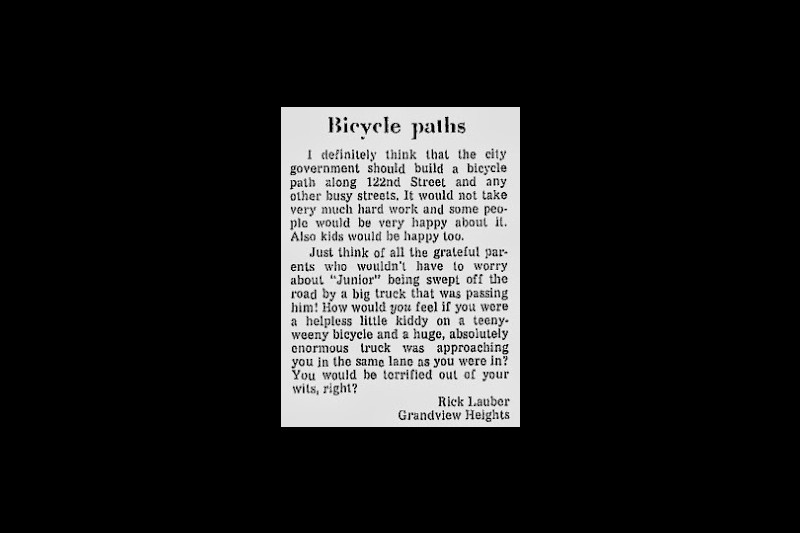
On this day in 1973, one Grandview Heights resident was calling for bike lanes in the city.
In his letter to the Edmonton Journal, Rick Lauber called for a bike lane along 122 Avenue and other busy roads. His concerns were mainly for the safety of kids, asking how readers to imagine how it would feel "if you were a helpless little kiddy on a teensy-weeny bicycle," passed on the road by a truck.

A year later, Edmonton would build its first dedicated bike path, but it wasn't where Lauber hoped it would be. Instead, the trail connected the University of Alberta to Michener Park, a student residence for couples and families. Over the next couple of decades, Edmonton added about 150 km of painted bike lanes on city streets and about a third as many paved paths in the river valley.
In 1992, the municipal government released its Bicycle Transportation Plan, noting that while recreational biking was "extremely popular," the number of people commuting on two wheels was relatively small (both groups were growing, however.) That plan laid out dozens of recommendations for improving and encouraging cycling in the city, including adding many more bike lanes, widening the curbs on roads to give more room to cyclists, and adding more secure bike parking.
The 1990s also saw a movement to repurpose old railway right-of-ways as multi-use trails, led by groups like Bike Edmonton. The push saw some success, most notably the Ribbon of Steel, which in 2003 turned the old rail lines that run south of Jasper Avenue into a walking and cycling path that runs along the streetcar route.
As the number of bike lanes increased, so did the number of people using them, for the most part. In 2015, there was a heated debate over eight kilometres of painted bike lane along 95 Avenue, a mere two years after it was put in. City councillors admitted that poor public consultation was done before the lanes were installed and argued they were underused and unsafe as a result. Eventually, the lines were removed, and the city promised changes to its consultation process.
While the city had hundreds of kilometres of bike lanes, they were little more than paint separating cyclists from cars. Better than nothing, perhaps, but cycling groups argued they remained unsafe. In 2017, Edmonton built its first protected bike lane, making it one of the last major Canadian cities to do so. (Well, unless you count the protected bike lane that some random person made along Saskatchewan Drive with tape and pylons a year previous.)
The protected bike lanes stirred up more than a little bit of controversy, even becoming a minor election issue the following year. But they proved to be a model, leading to new routes in Old Strathcona, central Edmonton, and other areas of the city.
Plans to expand the cycling network in Edmonton have accelerated, although not without some backlash. Last winter, the city removed one of a pair of protected bike lanes from Victoria Promenade after complaints of lost parking. Around the same time, city council approved a $100-million investment to fill in gaps in Edmonton's bike network, a decision that predictably brought on strong reactions from both supporters and detractors.
Those curious about what a cycling city looks like may want to attend Curbing Traffic: An Evening with Chris Bruntlett on Oct. 19, which will explore cycling infrastructure in the Netherlands.
This is based on a clipping found on Vintage Edmonton, a daily look at Edmonton's history from armchair archivist @revRecluse — follow @VintageEdmonton for daily ephemera.