
The Pulse
June 7, 2023

Here's what you need to know about Edmonton today.
Essentials
- 27°C: Sunny. High 27. UV index 7 or high. (forecast)
- Red/White: The High Level Bridge will be lit red and white for Canadian Rivers Day. (details)
- 46%: According to recent Angus Reid Institute polling data, 46% of Albertans say they are financially worse off than they were a year ago and 27% expect to be worse off one year from now. (details)
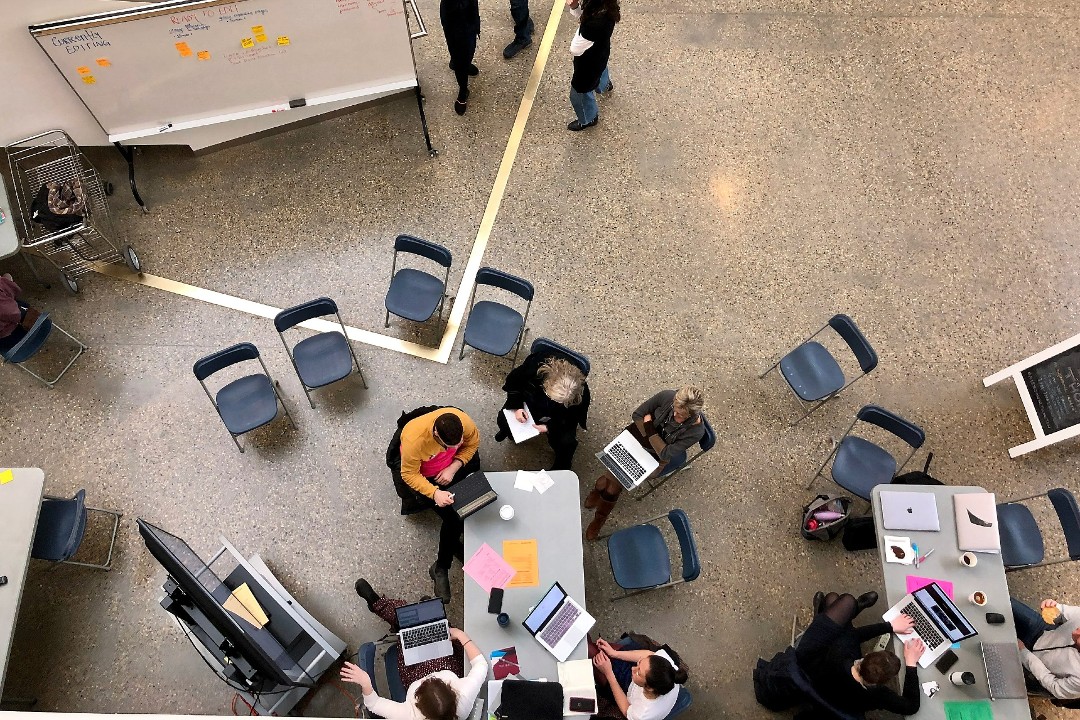
Wikipedia Edit-a-thon aims to increase visibility of Edmonton's queer history
The Edmonton Queer History Project (EQHP) is partnering with Art+Feminism to write Edmonton's queer histories into the books — or at least into the pages of Wikipedia.
A Wikipedia Edit-a-thon on June 10 at MacEwan University's Roundhouse will offer training on how Wikipedia works and information about queer history resources in Edmonton, to empower people to "help improve the world's largest online encyclopedia by making it more inclusive and representative of diverse sexual orientations, gender identities, and gender expressions."
The EQHP has held similar events in the past in an effort to close the information gap on Edmonton's queer history, an endeavour that aligns closely with Art+Feminism's global initiative to bring Wikipedia empowerment to the masses.
"Wikipedia is a natural kind of dissemination," said Sarah Severson, a local member of Art+Feminism and a board member with Wikimedia Canada, as well as a digitization librarian at the University of Alberta. "There's so much rich history already, it's just about getting it in front of people."
Severson has helped organize Art+Feminism events for years now and is working with Kristopher Wells of the EQHP to digitize documents regarding Edmonton's queer history.
"It's about sort of democratizing history as well, and not just having it in the hands of the so-called historians or the experts that are out there," said Wells, a MacEwan University associate professor who holds the Canada Research Chair for the Public Understanding of Sexual and Gender Minority Youth. "So it ties in really well for the kind of work that we do."
The June 10 Edit-a-thon, which runs from 10am to 2pm, aims to be accessible to all community members, with a drop-in supervised art activity to keep children occupied, as well as access to laptops, if needed.
"This is a community coming together in person, it's about collaborating on these articles," Severson said, mentioning that one-on-one help will be available. "There's going to be a community there that can kind of help support them in that space."
Past Edit-a-thons have resulted in the creation of Wikipedia pages on artist Lauren Crazybull, the Latitude 53 art gallery, and feminist bookstore Common Woman's Books.

Get free access to AGA & 14+ galleries!
Did you know, AGA membership gives you free admission to the Art Gallery of Alberta and 14 other galleries from across Canada? Take advantage of our 20% off membership from June 7-11. It can be your perfect gift for Father's Day!
Headlines: June 7, 2023
- The city announced that attendance at recreation centres has nearly returned to pre-pandemic levels, with 96% attendance reported from January to March of this year compared to 2019. Registrations for city-run summer day camps have also nearly returned to pre-pandemic levels, while the number of active memberships, Leisure Access Program enrolment, and program attendance have exceeded 2019 levels. There are 20 city recreation centres and pools across Edmonton.
- Civic Service Union 52, which represents more than 6,000 Edmonton civic service employees, launched an awareness campaign to inform residents of the roles played by its members. The campaign's timing aligns with the city's ongoing work related to a budget amendment called OP12, which aims to assess the priority of city services and find $60 million in cost savings over the 2023-2026 budget cycle.
- Council's community and public services committee received the second annual state of immigration and settlement report last week and passed a motion asking for the city's immigration policy to be revised. The report, titled Dignity in Employment and Education: Creating Opportunities So Newcomers Can Thrive, found newcomers to Edmonton face barriers to employment and education and suggested the city must build authentic relationships, recognize newcomers' skills, and improve its image as an employer of diverse people.
- Harm reduction teams with Boyle Street Community Services have been responding to more overdoses than usual so far in June. Health services director Marliss Taylor said the teams have responded to 10 overdoses this month and know of 10 others, compared to a total of 25 overdoses for the entire month of May. She said the overdoses are mainly happening to people who inhale substances rather than eat or inject them. Ginetta Salvalaggio, an associate professor in the University of Alberta Department of Family Medicine, said some parts of the city are seeing very potent or polluted opioids, which lead to more complicated overdoses that require higher doses of naloxone or hospitalization to reverse. Alberta Health Services said there were 177 calls to 911 related to overdoses in Edmonton from May 15-28 of this year.
- Global News spoke to Shalayn Martel from Legal Aid Alberta to discuss the importance of the Edmonton Indigenous Court, which opened in 2022 to provide a culturally relevant and restorative approach to justice for Indigenous individuals. The court was created as part of the Provincial Court of Alberta's Indigenous Justice Strategy and designed in consultation with Indigenous legal experts and First Nations and Métis groups. Reconcili-ACTION YEG, a student-run blog from the University of Alberta Faculty of Law, visited the Edmonton Indigenous Court in February and reflected on how such courts contribute to the overall goals of Indigenous legal autonomy.
- For the past five years, Edmonton Public Schools has been installing solar panels on school roofs, which provide energy as well as learning opportunities for students. So far, 24 schools have installed solar panels, the most recent being a 797-panel installation at J. Percy Page high school. Coreen Moccia, the director for infrastructure supports and operations at Edmonton Public Schools, said the solar panels provide 7.5% of the division's energy requirements and save an estimated $650,000 each year to redirect back into classrooms.
- The Kiwanis slide at the Edmonton Expo Centre, which is better known as the "big yellow slide," is scheduled to be demolished on June 7. The slide opened in 1974 but hasn't been used since 2019 because of structural problems. "Most Edmontonians know the landmark and have braved the slide once or twice," said Quinn Phillips with Explore Edmonton. "But not to be forgotten, it was also a community builder, raising thousands for local and international groups."
- EPCOR announced it is bringing back its "Glass of the Sask" program this summer, which will be expanded to include additional touchless hydration stations at major festivals and community events. According to a release, stations will be installed at the Heritage Festival and the Fringe Theatre Festival for the first time, along with five additional locations at K-Days.
- An elective course offered by St. Albert Public Schools exploring 2SLGBTQ issues is believed to be the first of its kind in Alberta. Students who take the course will study the history of the 2SLGBTQ community, its celebrations, and how to access mental health support. Kristopher Wells, an associate professor at MacEwan University and Canada Research Chair for the public understanding of sexual and gender minority youth, said similar courses exist in other places across the country and that school districts are developing these courses locally because they aren't included in provincial curriculum. In a statement, St. Albert Public Schools said that students in the 2SLGBTQ community can feel "isolated and disconnected" and that the course "helps them see themselves in the curriculum."
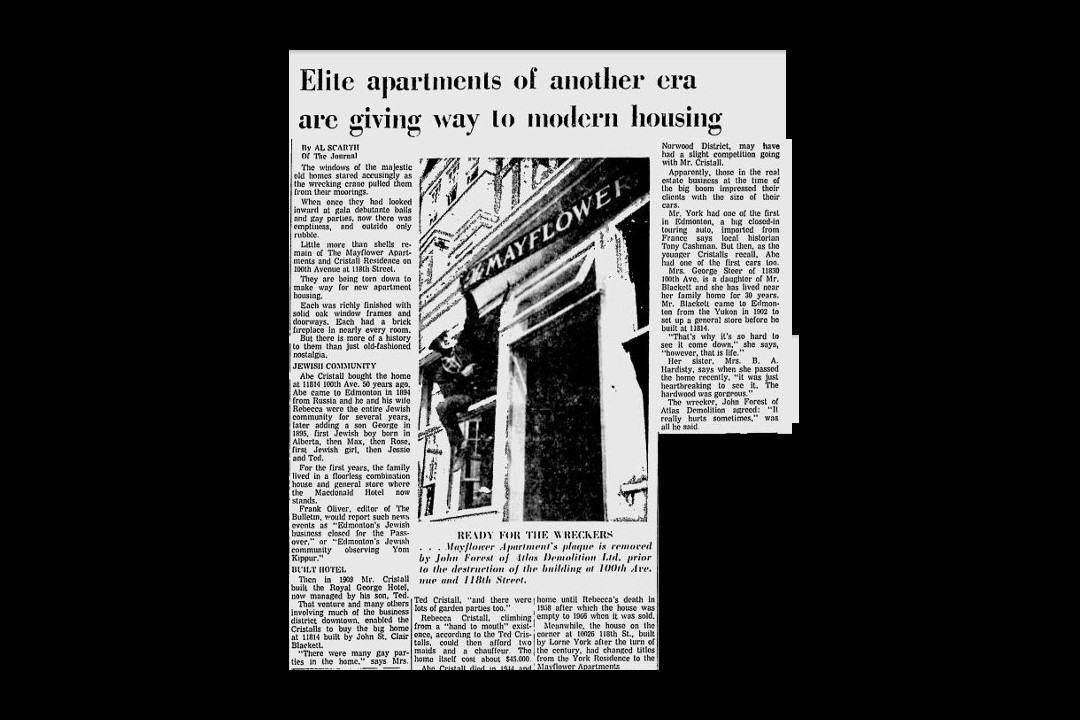
A moment in history: June 7, 1969
On this day in 1969, demolition was underway on the building once home to Edmonton's first Jewish family.
The demolition saw the end of both the original Mayflower apartment building and the old Cristall Residence, the former home of Abe and Rebecca Cristall. The couple became the first Jewish residents of Edmonton when they arrived in 1893. Abe was among a growing population of Jews fleeing Russia, where they faced increasing violence, confinement, and discrimination after the death of Alexander II.
Shortly after arriving in Edmonton, the Cristalls partnered with another early Jewish resident, Henry Sigler, to open a general store. Their enterprise was housed in one of the city's first buildings: the former Reverend McDougall Mission building near the site of what is now the Hotel Macdonald.
Edmonton's Jewish community was still small at the turn of the century, numbering just 17 people around 1901. But with the arrival of the railway a few years after, it began to grow rapidly. Among the newly arrived residents was William "Boss" Diamond from Calgary, who came to open a clothing store in Edmonton. While Diamond and Cristall were business rivals, they worked together to build the community. The pair were among the founders of the Edmonton Hebrew Association in 1906, and they brought Edmonton's first rabbi, Hyman Goldstick, in from Toronto. (Goldstick must have kept a busy schedule — for years, he served as rabbi for both Edmonton and Calgary, as well as being the kosher butcher and performing circumcisions for both cities. He'd later become the mayor of Edson.)
The following year, Cristall purchased land to create the city's first Jewish cemetery. By 1912, the Jewish community had grown large enough to need a dedicated synagogue. Construction soon began on Beth Israel at its original location at 95 Street and Rowland Road. Cristall would be the synagogue's first president, with Diamond taking over the role after. While many Jewish immigrants coming to Edmonton were hoping to escape antisemitism, they would find great hostility in their new home. Newspapers and public officials were openly dismissive of Jewish citizens. One account from 1914 describes Cristall confronting a politician who called Jews "undesirable citizens." When challenged, the politician reportedly assaulted Cristall.
During the same period, Cristall's enterprises would continue to grow. He got into the hotel business after building the Royal George Hotel on land now occupied by City Centre Mall. In 1922, Abe and Rebecca bought a new home on the corner of 100 Avenue and 118 Street. Edmonton's Jewish community had seen another surge of growth in the years just after World War I, as many left the devastation in Europe. This was short-lived, however, as Canada's 1919 Immigration Act severely limited Jewish immigration.
As a successful businessman and prominent citizen, Cristall's home became a social and cultural hotspot. The Edmonton Journal quotes the couple's son saying the Cristall Residence was the site of countless gatherings, celebrations, and garden parties. Abe Cristall would live there until he died in 1944, with Rebecca passing away 14 years later. After that, the house would sit largely vacant until its demolition in 1969.

Since the Cristalls' arrival 130 years ago, Edmonton's Jewish community has grown from a single family to a vibrant part of the city's fabric. Hatred and discrimination have not disappeared, however. Earlier this year, the Edmonton Jewish Federation unveiled Shine A Light on Antisemitism, a mosaic art project highlighting the personal experiences of Jews in Edmonton. The project was recently honoured by IABC Edmonton and the Canadian Public Relations Society.
This is based on a clipping found on Vintage Edmonton, a daily look at Edmonton's history from armchair archivist @revRecluse — follow @VintageEdmonton for daily ephemera via Twitter.