
The Pulse
April 26, 2023

Here's what you need to know about Edmonton today.
Essentials
- 15°C: Sunny. Becoming a mix of sun and cloud in the afternoon. High 15. UV index 4 or moderate. (forecast)
- Green: The High Level Bridge will be lit green for Canadian Fertility Awareness Week. Ariadne Daniel, a doctor with the Alberta Reproductive Centre, spoke about redefining infertility during an appearance on Global News. (details)
- 6-3: The Edmonton Oilers (3-2) defeated the Los Angeles Kings (2-3) in Game 5 of their playoffs series on April 25. (details)

Two hydrogen-refuelling stations on the horizon for Edmonton
Both the City of Edmonton and Air Products announced plans for hydrogen-refuelling stations during the second annual Canadian Hydrogen Convention, increasing the infrastructure necessary to make the use of the fuel practical.
Mayor Amarjeet Sohi told conference-goers on April 25 that a request for proposals for a hydrogen station at the city's bus garage would open on April 28 through the Alberta Purchasing Connection.
"Industry leaders take note of this opportunity," Sohi said on the conference's opening day. "The city's first hydrogen-fuelling station represents a key milestone in advancing the Edmonton region's clean-hydrogen economy."
Later in the day, Eric Guter of Air Products announced his company's own plans for a station, expected to be complete by early 2025.
"I'm here to announce that we're going to install the first multimodal hydrogen-refuelling station in Edmonton," said Guter, who is the company's global vice-president of hydrogen for mobility. "(It) can support light-duty and heavy-duty off-take, (and is the) first liquid and commercial-scale fuelling station here in Edmonton."
Such infrastructure will be needed if the 5,000 Hydrogen Vehicle Challenge succeeds. The initiative, which Edmonton Global floated last fall, was officially launched at the convention.
"Our collective goal is to have 5,000 hydrogen- or dual-fuel vehicles on the road in Western Canada within the next five years," said Alanna Hnatiw, chair of the Edmonton Region Hydrogen HUB and mayor of Sturgeon County. "To meet Canada's net-zero targets, we need 30,000 hydrogen-fuel vehicles on the road by 2035."

Unlock new possibilities at Edmonton Unlimited's open house!
Save the date — Edmonton Unlimited's Open House is on Friday, May 12 from 11am to 4pm! Explore Edmonton's newest innovation destination in the heart of our city's downtown on 10107 Jasper Avenue. Tour the space, see local innovation in action, and enjoy food, drinks, prize draws, and more!
Headlines: April 26, 2023
- City council's urban planning committee will receive a report on May 2 about tree management for the William Hawrelak Park Rehabilitation Project. The park closed March 13 and is expected to reopen in early 2026. An arborist report produced for the project shows that 741 trees are potentially at risk, with 112 expected to be cut down and 85 injured, while efforts will be made to preserve the other 544. Roughly 220 trees were previously thought to be at risk, according to city director Jesse Banford, who told Postmedia last month that those trees would be "impacted" but not necessarily removed. Raquel Feroe of the Edmonton River Valley Conservation Coalition, which has been outspoken about the work's impact on trees, expressed concerns that the city is approaching the project through the lens of infrastructure renovations rather than protecting nature and advancing climate goals.
- The city is seeking proposals to build a hydrogen fuelling station at Centennial Garage, located at 15520 Ellerslie Road near Anthony Henday Drive. According to a release, the station will fuel the private transportation sector as it transitions to heavy-duty hydrogen vehicles. It will also fuel the city's first hydrogen bus, which is slated to come into service this summer as part of a pilot project to test two hydrogen buses, one with the Edmonton Transit Service and one in Strathcona County. The city launched a request for proposals to build the fuelling station in collaboration with the Alberta Motor Transport Association and The Transition Accelerator, a partner of the Edmonton Region Hydrogen HUB. "The Edmonton region is leading Canada's hydrogen transition, and this milestone is significant to building a vast roadmap for hydrogen across the region," said Malcolm Bruce, CEO of Edmonton Global, which is co-hosting the Canadian Hydrogen Convention at the Edmonton Convention Centre from April 25-27.
- City council passed the 2023 tax bylaw, which maintains the municipal property tax increase of 4.96% approved during budget talks last year. The increase will affect property owners differently depending on their property's assessed value compared to the market. The average household will pay about $725 for every $100,000 of assessed home value, which is $34 more than in 2022. Tax notices will be mailed to property owners on May 23, and property taxes are due June 30.
- Salaries for Edmonton's mayor and councillors have increased by 2.4% this year after more than two years of wage freezes approved in October 2020 amidst pandemic budget pressures. The increase was applied automatically in January. Council compensation is recommended by an independent committee and is listed publicly on the city's website.
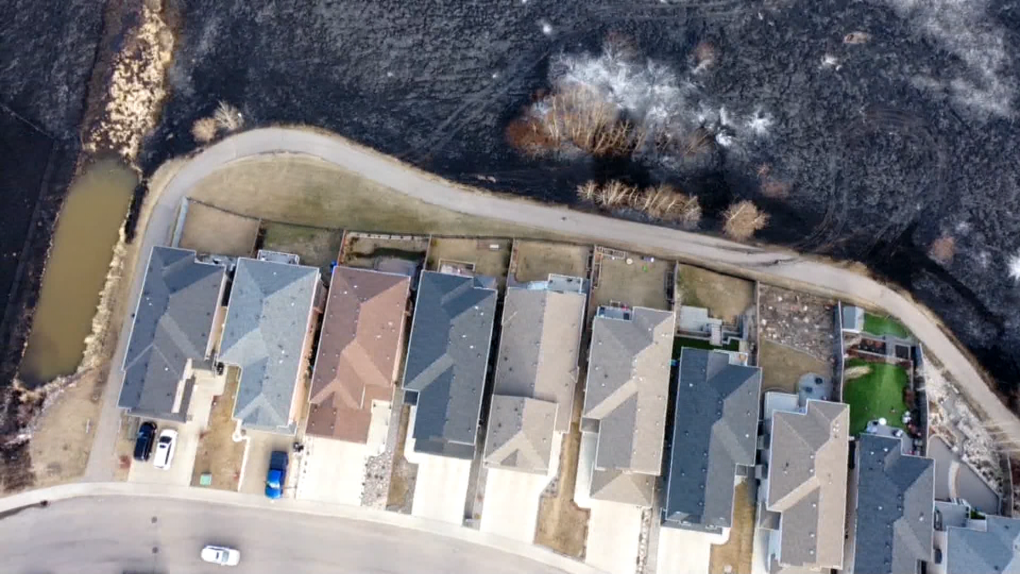
- Some Albany neighbourhood residents reflected on the grass fire that broke out on April 24 and came dangerously close to homes. Darren Rachkewich with Edmonton Fire Rescue Services said the cause remains under investigation, but most grass fires are started by human activity. He added that less snow cover this winter has caused it to be "particularly dry this spring, and with that comes grass fires."
- The province installed a brass plaque outside the Queen Elizabeth II Building, which was formerly known as the Federal Building and is located at the northeast corner of the legislature grounds. The building was officially renamed by former premier Jason Kenney and then-infrastructure minister Nicholas Milliken after the queen's death in September 2022.
- A camera operator who works NHL broadcasts at Rogers Place posted an Ask Me Anything (AMA) on the Edmonton sub-Reddit to answer questions from curious Edmontonians.
Correction: This file has been updated to reflect that this year is not the inaugural Canadian Hydrogen Convention as the event was first held in 2022.

A moment in history: April 26, 1897
On this day in 1897, Edmonton businesses were cashing in from cyclists during the bicycle boom.
It can be a little hard to imagine now, as bikes are a mundane sight and a staple of childhood for many, but there was a time when the bicycle was cutting-edge technology.
Until late in the 1800s, bicycles were expensive, unwieldy, and dangerous. Then, the bike boom hit with the invention of the "safety bike". Driven by a chain, with pedals, brakes, air-filled tires, and same-sized wheels, it was similar to what we consider a modern bike. Cycling fever swept over North America and Europe, and Edmonton wasn't immune to the allure of these two-wheeled machines.
The bicycle most appealed to urban professionals, who were coming to the city in large numbers toward the end of the 19th century. At the time, most people living in the core relied on street cars to get around. Vehicles were rare, and horses were both expensive and difficult to care for. For the growing number of office workers, medical workers, and others in Edmonton, the bicycle offered the chance to travel freely.
Edmonton's first bicycle club started in 1890, with its leadership made up of doctors, lawyers, and other well-to-do riders. While bicycles had come down in price, this still wasn't a cheap way of getting around. The $55 price tag listed in this 1897 advertisement would be the equivalent of a couple of thousand dollars today. And that's not including the club fees.

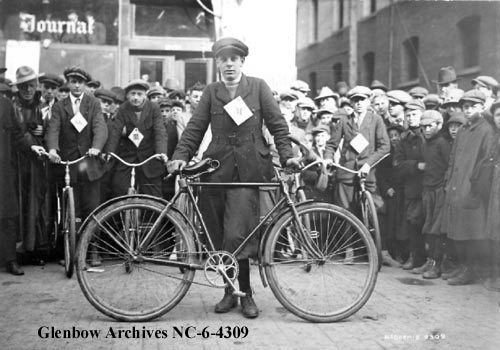
While the intense demand for bicycles cooled somewhat in the 1910s, partially due to the arrival of automobiles on city streets, it didn't go away. Cycling competitions were popular in Edmonton; photos of one such contest put on by the Edmonton Journal in 1912 show a healthy number of spectators and riders. The more competitive-minded riders would form clubs and leagues with names like the Silver Hawks and the Golden Eagles. In 1935, the Edmonton Cycling Club was founded and grew quickly in popularity. The ECC was soon hosting several large trophy races in and around Edmonton, which would draw competitors from as far as Manitoba.

While popular, Edmonton's cycling clubs could not keep pedalling through the 1940s — young men were leaving to fight overseas during the Second World War, and factories shifted from consumer goods to wartime equipment. The post-war period saw roadways increasingly geared towards car use.
While cycling has never again become the obsession it was in the early years of Edmonton, it's still popular. Bicycle clubs began to make a return in the 1980s, and during the '90s, Alberta had the highest rates of bicycle ownership in the country. Encouraging cycling and other methods of active transportation is a pillar of Edmonton's City Plan as a way to combat climate change and reduce sprawl. Edmonton city council has recently approved $100 million towards bike infrastructure over the next four years, a move that bike groups in the city say is helping feed more interest in cycling.
This is based on a clipping found on Vintage Edmonton, a daily look at Edmonton's history from armchair archivist @revRecluse — follow @VintageEdmonton for daily ephemera via Twitter.