
Belgravia offers lessons in effective public engagement
Trust is built when residents can see that their feedback has made a difference, says a Belgravia community league representative who worked with the City of Edmonton on traffic solutions in the neighbourhood.
"What people were saying was being heard and acted upon and incorporated into the plans," Lindsay Vanstone, director of planning and place at the Belgravia Community League, told Taproot. Meetings with the project team, Dallas Karhut and Lavina Ng, were full because "the people who had been going to the sessions were able to relay to their friends, their neighbours, that they were being listened to and they did have faith in this engagement," Vanstone added.
Edmonton's administration worked with Belgravia residents for about 18 months to address traffic and shortcutting in the south-central neighbourhood. Roads surrounding and running through Belgravia experience considerable congestion during rush hour periods because of heavy use from drivers going to and from the University of Alberta and the Groat Road Bridge. The LRT line, running along 114 Street NW, further impedes vehicular traffic flow. The potential solutions, presented to councillors in October, include traffic-calming and diversion measures both within the neighbourhood and on the roads surrounding it. Councillors will discuss allocating $2.12 million to implement the short-term measures identified in the assessment.
When the options were presented to council's urban planning committee, many shared their support, as well as accolades for the staff members that engaged the community. The praise was notable given the criticism that has surrounded some of the city's other engagement processes. Alberta's Municipal Affairs Minister Dan Williams cited "minimal public consultation" when he directed Edmonton to revert its zoning bylaw to rules that were in place before 2024, even though the city did eight years of engagement, including a one-year delay after community leagues and residents asked for more time to consult. Some Edmontonians who oppose bike lanes in their neighbourhoods say there hasn't been consultation, including residents who started a petition against the infrastructure in north Edmonton. The city admits that the active transportation infrastructure rollout of the past four years has involved limited public engagement. And though the city's neighbourhood renewal program includes several public engagement touchpoints, residents often still end up saying they weren't heard.
Kirsten Goa, a public engagement expert, told Taproot that residents often say there wasn't enough public engagement when they don't like a decision. "Sometimes that's the case, and sometimes it's a way to say, 'My perspective isn't reflected in the final decision,'" Goa said. "The final decisions are always a compromise — they're never perfect, they never meet everyone's needs."
What can be learned from the Belgravia engagement?
Vanstone said there was an understanding between the city and Belgravia residents about what options were realistic — for example, tunnelling the LRT tracks underground was off the table. The residents were also aware of how much influence they had and how the feedback was going to be used.
This is easy enough when it's a group of residents telling administration about a project concerning city-owned infrastructure, but it gets more complicated when it involves a third party, such as a real estate developer building infill. That has led to a lot of frustration, Goa said. She was the public co-chair of the Council Initiative on Public Engagement. The council initiative was started after the 2013 election, when many Edmontonians, including council and administration, were not satisfied with how the City of Edmonton was doing public engagement. More than 1,000 residents and city employees attended collaborative and consensus-based workshops in 2014 and 2015 to discuss problems and opportunities.
"Most engagement that the city participates in is around change, and the amount of power or influence the city has in terms of what that change is going to look like varies depending on who's responsible for it," Goa told Taproot. "With a lot of engagement, there's often other parties involved … they may have system issues that they can address from a policy side, but on the ground, they might not have as much ability to move around what's going on in that particular instance."
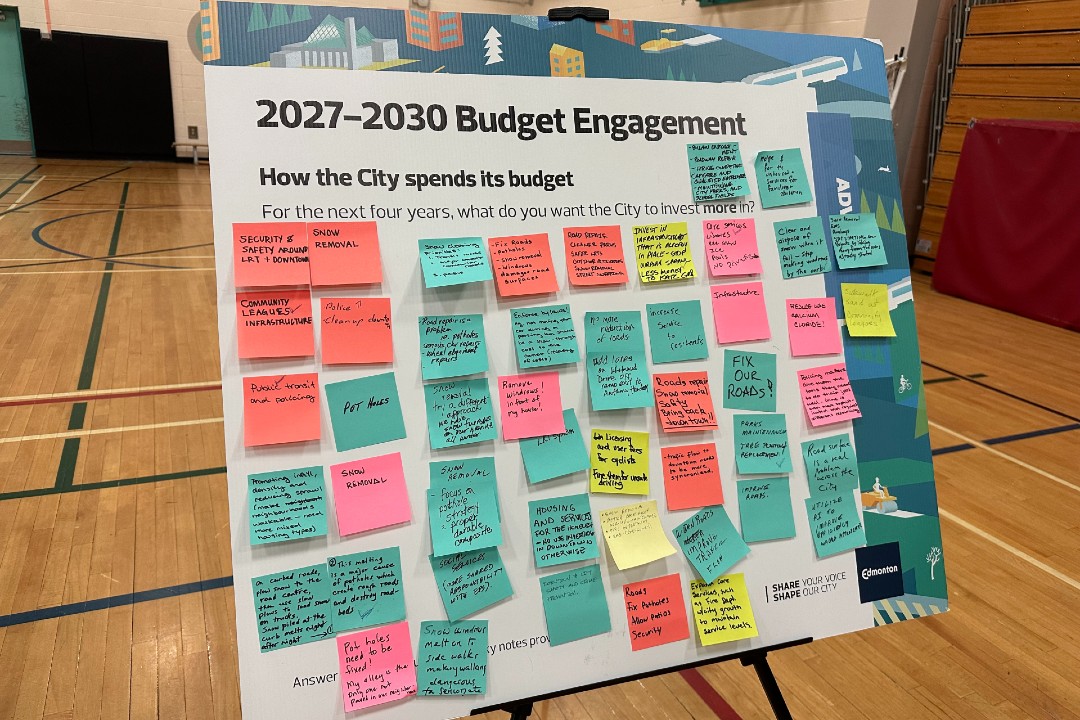
The City of Edmonton started public engagement for the 2027-2030 budget back in April, much earlier than administration typically begins consulting residents. (Stephanie Swensrude)
Goa said the Belgravia project is an example of city engagement getting better since she served on the initiative. "A lot of those approaches were not standard, were not typical, and they're not necessarily always typical now, but we have a number of examples over the last decade of really fantastic engagement … that the city has performed."
Vanstone said the Belgravia traffic project's engagement was so effective because the problem everyone was trying to solve was very clear — visible traffic clogging up neighbourhood streets. What the city could learn from Belgravia, Vanstone said, is that it needs to be clear about what the problem is that it's trying to solve. With an issue such as infill, which Belgravia has seen a lot of as well, most people don't understand the problem, she said.
"Is it a budget issue? Then that is the problem, every single time, that you need to bring up. Is it that you need more units? OK, well, bring that up," Vanstone said. "But you need to be able to explain why … so that somebody could understand that it's a problem."
On the private side, developers could build trust by holding "get-to-know" sessions, Vanstone said, either at a community league or in front of the infill site. "You're on site, you can have conversations about it, get to know the developer, get to know what's happening at a stage — and hopefully with an openness — that they could accept some changes to their project," Vanstone said, adding that residents could bring ideas from living in the neighbourhood. "It would be great to … be able to say, 'Here's some examples of something that's worked well. Can you integrate this into your development?'"
While many recommendations from the council initiative have been implemented, Goa said, one factor that's still missing is supporting and developing leadership within a community to support public engagement. "Part of what happens if we have conflict in community, people stop talking to each other, and that trust breaks down at the community level," Goa said. Building relationships between residents, developers, and other people shaping their neighbourhoods outside of contentious project discussions can create opportunities for more meaningful conversations about what communities want to see.
Elected officials also have a role in fostering that leadership, Goa said."There are a lot of these conversations where you actually need political leaders to come in and help with that change management conversation beyond the public engagement, because it is a much more fraught situation."
More engagement underway and to come
In what will likely be one of the largest public engagement exercises of this term, council is in the midst of hearing from hundreds of people about its 2027-2030 budget. The city began seeking feedback in April, earlier than it typically starts consulting residents about the budget.
Another public engagement exercise is on the horizon. Council has approved a panel to hear from Edmontonians about growth management and the cost of living, with the feedback intended to inform potential updates to the City Plan. The panel will consider topics including built-form regulations in developing and redeveloping neighbourhoods, the financial performance of those neighbourhoods, mass transit, and greenhouse gas emissions and the climate budget.
Mayor Andrew Knack, who introduced the motion calling for the panel, said it was based on the Citizens' Panel on Climate Change, which brought together Edmontonians with diverging views in 2012 to develop recommendations on how the city should respond to climate change and energy vulnerability.
Knack said it will be valuable to bring together a representative sample of Edmontonians to learn about the issues. "That is critically important so that we can make sure you have a large enough group so that everyone has a chance to be heard and understood and the variety of perspectives that exist are brought to the table."
This story is based in part on a conversation with Kirsten Goa and Lindsay Vanstone on Taproot Exchange, a members-only livestream we hold regularly to go deep on issues of interest to Edmontonians. The next one will take place on Dec. 4 on the topic of "how to enjoy winter." Become a member for access to that and future livestreams.
Share