
A look at how Edmonton's budget stacks up so far
In a proposed budget that city manager Eddie Robar described as "not sexy," Edmontonians can expect renewal, operating funding for basic maintenance, and the completion of several large capital projects. But the wishes of some community groups are so far unfulfilled.
The proposed capital, operating, and climate budgets were released on Nov. 2, with the utility budget to come on Nov. 12. The capital budget is $6.3 billion over four years and the operating budget is between $4.2 billion and $4.7 billion each year. If unamended, the budgets would result in a 4.9% tax increase in 2027, 4.7% in 2028, 4.5% in 2029, and 3.9% in 2030.
Funded service packages and capital profiles make up administration's proposed operating and capital budgets, respectively. If a service package or capital profile is unfunded, it means administration has done the research to determine how much it will cost and is presenting it as an option to be added to the budget. Council can add them by cutting other spending or raising taxes, and administration will rank them based on their alignment with council priorities.
In previous budget seasons, if council directed administration to bring forward an unfunded service package, it would have come to budget deliberations. But this year, administration made its own decisions based on strict parameters, such as whether something is mandated by legislation, required due to safety concerns, or eligible for funding from other levels of government. This means that if administration thought an unfunded request aligned with council priorities, it could actually include it as a funded package or profile. An example of this is the funding required to implement a non-residential derelict tax subclass. The remaining unfunded packages will rely on councillors to make the necessary trade-offs if they are to happen.
Registration is open now for the public hearing portion of budget deliberations on Nov. 23. Council will debate and likely make changes to what administration has proposed before approving a final budget by Dec. 18.
For the past six months, Taproot has been talking to community groups and organizations about what they hoped to see funding for. What follows is a look at what the proposed budgets say about investments in the active transportation network, pedestrian and transit improvements on Whyte Avenue, climate action, arts, and sports.
$30M for active transportation gets a no
It would cost $30 million to continue implementing the active transportation network, but administration recommends against including that in the four-year budget.
The updated active transportation implementation guide says the most strategic way to build cycling infrastructure is by pairing it with other capital projects, such as neighbourhood renewal, which "has proven a successful and efficient mechanism for the engagement, planning, and delivery of local networks."
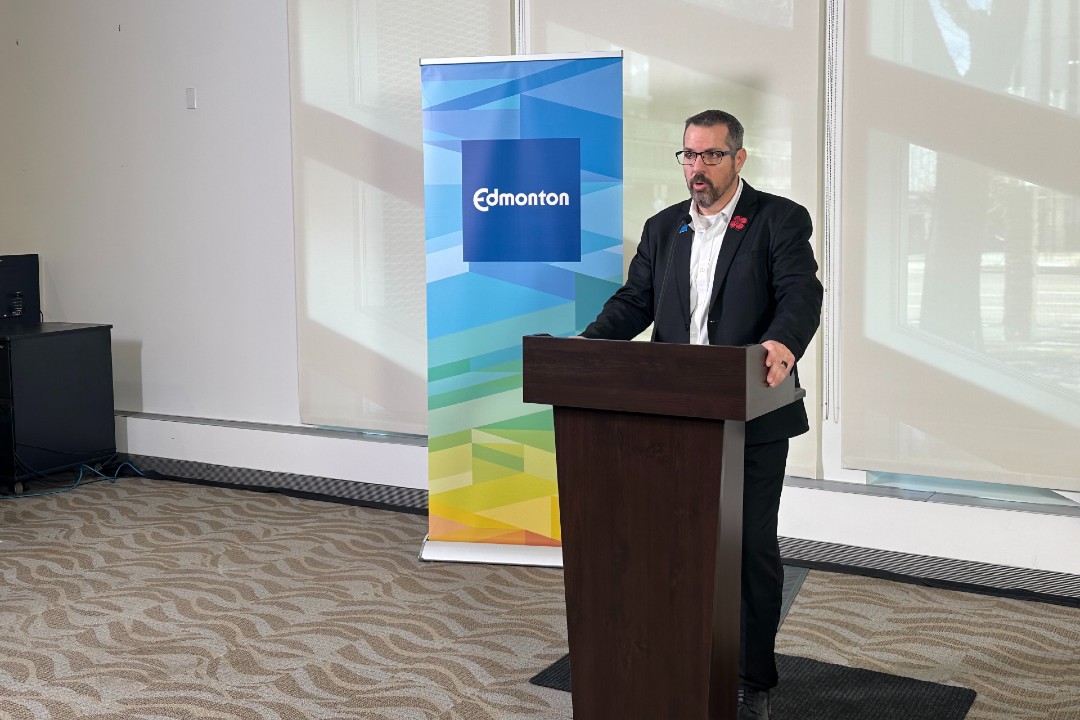
City manager Eddie Robar introduced the 2027-2030 draft City of Edmonton budget on Nov. 2, 2026. (Stephanie Swensrude)
The Edmonton Bike Coalition's Aaron Budnick told Speaking Municipally in August that he wanted to see a standalone capital profile for active transportation funding, much like the $100-million capital profile that was included in the 2023-2026 budget.
He also noted that active transportation infrastructure often overlaps with investments into the overall safe mobility strategy. Administration did not include funding for the safe mobility strategy in the base budget; however, two different options to fund the strategy are second and third on administration's prioritization ranking. The two options would cost $161.4 million and $78.7 million, respectively.
$31.2M to improve Whyte ranks low
Earlier this year, community groups — including the Old Strathcona Business Association, the French Quarter Business Association, Paths for People, and Edmonton Transit Riders — came together to form Prioritize Whyte Ave.
They urged council to fund two simultaneous projects on Whyte Avenue: the Old Strathcona Public Realm Strategy, which would improve the pedestrian experience on the street; and the city's bus rapid transit system, which includes two cross-town routes that would run down Whyte. And they had a councillor with them on that front. "If we're going to be doing BRT down Whyte Ave — if we're going to be chopping up Whyte Ave anyway — let's do the pedestrian realm improvements around the sidewalks and around the intersections," Coun. Michael Janz said in March, while requesting the service package.
Administration recommends against allocating $31.2 million for the planning, design, and delivery of the re-envisioned corridor. It is ranked as a relatively low priority.
It also recommends against a $44-million capital profile to fund the next stages of design for the two bus rapid transit routes that would go down Whyte Avenue: B1 between Castle Downs and Century Park, and B2 between West Edmonton Mall and Bonnie Doon.
Some climate investment included
The Alberta Ecotrust Foundation asked council to contribute $10 million toward its work in the four-year budget, suggesting that such a collaboration would save time, money, and CO2 emissions. Those packages are unfunded.
Other climate groups also urged council to support funding the entirety of the new climate implementation priorities. About $257 million would be required to deliver the whole package. Because there are so many climate projects under different capital profiles and service packages, it's not entirely clear if climate groups got that wish; however, earlier city reports had indicated that $123 million would be presented for consideration.
Administration's recommended climate investments are largely focused on mitigating the impacts of climate change, with measures such as dry ponds for drainage, renewing parks, tree planting, and renewing existing infrastructure to make it more resilient to extreme weather events, a spokesperson told Taproot.
The documents say the city is even closer to blowing through its climate budget than previously forecast. Edmonton introduced a carbon budget (now renamed to climate budget) in late 2022 during budget deliberations. Unlike the operating and capital budgets, the climate budget is not debated or modified. Instead, it is meant to show council how its funding choices could increase or decrease carbon emissions. The budget is divided into two parts: corporate emissions, which city administration has direct control over, and community emissions, which city administration can influence with policy.
The community carbon allocation is forecast to be depleted by 2034, and the corporate carbon allocation is forecast to be depleted in 2030.
Status quo recommended for arts
Administration proposes keeping the Edmonton Arts Council's funding stagnant for another four years. CEO Renée Williams told Taproot in June that the organization needed an increase to help the city's growing number of artists bring their creativity to life.
The 2027-2030 operating budget includes just under $18 million annually for the EAC, the same annual amount that has been allocated since 2019. Williams told Taproot that the organization received just under 1,200 applications in its individuals and collectives stream in 2025. Out of those, it was only able to fund 234, the annual report indicates. In previous years, the success rate had been around 30% of applicants, but that number has now declined to about 19%, she added.
No boost for Sport Edmonton
Sport Edmonton CEO Evan Daum told Taproot the organization will not be getting an increase to its core operating budget. The organization is not listed in the budget the same way as civic agencies like the EAC, and is instead included under the sport and recreation branch.
Daum told Taproot in August that Sport Edmonton was seeking about $1.1 million annually from the city. "We think that we can achieve a lot with that amount annually, and we think it's reasonable based on the other sport councils (in Alberta)," Daum said.
Sport Edmonton's funding works out to the equivalent of 19 cents per resident, much lower than other cities in Alberta spend. More funding would have made it possible for the organization to collect data and provide advocacy, networking, professional development, and grants such as the Edmonton Event Accelerator Fund piloted with money from Edmonton Destination Marketing Hotels.
While the organization's operating budget will not increase, Daum said it is working with the city to be the distributor of grant funding to sports groups.
What comes next?
It's extremely unlikely the budget that was presented on Nov. 2 will be the same one approved in mid-December. Council will hear from the public on Nov. 23 before debating changes between Nov. 24 and Dec. 18. Councillors will vote to add or remove service packages and capital profiles before voting on the entire budget.
Share