
On the agenda: Community court, Belgravia traffic, industrial incentives
This week, councillors will discuss a proposed community court program, potential solutions to traffic in and around Belgravia, and two new incentive programs for industrial development.
There is a community and public services committee meeting on Oct. 19, an urban planning committee meeting on Oct. 20, an executive committee meeting on Oct. 21, and a special city council meeting on Oct. 23.
Here are some key items on the agenda this week:
- A community court program, which aims to connect people to supports as an alternative to prosecution, would cost about $1.17 million annually, says a report that will be presented to community and public services committee. Administration has presented the program as a way to mitigate the negative consequences that the public spaces bylaw may have on vulnerable Edmontonians. A community court aims to break the cycle of repeat infractions by addressing the underlying issues that contributed to the disorderly behaviour. Research on existing community court programs in North America suggests they reduce recidivism and court costs while providing a return on investment. David Rivera-Kohr of the Edmonton Coalition on Housing and Homelessness told CBC that such a program would still criminalize poverty. Administration will present a funding package for the program as part of the 2027-2030 operating budget.
- A traffic study found that drivers attempting to avoid congested roads south of the University of Alberta by shortcutting through Belgravia resulted in delays of five to 25 minutes for those trying to leave the neighbourhood, while some residents told the city that it can take 45 minutes or more to exit. The roadways that surround and bisect Belgravia are considerably congested during rush hour periods because of heavy use from drivers going to and from the University of Alberta and the Groat Road Bridge, as well as those waiting for the LRT on the line running along 114 Street NW. Administration has presented options to reduce shortcutting, with a focus on improving traffic flow on the arterial roads surrounding the neighbourhoods to avoid incentivizing shortcutting. In the short term, administration proposes reconfiguring the intersections and signal timing where 114 Street crosses 76 Avenue, University Avenue, and 87 Avenue, with a pedestrian scramble proposed at 87 Avenue. The short-term measures are estimated to cost around $2 million and would require approval in the 2027-2030 capital budget. Longer term, options include redesigning intersections at 87 Avenue and Groat Road, Belgravia Road and 114 Street, and at Fox Drive and Whitemud Drive to significantly improve network efficiency and traffic flows.
- Council will be asked to approve two new incentive programs for industrial development as part of the 2027-2030 operating budget, says a report that will be presented to executive committee. The industrial infrastructure first mover program would fund a single major component of oversized industrial land development sites across the city, while a new tax abatement program would reduce property taxes by 25% over three years to accelerate construction of industrial buildings within priority sectors. Administration also recommends retaining nine existing industrial incentives and programs. Several key performance indicators on the 10-year industrial investment action plan did not meet their target, the report said. While administration purposely set high targets to keep pace with the results of residential growth, the KPIs signal that changes are needed to speed up a positive trajectory.
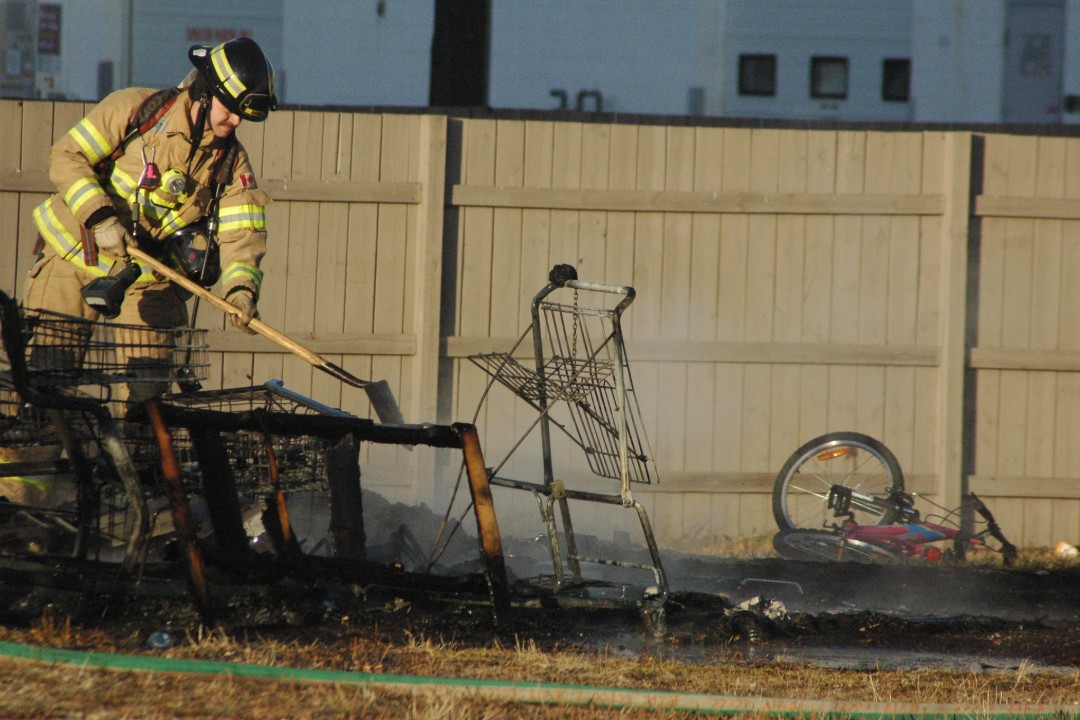
A firefighter deals with the aftermath of a fire at an encampment in October 2024. Community and public services committee will receive a report on Oct. 19 exploring a community court program to connect vulnerable people to supports instead of fining or charging them for disorderly behaviour. (Jon Spencer/Flickr)
Here are more key items:
- Regional municipalities told Edmonton's administration that they routinely send residents to Edmonton or elsewhere when they require social supports, according to the Regional Housing Needs Assessment, which will be presented to community and public services committee. The only municipality outside of Edmonton that operates an emergency shelter during extreme cold is Spruce Grove, and there is no permanent supportive housing in the region. "Ultimately, these insights reveal that addressing regional housing need requires a holistic approach that considers the interplay between housing affordability, regional connectivity, and the social and health supports required for residents to thrive," the report said. Administration recommends sustaining investment in supportive and affordable housing; bridging crisis substance use response to recovery and housing; and refining the overall social service system to address barriers that vulnerable people face when accessing support.
- Administration will take three targeted actions to pursue municipal leadership in the integration of housing and health solutions, says a report that will be presented to community and public services committee. The city plans to establish joint targets for supportive and recovery housing with the provincial government; inform the renewal of the National Housing Strategy to reinforce federal commitments toward integrated housing and health support models; and combine municipal, community, and health data sources to build a deeper understanding of substance use and mental health supports. Administration will include $93.9 million in the 2027-2030 operating budget for affordable housing investment. Staff will also include $18 million for the renovation of 11 city-owned social housing properties.
- Administration has developed a plan to introduce a one-year trial of a voluntary naloxone training program for transit inspectors. The employees don't necessarily operate transit vehicles; instead, they act in a managerial role, providing mentorship to operators and assistance to riders. Inspectors receive standard first aid training, making the group of employees a good trial for naloxone training, administration said. If the trial is successful, administration could expand voluntary training to other employee groups.
- Community and public services committee will be asked to approve a contract with Bent Arrow Traditional Healing Society for the Community Outreach Transit Team (COTT) partnership. Administration proposes a three-year term, valued at $700,000 annually, starting on Jan. 1 with the option to extend up to 10 years. The team recorded a nearly 150% increase in interactions in the first half of 2026 compared to the same period in 2025.
- Councillors on the executive committee will review an update to the storefront improvement program that increases the maximum grant amount, which is based on 50% of eligible costs, to $50,000 per building. The update also adds a grant covering 50% of permanent landscaping costs up to $10,000 per building. Council approval is required.
- Administration laid out options to strengthen city supports for business improvement areas, split among four themes: recognizing BIAs as economic development partners, autonomy for operations and procurement, interdepartmental alignment, and agility in service baseline and regulations. Some of the action items can be carried out using existing resources, while others would be included in the Edmonton Advantage implementation service package that is set to be debated as part of the 2027-2030 budget deliberations.
- Administration presented two options for proactively communicating upcoming infrastructure projects. The first option involves administration installing a sign about 18 months before construction begins on major capital projects. The second option relies on digital communication during the year before the project and a physical sign about six months before construction begins.
- There are no resources dedicated to directly supporting the nighttime economy, says a report that will be presented to executive committee. The Edmonton Advantage economic development plan helps businesses broadly and could indirectly help nighttime businesses, the report said, and Explore Edmonton also supports the tourism economy generally.
- Administration recommends that council refuse a developer's request to create a statutory plan for the Winterburn Industrial area because it does not align with city policy. The 107-hectare parcel is bordered by undeveloped and developed industrial land, an active landfill, and a mobile-home park. The developer has proposed residential, mixed-use, and open space uses. However, the district policy generally discourages residential development in industrial areas, and the Winterburn Industrial area structure plan specifically aims to prohibit residential land uses. Further, administration recommends retaining the industrial designation because Edmonton lacks shovel-ready land.
- Urban planning committee will hear from the Edmonton Design Committee and the Naming Committee, and community and public services committee will hear from the Accessibility Advisory Committee, the Family and Community Support Services Advisory Committee, and the Edmonton Combative Sports Commission for the first time since approving a new governance framework for council committees. The framework requires council to approve terms of reference and a two-year work plan for the committees.
- Council will meet in private on Oct. 23 to discuss the future of the community safety and wellbeing framework and government relations.
And here are updates on some of the items we told you about last week:
- Council voted 12-1 to request that the province specify in writing its directive that Edmonton must revert its infill rules to where they were before 2024. Coun. Karen Principe voted against the motion. Administration told city council the directive will likely apply to the small-scale residential (RS) zone, which covers much of the redeveloping area, and not the entire zoning bylaw. Councillors requested clarity because at the news conference announcing the directive, Premier Danielle Smith mentioned infill developments with 32 units, which is not possible under the RS zone. Staff said the provincial directive would likely mean that there would be up to 2,700 fewer homes provided through the RS zone, with an associated reduction of up to $610 million in local construction value. Reintroducing parking minimums could further reduce housing units, administration said. Mayor Andrew Knack said administration and council will continue conversations with the provincial government. Council also scheduled another special city council meeting for Oct. 22 at 1:30pm.
- Council roundly rejected a rezoning application for a property that is partially within the boundary of the Westmount Architectural Heritage Area. Councillors said they believed the current zoning was sufficient for the site.
- Council voted 9-3 to approve a rezoning application in McKernan to allow for a three-storey residential building that is taller than what the former zone allowed (councillors Reed Clarke, Mike Elliott, and Thu Parmar opposed). Those voting in favour said the site's proximity to the McKernan/Belgravia LRT Station makes it a good candidate for density. "If not here, then where?" Mayor Andrew Knack said. "The challenge in this is that in the next 50 years, around this LRT station, you will see larger-scale developments."
- Council approved a rezoning application and district plan amendment in Meyokumin that increases redevelopment potential for the Hope City Church.
- Council received a report about municipal funding arrangements without debate.
- Council approved rezoning applications in Kenilworth, Queen Alexandra, and Ritchie without debate.
Meetings stream live on YouTube on the Chamber channel and River Valley Room channel.
For more on civic affairs, including reactions to the provincial infill directive and perspectives on the upcoming referendum, listen to Episode 376 of Speaking Municipally.
Share