
On the agenda: Derelict properties, budget engagement, Valley Line LRT
By Stephanie Swensrude and Mack Male
This week, council will consider tax subclasses for derelict properties, review public engagement on the 2027-2030 budget, and vote on funding for the Valley Line LRT transition and equipment for the expanding network.
There is a city council meeting on Sept. 8, with a continuation on Sept. 9 if required.
Here are some key items on the agenda this week:
- Council will vote on the first reading of a bylaw that would establish a citywide tax subclass for derelict non-residential properties that have been unoccupied for at least a year. Administration estimates implementation would require up to $274,000 in annual operating funding starting in 2027 and up to $1 million in capital funding, with those requests to be considered during the 2027-2030 budget deliberations. Council will also consider all three readings of a bylaw expanding the existing derelict residential subclass from mature neighbourhoods to the entire city. Funding for that expansion is already approved. If the bylaw passes, eligible properties across Edmonton will be included starting with the January 2027 assessment notices.
- Participants in public engagement on the 2027-2030 budget wanted a focus on core services but disagreed on what "core" means, says a report due at council. Of the 1,467 residents who used an online budget tool, 42% kept property tax revenue the same, 40% increased it, and 18% decreased it. More than half of budget-tool participants chose spending cuts for police, environment and climate, and a combined category covering arts, culture, tourism, inclusion, and economic development. Administration will use the feedback to help shape the proposed four-year operating and capital budgets.
- Council will be asked to approve funding for a transition management office to transfer the operations and maintenance of the Valley Line Southeast LRT from TransEd to the Edmonton Transit Service in 2027. Administration is seeking about $7.7 million for the temporary office and $20.5 million for vehicles, tools, equipment, and operating systems for Valley Line Southeast and other LRT expansions, all from the LRT reserve. The request excludes the payment to terminate the TransEd contract.
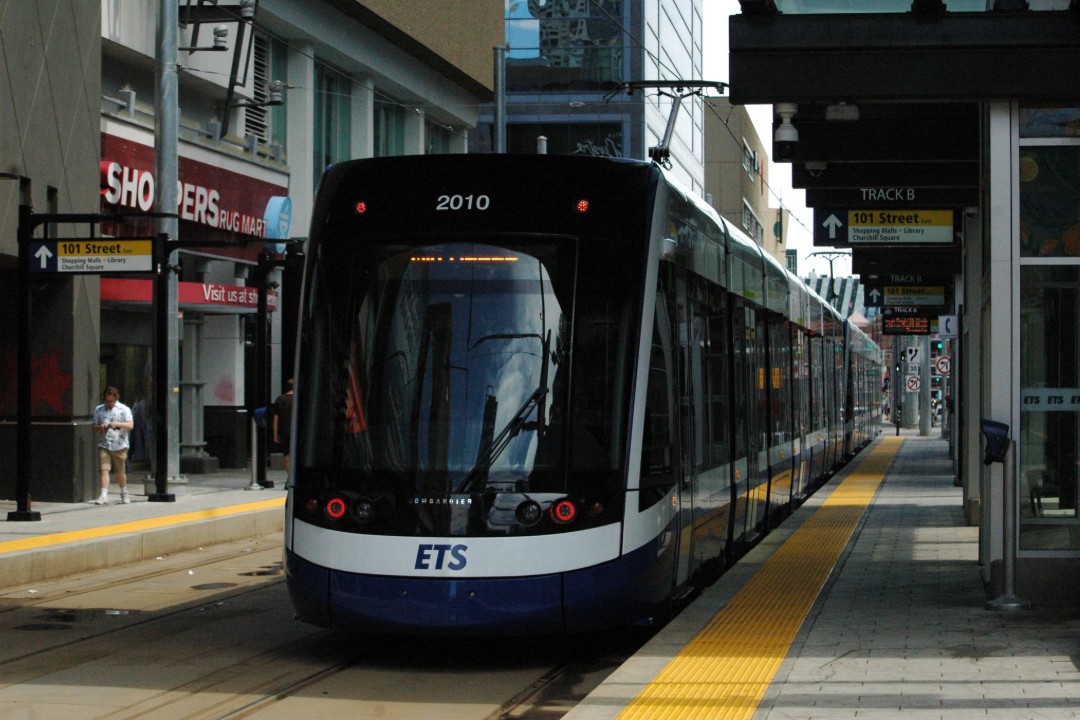
Council will be asked to approve about $28.2 million from the LRT reserve for the Valley Line transition office and equipment for the expanding LRT network. (Jon Spencer/Flickr)
Here are some more key items:
- Council will vote on updates to the public art policy and the climate resilience policy, following infrastructure committee's recommendations. The art update clarifies that funding is based on historical investments and collection maintenance needs. The climate update adds adaptation targets and a sustainable return on investment threshold to guide climate requirements for new city buildings.
- Coun. Ashley Salvador will introduce a motion requesting funding options for active transportation routes awaiting feasibility reviews and funding, plus an unfunded capital profile to continue implementing the Bike Plan, for the 2027-2030 budget deliberations.
- Coun. Thu Parmar will introduce a motion calling for a public hearing and an analysis of shifting up to $220 million from the Neighbourhood Renewal Program tax levy to arterial-road renewal for the 2027-2030 budget cycle.
- Council will consider first reading of a bylaw allowing the city assessor to delegate municipal tax relief decisions to directors and managers. The existing $500,000 annual limit on tax forgiveness by administration would remain unchanged.
- The city's operating budget is projected to end 2026 with a $500,000 surplus after using $51.4 million that was set aside to manage budget pressures to offset a $50.9-million shortfall. Higher snow-clearing and overtime costs, as well as lower revenues from transit advertising and permits, are among the pressures. The forecast excludes the net effects of tariffs and heavy rainfall in June and July. The Financial Stabilization Reserve is still projected to end the year $15.4 million below its minimum balance of $150.4 million.
- Most significant capital projects are within acceptable tolerances for budget and schedule, administration says. Weighted by approved budgets, about 83% are within an acceptable range in terms of budget, and 94% are within an acceptable range in terms of schedule.
- Council will meet in private to discuss public safety, strategic planning, and intergovernmental matters, including a provincial pre-budget submission and partnership opportunity.
And here are updates on some of the items we told you about last week:
- Community and public services committee unanimously recommended that council approve the updated snow and ice control policy. It requested unfunded service packages for the 2027-2030 budget to enhance school-zone clearing and continue assisted snow removal, using a structure similar to Calgary's, informed by provincial discussions and options to lower per-household costs and serve more residents. Councillors opposed resuming direct calcium-chloride application on roads after speakers warned that long-term corrosion costs to vehicles and infrastructure outweigh short-term savings.
- Executive committee unanimously recommended that council adopt updated climate implementation priorities and requested 2027-2030 budget proposals for eight actions with combined implementation estimates of $114.58 million, some of which are already partly funded. These include energy-efficient city infrastructure, fleet decarbonization, climate-resilient buildings, and community hubs offering relief from extreme weather and smoke. Work requiring no new funding can proceed, including four actions using existing staff time, such as improving grid resilience with utility partners. Committee also requested separate $5-million budget proposals for community climate initiatives and the Alberta Ecotrust Foundation's Climate Innovation Fund endowment.
- Urban planning committee unanimously recommended that council approve the revised heritage places policy, broadening the city's approach beyond built heritage to include natural, Indigenous, community, and cultural heritage. It also directed administration to work with the Strathcona Rail Community Garden Society to explore historic designation for the garden, now that it is part of Edmonton's inventory.
- Executive committee unanimously requested an unfunded service package for a community-led Chinatown cleanup pilot for the 2027-2030 budget. The proposed grant-funded pilot would fill gaps in existing municipal and community services and encourage community participation. Three specialized city teams already serve Chinatown through the Centre City Optimization Program, which has a $595,000 annual budget focused on Chinatown.
- Following urban planning committee's review, the city's daily on-street construction and maintenance permit fee will rise from $25 to $32 on Jan. 1 to shorten construction disruptions. Single-detached, semi-detached, and row-house projects will pay a flat $185 permit fee, which includes an exemption from the new $10 daily fee for waste bins on public roads.
- Community and public services committee directed administration to include a $500 fine for parking in a disabled parking stall in upcoming traffic bylaw amendments. It also requested a report on a potential parking enforcement service standard, including performance targets, resources, and costs, for the second quarter of 2027.
- Executive committee postponed the 311 service experience report and a proposed amendment to the agreement with Azolla Hydrogen until its Oct. 2 meeting.
- Executive committee unanimously recommended that council repeal the bylaw that granted municipal historic designation to the Arlington Apartments. Fire damaged the building in 2005, and its remaining walls were demolished in 2008.
Meetings stream live on YouTube on the Chamber channel and River Valley Room channel.
For more on civic affairs, including an interview with Coun. Ashley Salvador and the Edmonton Bike Coalition's Aaron Budnick about the active transportation network expansion, listen to Episode 370 of Speaking Municipally.
Share