
On the agenda: Bike lanes, climate resilience, Low Level Bridge
This week, councillors are set to discuss a pause on future bike lanes that take away parking or travel lanes, amendments to the city's climate resilience policy, and early designs for the Low Level Bridge replacement.
There is a utility committee meeting on Aug. 24, a public hearing on Aug. 25, and an infrastructure committee meeting on Aug. 26.
Here are some key items on the agenda this week:
- Administration has proposed pausing planned active transportation infrastructure that takes away parking spaces or vehicle travel lanes because of expected provincial legislation, as well as community pushback. A report due at infrastructure committee said that because the previous council chose the "rapid" approach to building bike lanes and other active transportation infrastructure, public engagement was limited and adaptable infrastructure was often used. The report said this has garnered significant negative feedback and pointed specifically to the recent decision to redesign infrastructure on 50 Street. The new design — retaining parking and vehicle travel lanes — costs about double the initial construction costs. Alberta Transportation Minister Devin Dreeshen spoke to residents in Capilano about that project in July. Dreeshen applauded a recent Ontario court decision that overturned an earlier ruling that stopped the provincial government from replacing protected bike lanes with car lanes in Toronto. "The appeal court made clear that governments have the authority to make and change transportation policy and that there is no constitutional right to a bike lane," Dreeshen wrote. Though the provincial legislation limiting active transportation infrastructure doesn't yet exist, the city report said making a proactive decision could help mitigate legal implications, which will be discussed in camera. The change in direction requires council approval; infrastructure committee is expected to give a recommendation to council, which will make the final decision at a future meeting. Additionally, administration is in the process of updating the Active Transportation Implementation Guide, which will be presented to council before the four-year budget deliberations. Administration has already cancelled planned infrastructure in Grovenor. That project didn't involve separated bike lanes, but rather traffic calming features and reduced parking.
- Administration has prepared amendments to the climate resilience policy that incorporate the optimal point for capital investment that yields the best return for taxpayers when considering economic, environmental, and social benefits. The proposed change introduces a sustainable return on investment (S-ROI) analysis, meaning that projects would incorporate climate-resilient requirements to a point where a positive S-ROI is demonstrated, the report said. While this responds to financial constraints, it could also result in reduced environmental outcomes, meaning alternative solutions may be required to meet the city's emissions targets, administration said. The policy update also includes a new community adaptation target, which would combine data across multiple climate hazards to provide a measurable, citywide view of risk related to climate change. This work involves tracking the climate risk and adaptation of individual neighbourhoods. Fifty-seven neighbourhoods have a high or very high climate risk, and administration aims to reduce that number to zero by 2050. Infrastructure committee will review the changes before council makes the final decision at a future meeting.
- Administration has released its preliminary plans for replacing the Low Level Bridge. A report set to be presented at infrastructure committee said that the city will likely build a functional roadway bridge rather than a "signature" structure. The report added that the initial traffic analysis suggested the replacement may need more than four lanes, but to align with city goals of reducing the number of people who use cars to meet their daily needs, a four-lane bridge will be considered. The alignment is expected to be to the west of the existing bridge. Administration had initially said the Low Level Bridge replacement project could involve simplifying the road network surrounding the bridge, as well as daylighting Mill Creek. However, this report says the replacement can be done without reconfiguring the road system. Public engagement will begin in the fall; the report notes that there are "no immediate risks when moving forward with only the Low Level Bridge replacement work at this time." Starting in 2027, the northbound bridge is expected to close for a construction season for repairs, and administration will create the preliminary design for the replacement bridge. Construction is expected to take place from 2029 to 2031. The following year, the southbound bridge is expected to be decommissioned and the northbound one converted to active transportation.
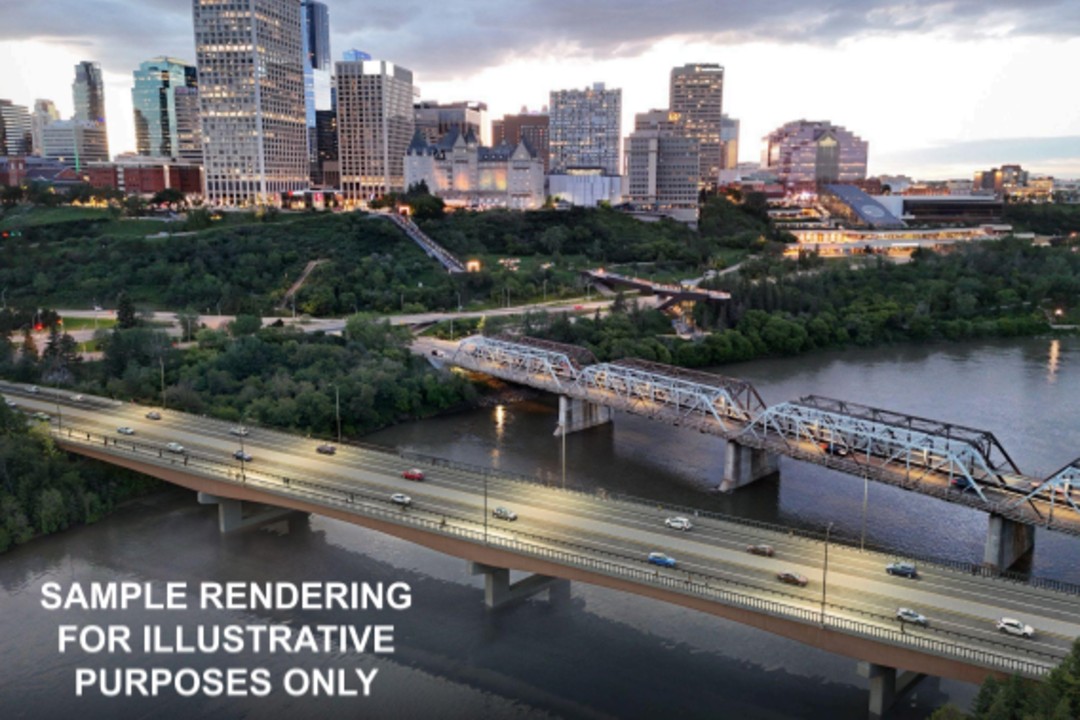
Administration has released a preliminary rendering of what the Low Level Bridge replacement could look like, with the preserved northbound Low Level Bridge in the background. (City of Edmonton)
Here are some more key items:
- Administration recommends amending the Public Art to Enhance Edmonton's Public Realm policy to clarify how art projects get funded. The program was previously called Percent for Art, and provided about 1% of eligible costs from capital projects to cover the cost of the artwork's creation and installation, as well as the Edmonton Arts Council's costs to oversee the project, plus lifecycle management costs, care, conservation, and restoration. Since 2021, the definition of "1% of eligible capital projects" has been based on historic spending patterns dating back several years. Now, administration has proposed amending the policy to say that the city will allocate funding for a public art reserve through the operating budget approved by council, with reserve funding levels based on historical public art investments and collection maintenance requirements.
- Council's infrastructure committee will revisit a report about the results of a call that asked private and public partners if there was interest in developing city infrastructure. Administration put out a request for expressions of interest for the Woodcroft Library, Cumberland and Big Lake Fire Stations, Windermere North Transit Centre, and arenas in general. The report said most submissions proposed building a facility and turning it over to the city, or financing an asset with a payment plan to the city. The report said administration will develop a competitive procurement process to find a partner to develop a fire station with funding from the 2027-2030 capital budget.
- EPCOR is scheduled to give utility committee a verbal report about its response to storms.
- EPCOR will provide an update on its performance-based regulation application. Performance-based regulation, or PBR, is a way of setting utility rates that tries to reward EPCOR for running the system efficiently while still requiring it to meet service standards. The report is asking councillors to support changes to how Edmonton's PBR process, performance measures, public engagement, and oversight should work before EPCOR files its next application.
- Councillors on the infrastructure committee will hear an update about the impact of weather events on construction projects.
- A landowner has submitted an application to rezone a corner residential lot in the Glenwood neighbourhood to the mixed-use zone, which allows for a building of up to four storeys. Some residents said the lot's location at the corner of 167 Street and 96 Avenue NW would lead to traffic safety risks as it is near a school and there is no alley access.
- A surface parking lot in the downtown core could be turned into a park if council approves a rezoning application. The City of Edmonton's economic investment services team has submitted an application to rezone a surface parking lot at 10008 103 Street NW to the parks and services zone.
And here are updates on some of the items we told you about last week:
- Council voted 7-6 to postpone a rezoning application for a property in Garneau to a public hearing in December. Mayor Andrew Knack voted against postponing, as did councillors Erin Rutherford, Ashley Salvador, Anne Stevenson, Keren Tang, and Jo-Anne Wright. Some voting for postponement said they wanted to wait for the results from a community-led amendment to the zoning bylaw and district plans. Those voting against postponing said the location was ideal for increased density.
- Council postponed a public hearing for a property in the Girard Industrial area where the Hope Mission intends to convert a facility to an emergency shelter and wellness facility.
- Council voted unanimously to approve a rezoning application to facilitate changes to the broad planning documents for the Gorman neighbourhood.
- Council voted 9-4 on a motion requesting a report about the impact of infill housing on the property values of surrounding homes. Those who voted against the motion said property values are based on a complex set of factors, and it's hard to prove whether an adjacent infill development made a difference. Proponents said it will be good to have more data to tell the whole story of infill development in the city. Councillors Erin Rutherford, Ashley Salvador, Keren Tang, and Jo-Anne Wright voted against requesting the report.
- Council voted 7-6 to direct administration to prepare an unfunded service package for a fare gate pilot project in at least one LRT station. The service package will be voted on during the 2027-2030 budget deliberations. Councillors Michael Janz, Aaron Paquette, Erin Rutherford, Ashley Salvador, Keren Tang, and Jo-Anne Wright voted against the motion.
Meetings stream live on YouTube on the Chamber channel and River Valley Room channel.
For more on bike lanes, fare gates, and infill, plus comings and goings at city hall, listen to Episode 368 of Speaking Municipally.
Share