
RNARevive eyes commercialization for personalized biotech
An Edmonton-based company is seeking to harness the power of RNA to help people live longer and healthier lives.
"Our big, hairy audacious goal is freedom from disease," said Nina Karpoff, co-founder and business development lead for RNARevive. "We're not going to manage disease, because we can do with technology so much more … We're in the business of making recipes to empower you to be your own personalized, medicine-making factory."
RNARevive is one of 10 companies that will be showcased during Edmonton Startup Week, the latest in a string of recognition and support amassed over the past two years.
It all started in the hallways of the University of Alberta, where Karpoff was inspired by founder Mardin (Asghar) Fallah's desire to make the world a healthier place, she told Taproot in an interview on the Technology Alberta stage during KDays on July 23.
"He had this vision of how the world would be so much different if we just had his technology commercialized, and he really didn't understand how to build that out," she said. "I'm a very roadmap-thinking person, and I got very excited. Fast forward, my son was born in September of 2024, and I took that chance to rethink my career, took a leap of faith, and went headfirst into this technology company with them and helped them launch."
RNARevive is developing a platform to deliver self-amplifying RNA therapeutics. The company is looking at improvements in bone and eye health related to aging right now. Its therapeutics stimulate the body's own healing mechanisms and can reduce the number of doses required to treat patients, thus saving precious time and money in care. They can be personalized to patients in a single batch, so there's no need for mass production to take place before accessing care.
Existing therapies for age-related macular degeneration, or AMD, are "not perfect," Karpoff said. "What we've discovered is we could just do it so much better."
Figuring out a repeatable process for that condition opens the way for RNARevive to do even more, she added. "Once we tackle AMD, we can start to tackle other kinds of diseases — rare diseases that never before had the economics make sense."
The company has a lot of momentum heading into Edmonton Startup Week, which runs from Oct. 5 to 9. Fallah received an Innovation Catalyst Grant in January 2025, and the company has been part of programs offered by Plug and Play, Edmonton Unlimited, Startup TNT, UCeed, and others. Karpoff has just been selected for the Movement51 Fall Founder Lab to deepen the company's investor readiness and scalability.
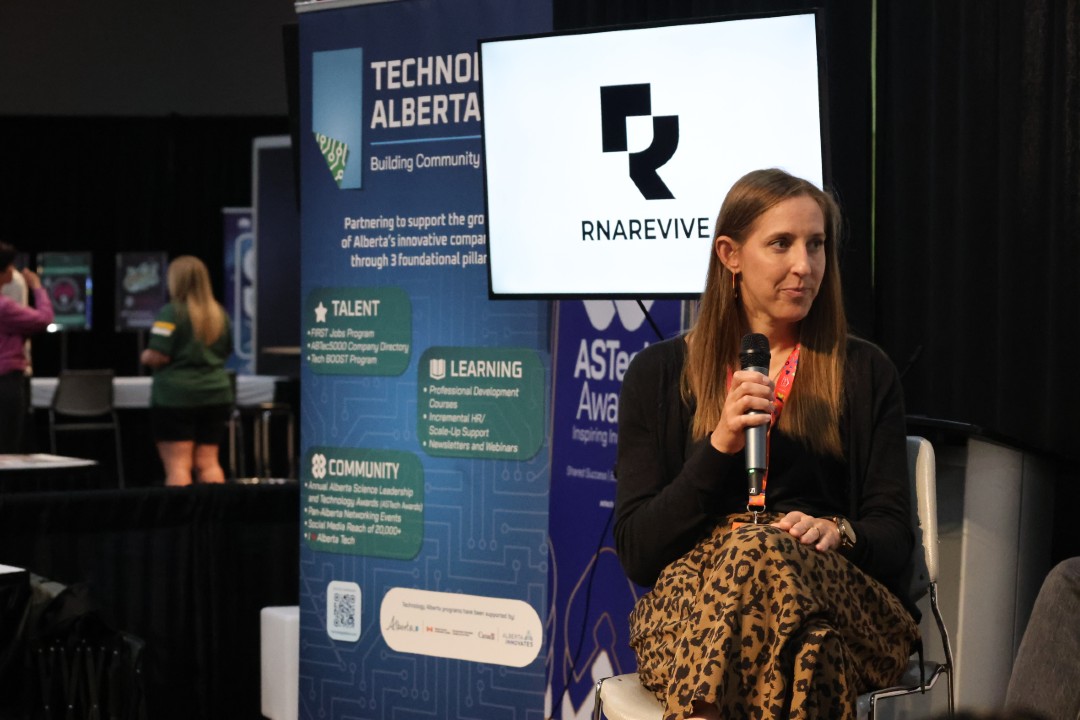
RNARevive's Nina Karpoff on the Technology Alberta stage during KDays on July 23. (Julia MacKay/Technology Alberta)
RNARevive operates from the U of A's Health Innovation Hub at Enterprise Square, which is supported by Applied Pharmaceutical Innovation and offers knowledge-sharing among peers such as SpectraCann. Yet despite the local support, including a visit from Sen. Paula Simons during the Pacific Northwest Economic Region Summit in July, Karpoff said RNARevive is best known beyond its backyard.
"They see us on an international scale here in Edmonton, and our own brothers and sisters in our community don't even know we're here," she said. "We're making waves, making sure people know who we are, telling our story, and helping people understand this vision."
RNARevive's primary commercialization strategy is to partner with other biotechnology companies to license or co-develop its therapeutics, having made connections with multinational pharmaceutical brands such as Eli Lilly and Company, Roche, and Bayer. Karpoff added that a long-term possibility for RNARevive is to develop, manufacture, and commercialize its own medicines.
"We're trying to understand what it is to be successful with them and building those relationships," Karpoff said. "Honestly, right now, it's looking pretty good. Hopefully a big fish can pick this up, and if not, a medium pharmaceutical company that needs the IP to be successful would be a good opportunity for us as well."
Building those relationships includes a trip in September to Singapore, "an area where next-generation technologies are really well-understood and celebrated," Karpoff said. The company's vision is to go global, but regulatory hurdles vary depending on the jurisdiction. For example, Moderna's road to approval in the United States for its new flu vaccine has been filled with twists and turns, and such uncertainty can stop fledgling companies from leaving the nest.
"For early-stage biotechnology companies, predictability is extremely important because investors and partners are making decisions years before a product reaches patients," Karpoff wrote in an email.
As for here at home, Alberta's rapidly changing healthcare system has little direct impact on RNARevive at its current stage. However, Karpoff added that government investments in research and innovation make Alberta a good place to do business.
"Internationally, Edmonton's researchers and innovators are highly respected and regularly collaborate with leading organizations around the world," she wrote. "Yet many Canadians are still unaware of the depth of innovation taking place here. Continued support for commercialization can help ensure more of those discoveries grow into globally competitive companies headquartered in Alberta."
The local ecosystem will see more of RNARevive during Edmonton Startup Week, at a pitch event on Oct. 5 and at Launch Party 17 on Oct. 8.
Share