Rossdale debate reflects differing worldviews and capacities, advocates say
Decisions such as the land-use changes that Edmonton's city council recently made in Rossdale tend to draw imaginary lines as if they are real, says an Indigenous relations expert.
Colonial ideas of land use posit that "one side of the fence equals this and the other side of the fence equals this," said Miranda Jimmy, who has worked in Indigenous relations with the City of Edmonton, the Confederacy of Treaty 6 First Nations, and the Government of Alberta and now works in the private sector. "But what about that tree that grows on the fence line? It is impacted by the decisions on every side of the fence … What about the watershed that feeds that tree? What about the mammals that walk through that field?"
The neighbourhood dubbed Rossdale, on the north bank of the North Saskatchewan River in the centre of the city, is on land whose history long pre-dates the establishment of Edmonton. Indigenous engagement is especially important there, and it needs to be undertaken with sensitivity, said archeologist Kisha Supernant, director of the Institute of Prairie and Indigenous Archaeology at the University of Alberta.
"The people who work within (Indigenous governments) are often extremely overloaded with so many other things, and knowing how to even route the right requests to the right people can sometimes be really challenging," said Supernant, who joined Jimmy on Episode 366 of Speaking Municipally to discuss Rossdale and broader issues of engagement. "It's often on timelines that are completely unworkable for Indigenous people."
Administration heard a similar message when it looked into what Indigenous engagement is legally required on city-owned land in and adjacent to the river valley for a report presented to urban planning committee at the beginning of July. Indigenous nations and communities told the city they need flexible timelines, the report said, and insufficient capacity and resources affect their ability to engage.
This came up when city council considered rezoning a plot of land in Rossdale, most of which is used as a parking lot for baseball games at Re/Max Field. The rezoning application, submitted by the city's real estate and land development branch, sought to slightly change the height of future buildings that are already allowed on the lot, aligned with what has been approved in the wider River Crossing Business Plan.
Administration said it notified governments of Treaty 6, 7, and 8, as well as the Métis government and Lac Ste. Anne Métis Community Association, and heard no feedback. Councillors questioned whether that meant the groups were fine with it.
Supernant agreed. "Assuming that non-response means compliance or means support is really problematic," she said.
Administration said that while feedback was limited on that particular rezoning application, staff had been engaging extensively with Indigenous communities on the wider River Crossing plan. After a public hearing at which a number of Indigenous representatives spoke in opposition, while Enoch Cree Nation and the Confederacy of Treaty 6 First Nations spoke in favour, city council approved the rezoning. It was later revealed that Enoch and the Confederacy have submitted an expression of interest for the River Crossing project.
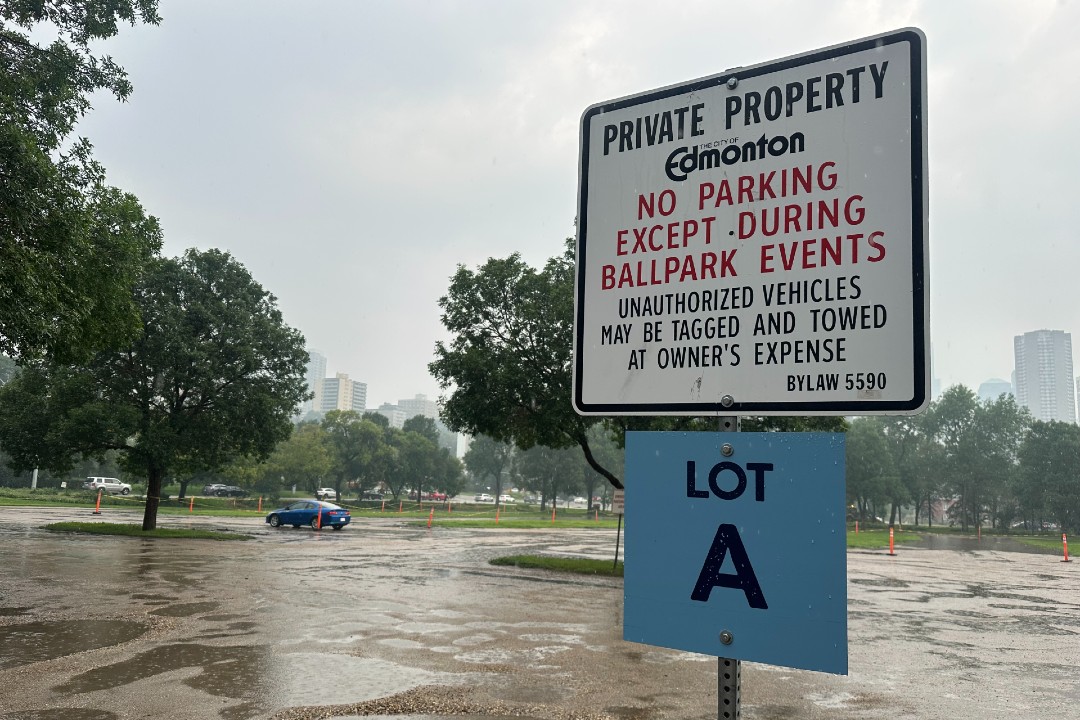
The recent rezoning of land in Rossdale that is currently used for parking at Re/Max Field raised questions about whether Indigenous groups were sufficiently consulted. (Stephanie Swensrude)
Jimmy noted that three current projects in Rossdale are treating Indigenous engagement differently, while following city policies. The River Crossing Business Plan and the Heritage Interpretive Plan require Indigenous engagement for projects within their scope. Meanwhile, the city is also in the planning and design phase for neighbourhood renewal in Rossdale, and that "requires zero Indigenous engagement, even though it's ground disturbance and it's impacting vegetation and mammals, just like the River Crossing project will," Jimmy said.
Then there's the site of the Rossdale Brewery, on which Dub Architects is proposing to build a set of towers. Because it's a private development, it requires no Indigenous engagement, though the city says it encourages private developers to do their own engagement.
The land is important to Indigenous people regardless of whether the construction crew digging into it is public or private, Jimmy said, "but the city sees it as these definitive boundaries that don't impact each other."
The provincial Historical Resources Act mandates that all city projects in the river valley must have Indigenous monitoring, and the city said it is discussing what Indigenous monitoring will be required during the neighbourhood renewal project.
Indigenous monitors work on construction sites, often sifting through piles of dirt to watch for tiny artifacts such as stone tool flakes or bone shards. The monitors track where in the dig site the dirt piles come from and halt digging if something is found.
Rossdale is one of the most archaeologically rich places in Edmonton, Supernant said. While the Rossdale Burial Site is well-known and marked, she said there are likely many other types of materials throughout the River Crossing scope and the wider river valley. That could include Indigenous artifacts from before European contact, or post-contact materials such as glass, pieces of metal, or beads, which can sometimes be seen as garbage.
"Now, a trained archaeologist should be able to distinguish between them, but there is a challenge in that, (to) a construction worker … it's just some old glass," Supernant said. "But that is literally the belongings of our ancestors and our relatives that got discarded there."
Should development go ahead in Rossdale, Supernant said, it should be monitored by well-trained Indigenous representatives, and rights-holding communities should be notified if artifacts are found.
For much more, including further discussion of the archaeological significance of the river valley and how that history could be honoured through heritage interpretation, stay tuned for the July 24 episode of Speaking Municipally.
Share