
Hingston & Olsen Publishing reaches its epilogue
The numbers don't make sense anymore, but the publisher that sold 20,000 short story collections over 10 years said he doesn't feel despair about the future of physical media.
"People love buying beautiful books, and in fact, the philosophy here is that because you can just get the words on a screen if you want to, if it's going to be a book, it should be a nice-looking book," said Michael Hingston, co-founder of Hingston & Olsen Publishing. "I think the only way publishers are going to survive is if they lean into what they do differently than ebooks or audiobooks, which is really making a print object that people want to keep and want to look at."
Hingston, who now runs Porch Light Books, founded the publishing firm in 2015 with Calgary-based Natalie Olsen. They announced the boutique publisher would be winding down on May 5, citing increased costs and reduced efficacy of social media promotion.
The firm's most well-known product was the annual Short Story Advent Calendar, which Hingston said was inspired by beer and LEGO advent calendars. "I thought, 'I should go look for the literary version of this, because I want to buy it,' and then I couldn't find anything like that," he said. He tucked the idea away until the next summer when he emailed Olsen, who was open to trying it out.
The publisher got a lucky break in its second year when Patton Oswalt, an American comedian and actor who voiced Remy the Rat in Ratatouille, got a copy and did daily reviews on his Twitter account. "(It was) amazing free publicity, and he's such a thoughtful reader and a smart guy, so we were like, 'This is amazing,'" Hingston said.
Spotting an opportunity, he messaged the comedian, asking him to reach out if he ever had an idea for a box set. Oswalt then edited a horror story set called the Ghost Box, which earned Hingston & Olsen the attention of major American publications. "Having his name associated with us was a big deal, and it was our very first collaborator."
The company specialized in anthologies and deluxe box sets. Collaborations resulted in four Ghost Boxes, a science fiction collection, and a box featuring 25 stories from 25 countries, to name a few. Several of the boxes were edited by people that Hingston called the smartest or coolest person in their respective fields, including rare book dealer Rebecca Romney, best-selling author Kevin Wilson, and Alberto Manguel, director of the Centre for Research into the History of Reading in Portugal.
"We got really ambitious … It didn't really matter if we thought the odds were good, I always start from the top and just work down and see who will say yes to us and who's interested," he said. "We had an amazing hit rate — all those people I mentioned saying yes to us, any one of them, for a publisher of our size and reach — a part-time, two-person thing working off the side of our desk with no sales team — it's incredible that any of them said yes to work with us, let alone all of them."
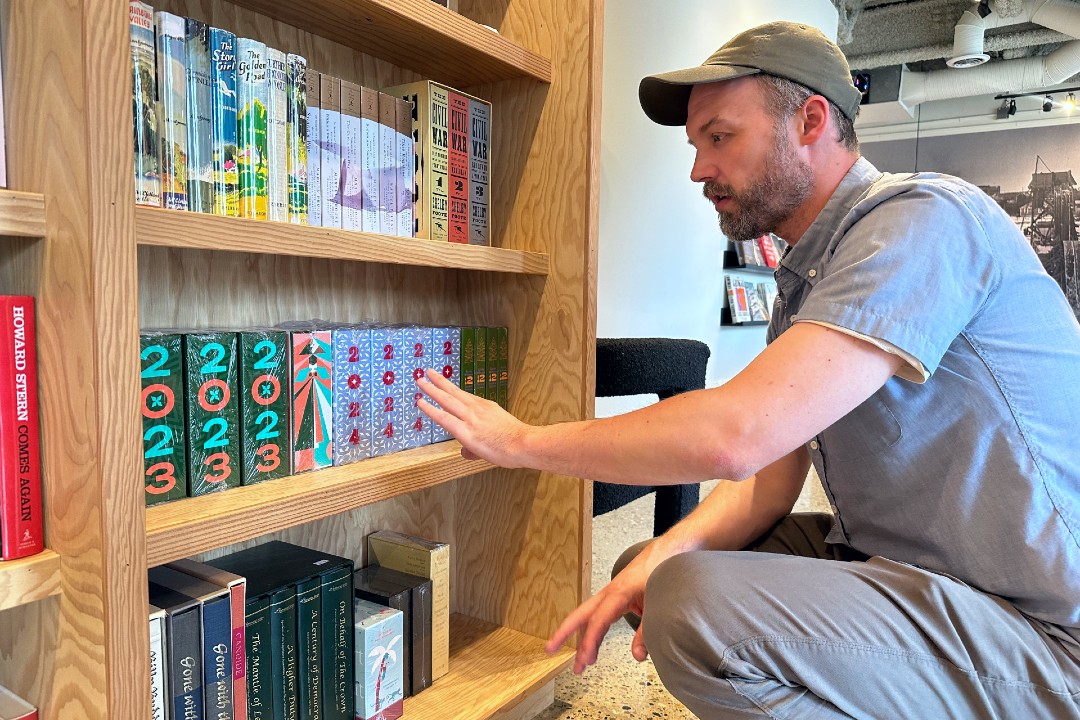
Michael Hingston is selling copies of short story collections from previous years at Porch Light Books. (Stephanie Swensrude)
Hingston said 90% of the company's sales were direct-to-consumer, because bookstores typically take a sizable chunk of the sale price. "Our books are so complicated and expensive that we didn't have that margin, so the only way we could even try to make a go of it was to sell direct to customers."
But now that he runs his own book store, Hingston said he has more understanding of retail price points. "If anything, I look at the prices that we charged on some of our stuff and I think, 'Man, we could have charged a decent amount more than we did,'" he said. "But we were always trying to balance making something high quality and keeping it accessible to people."
Despite this, the beautiful box sets became financially untenable, Hingston said. "Over the course of those 10 years, the price of shipping doubled, and the cost of paper doubled, so all of our margins essentially disappeared," he said.
Hingston said the company's scope was intentionally bigger than just local writers, but it still included several Edmonton authors through its collections, including Jason Lee Norman, Thomas Wharton, and Richard Van Camp.
Over the years, Edmonton was consistently the company's most supportive market, Hingston said. "People here just really got behind it from the beginning, and I think that's what allowed us to continue as long as we did — just instantly we had that level of support, and it kind of never went away."
Share