Your turn: Climate, leisure access, and pipeline route
This week's batch of calls for public engagement includes Edmonton's annual climate change and energy perception survey, feedback on the leisure access pass program, and open houses about the proposed Yellowhead Pipeline.
The climate change and energy perception survey is open until June 7 and is available to those enrolled in Edmonton's Insight Community. The preamble says the feedback will play a crucial role in shaping the city's climate policies and initiatives.
The survey has taken place annually since 2017. This will be the first survey since council voted to disband seven advisory committees, including the Energy Transition Climate Resilience Committee, a panel of experts that advised council on climate issues. Melanie Hoffman, former chair of the committee, told Taproot shortly after the decision that the committee's end means Edmontonians who care about climate are going to need to share their voice. "If we want a strong four-year budget that prioritizes a responsible, livable city, people are going to need to show up," she said.
Edmonton initiated the creation of Canada's first municipal carbon budget in 2021. It set a cap of 176 megatonnes of emissions through to 2050, when the city aims to reach carbon neutrality. The budget tracks emissions from both city operations and the broader community. But from the start, projections showed the city would exceed its limit by 2037, and updated forecasts now suggest both the city operations and community carbon budgets will be depleted even sooner. Administration said an updated carbon budget will be presented every four years alongside the operating and capital budgets.
Results from past surveys suggest that Edmontonians' thoughts and feelings about climate change have changed very little since 2017. The share of respondents who said they are concerned about climate change has stayed within a percentage point of 74%, while the share who said action is needed now rose modestly, from 72% to 77%.
Administration underscored the urgency in a report released last year. Understanding Edmonton's Changing Climate found that Edmonton is warming faster than the global average. Since 1885, the city's mean annual temperature has risen by 2.3C, while winter temperatures have increased by more than 4C. Wildfire smoke and other episodic air quality events have also increased exposure to harmful pollutants such as fine particulate matter, while annual precipitation has declined by 14% compared with the 1961-1990 baseline.
"The findings presented in this report are clear: climate change is not a future threat — it is a present reality in Edmonton," the report said. "These changes, while consistent with global and national trends, are unfolding locally in ways that are deeply shaped by Edmonton's geography, infrastructure, and social systems."
Administration is also updating the Climate Action Plan, which is scheduled to be presented to council in late June.
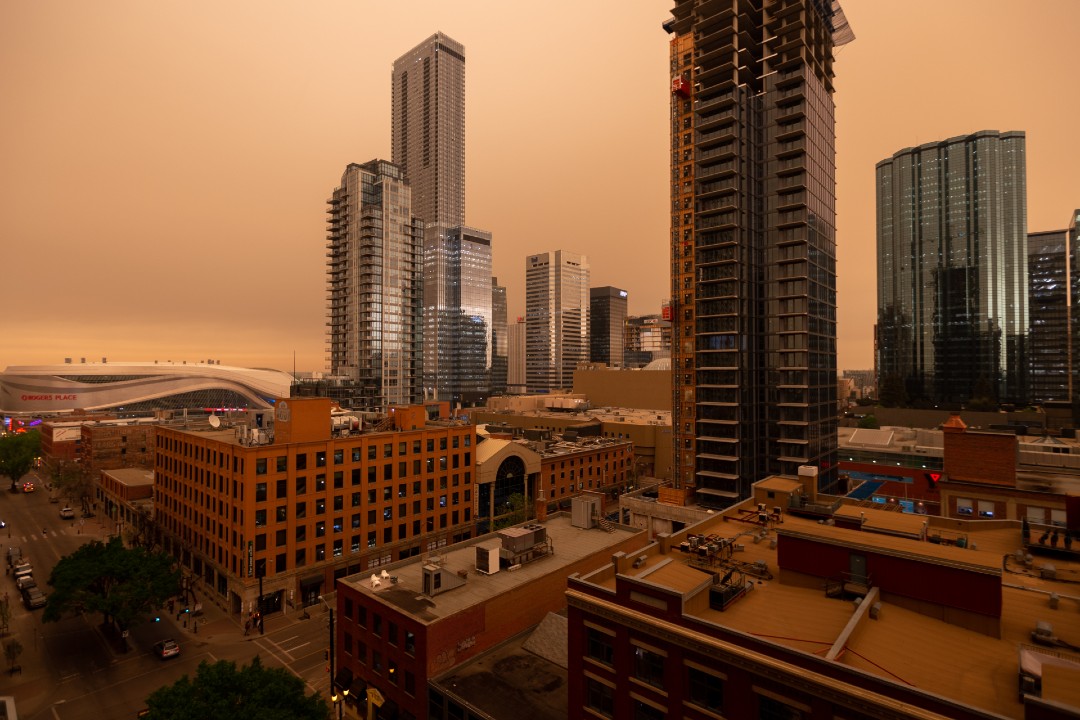
Edmonton on a smoky day in 2019. The city has launched its annual climate change and energy perception survey. (Mack Male/Flickr)
Here are some other opportunities to provide input in the Edmonton metro region:
- June 6: The City of Edmonton is hosting an open house on the downtown policy update at the Downtown Farmers' Market on 104 Street from 9am to 3pm.
- June 8: Parkland County is holding an open house about a new approach to area structure plans at Clymont Community Hall from 4pm to 7pm.
- June 9: ATCO is holding an open house about the Yellowhead Pipeline route at the Onoway Heritage Centre from 5pm to 8pm.
- June 9: The City of Edmonton is hosting an open house on the downtown policy update at Edmonton Public Library (Stanley A. Milner) from 5:30pm to 8:30pm.
- June 9: Parkland County is hosting a County Chat at the Magnolia Community Hall from 5:30pm to 7:30pm.
- June 10: ATCO is holding an open house about the Yellowhead Pipeline route at the Calahoo Community Hall from 5pm to 8pm.
- June 10: The City of Edmonton is hosting an open house on the downtown policy update at CO*LAB from 5:30pm to 8:30pm.
- June 11: Parkland County is holding an open house about a new approach to area structure plans at Entwistle Community Recreation Centre from 4pm to 7pm.
- June 15: ATCO is holding an open house about the Yellowhead Pipeline route at the Morinville Community Cultural Centre from 5pm to 8pm.
- Until June 15: The City of Edmonton is seeking feedback on the Leisure Access Program from those who are eligible but not currently using it.
- June 16: ATCO is holding an open house about the Yellowhead Pipeline route at Fort Saskatchewan Dow Centennial Centre from 5pm to 8pm.
- Until June 17: The City of Edmonton is seeking feedback on Vision Zero Street Lab installments in Ogilvie Ridge and Hodgson, Crystallina Nera West, Sakaw, York Street, and Brintnell.
- June 18: Parkland County is hosting a County Chat at the Woodbend Community Hall from 5:30pm to 7:30pm.
- Until June 18: Parkland County is seeking feedback on its 2026-2029 strategic plan.
- Until June 21: The City of Edmonton has launched a survey about the Downtown Policy Update, an initiative to encourage more residential and day-use programs within the downtown core. The update will consolidate the Capital City Downtown Plan and The Quarters Downtown Area Redevelopment Plan.
- Until June 24: The City of Edmonton is seeking feedback on its proposed bus rapid transit routes, focusing on how Whyte Avenue and the university area will change.
- June 24-25: A vote on the viability of Gibbons as a town is scheduled for June 24 and 25 at the Gibbons Cultural Centre. Voters must show government-issued ID.
- Ongoing: Edmonton has begun its 2026 business census. City employees will visit businesses in person, and there is an online survey. Responses will be accepted until August.
"Your turn" is Taproot's weekly collection of public engagement opportunities in the Edmonton region. Watch this space every week for opportunities to make your views known. If you know of a request for public input, send it to hello@taprootedmonton.ca.
Share