
On the agenda: CRLs, derelict properties, and Rossdale
This week, councillors will hear an update on community revitalization levies, consider a higher tax for derelict properties that aren't residential, and make a recommendation on renewing part of the Rossdale neighbourhood.
There is a community and public services meeting on March 23, an urban planning committee meeting on March 23, a special city council meeting on March 24 and 25, and an executive committee meeting on March 26.
Here are some key items on the agenda:
- Revenue generated from The Quarters community revitalization levy is not projected to cover the investment the city has made in the neighbourhood, a report set to be presented to executive committee said. Municipalities can use CRLs to finance infrastructure developments needed to attract private development to targeted areas, and the investment is meant to be paid back through the property tax uplift of new development. The Quarters CRL has funded $100 million in "catalyst projects," including The Armature, upgraded drainage servicing, Kinistinâw Park, and the adaptive reuse of City-owned buildings into new art spaces. The report said the improvements attracted more than $450 million in private development. Despite this, the revenues from the CRL are expected to be about $63.6 million short of covering all outstanding costs of the catalyst projects. The general tax revenue in The Quarters could cover the outstanding debt by 2041, 10 years after the CRL ends, the report said. Meanwhile, the city's revenue projection for the Belvedere CRL has increased by $5 million to $35.4 million, and that project is expected to break even by the end of its 20-year term in 2032. The downtown CRL was extended in 2025. The revenue projection for that CRL has decreased by $77 million to $1.4 billion.
- About 20 properties in Edmonton with a total assessment value of $29 million could be considered candidates for a derelict non-residential tax subclass, a report to be presented to executive committee said. The subclass is one way to address issues associated with abandoned, fenced-off, or dangerous non-residential properties. Edmonton introduced a higher tax rate for derelict residential properties in mature neighbourhoods starting in 2024, and assessed about 200 properties at the higher rate. The tax was deemed a success — about 60 properties were demolished or remediated after it was introduced — and the derelict residential rate will be expanded city-wide in 2027. If council chooses to pursue a derelict tax for non-residential properties, administration said it recommends establishing the subclass but keeping the normal tax rate at first as assessors develop and refine the process. The report said the threat of higher taxes can sometimes be enough to motivate owners of derelict properties to demolish or sell. A cross-referenced report details other ways to address vacant residential and non-residential properties, especially in the redeveloping area within Anthony Henday Drive. Council could establish a tax subclass for vacant properties or a tax incentive program to help spur development, the report said.
- Administration is looking to start construction on the first phase of the River Crossing plan in Rossdale, which would see the construction or rehabilitation of the roads north of Re/Max Field and the first steps toward housing development on the field's parking area. Councillors will be asked to approve $15 million for underground servicing, subdivision, and planning applications for the parking area, which would be divided into four lots for buildings between four and 12 storeys high, with up to 300 units. Executive committee is scheduled to review the proposal and make a recommendation to council.
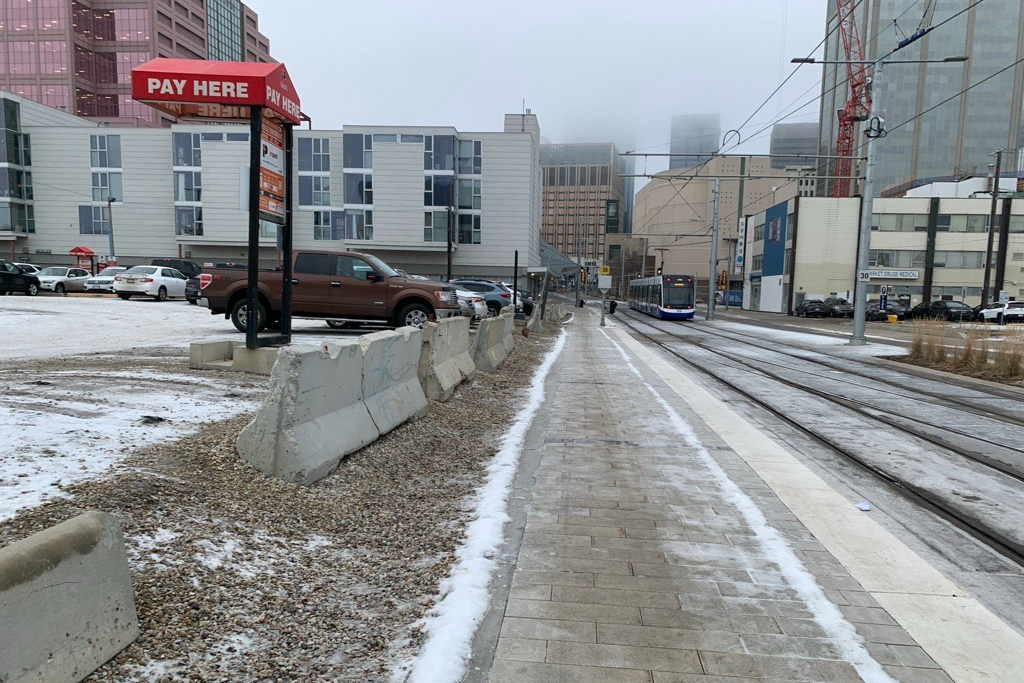
A Valley Line LRT rolls eastbound into The Quarters from downtown. Revenues from The Quarters community revitalization levy are expected to be about $63.6 million short of covering all outstanding costs of the catalyst projects. (Tim Querengesser)
Here are some more items on the agenda:
- Urban planning committee will examine options for funding transit priority measures and bus rapid transit. Administration said it is seeking funding sources for the next design phases for two BRT routes in the 2027-2030 budget, including from the Canada Public Transit Fund. Prioritize Whyte Ave, a coalition of area business associations and pedestrian advocacy groups, is urging councillors to support BRT along Whyte Avenue in the four-year budget, among other investments.
- Executive committee will be asked to approve a $5.4-million grant for the Brentwood Builds affordable housing redevelopment, which will deliver 112 new affordable units. Edmonton's Housing Accelerator Fund agreement with Canada Mortgage and Housing Corporation requires the city to approve building permits for nearly 2,000 affordable units by November 2026. Administration said the grant would allow the builder to expedite the design and enable the submission and approval of building permits before the November deadline.
- A report set to be presented to urban planning committee listed the roadways that need the most investment: 124 Street between Jasper Avenue and 107 Avenue; Jasper Avenue between 109 Street and 102 Street; and 127 Street between Yellowhead Trail and 137 Avenue. The report said it's unlikely these corridors will receive renewal funding in the 2027-2030 budget.
- Administration said it doesn't have legislative authority to refuse construction permits to builders who have a negative history. However, an update on the city's construction accountability program said the city is taking other steps within its jurisdiction to address builders who don't comply with construction standards. Administration said it has established a performance-based system to identify builders with low compliance rates and will require project implementation plans for such builders.
- Community and public services committee will be asked to recommend that council remove four surplus school sites from the First Place Program, which created 900 units for first-time home buyers. Administration proposes retaining sites in Dechene and La Perle for open space and sites in Dunluce and Sifton Park for affordable housing.
And here are updates on some items we told you about last week:
- Council voted 11-1 to approve a budget increase for the Lewis Farms Community Recreation Centre. The project is facing significant financial pressures despite several scope reductions. Administration said the amount of the budget increase is being kept confidential because staff is still working on contracts, and the amount will be made public as soon as possible. Coun. Mike Elliott voted against the increase; Coun. Aaron Paquette was absent.
- Council supported a motion from Coun. Michael Janz directing Mayor Andrew Knack to advocate to the provincial government to remove restrictive covenants that allow grocery chains to ban similar businesses near a site, even if the chain's store closes.
- Mayor Andrew Knack celebrated the projected $31.1-million operating budget surplus that will go to the financial stabilization reserve, which could be replenished a year earlier than planned. "Through the hard work and dedication of folks within our organization, we're in a much better financial position," he said at a meeting on March 17. "We're still not out of the woods, to be clear, we've still got lots of work … but I'm in a much happier position today, as I'm sure everyone in administration is, than we might have been three or six months ago."
- Council supported a $33.4-million grant to the Winspear Centre to help it complete its expansion project.
Meetings stream live on YouTube on the Chamber channel and River Valley Room channel.
For more on various civic issues, including the Prioritize Whyte Ave coalition, the budget increase for the Lewis Farms Recreation Centre, and patio fees, listen to Episode 348 of Speaking Municipally.
Share