
RWI adapts internal AI for third-party use
RUNWITHIT Synthetics is going to market with a licensable version of the tech it uses internally to help organizations foresee the consequences of their actions.
RWI launched INFLECTOR AI on Feb. 11, describing it as "an agent-based, inferential, artificial intelligence" in the announcement.
"What our customers are telling us now is that they need to be able to use this technology inside their markets, their organizations, and their technologies in order to do what we do in their part of the world," Dean Bitter, co-founder and chief visionary officer at RWI, told Taproot. "They're all very interested in creating and sharing what we call 'content' — and content, for us, is this very dynamic and interactive combination of data and models and visualizations."
INFLECTOR is not a new invention so much as a packaging of more than a decade of work. It's the toolkit that allows RWI to build synthetic twins of cities or regions and run scenarios to show decision-makers the impact of choices they might make. The company's award-winning model of the Edmonton region has been used to analyze business matters such as hydrogen demand, as well as social concerns such as economic precarity.
RWI sees governments, researchers, and corporations that are invested in the future of their communities as the market for INFLECTOR. But RWI plans to continue with the service side of its business as well, as the company's market consists of both hands-on and hand-off customers.
"Some want to build a spaceship, and others just want to fly in it," as co-founder and CEO Myrna Bittner put it after a $3.5 million investment from Raven Capital Partners in 2024.
The Bittners were not previously interested in RWI "coming out" as an AI company, Myrna told Taproot, because their customers were focused on end results, not the connotations of disruption that AI can bring. That said, the Bittners' previous company, NeuralVR, allowed for three-dimensional search within complex construction documents using natural language all the way back in 1999.
"We were doing agentic AI before it became known as agentic AI," Myrna said.
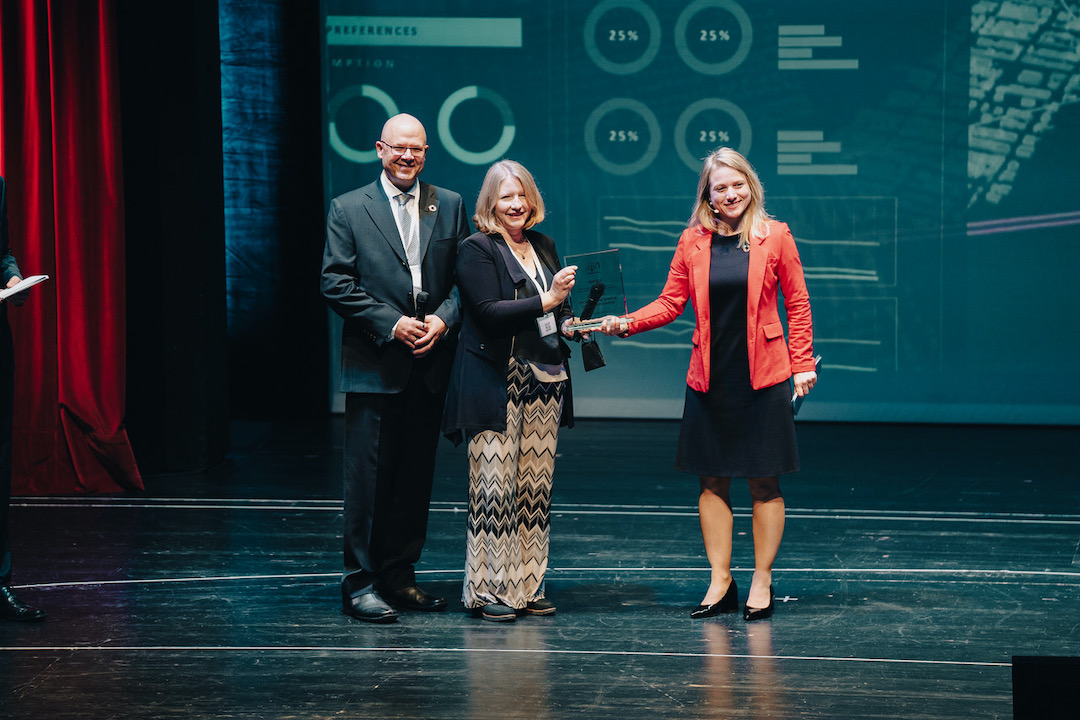
RUNWITHIT Synthetics co-founders Dean (left) and Myrna Bitter in 2021 when they received the United Nations Industrial Development Organization Global Call Award for Decarbonizing Growing Urban Environments in Remscheid, Germany. (Supplied)
While the launch of INFLECTOR AI suggests RWI is now happy to position itself more explicitly as an AI company, Myrna indicated some ambivalence about what artificial intelligence is doing to the world.
"I think once this really significant push to incorporate AI into every aspect of our creative lives and our mental health and our social lives (subsides), there's going to be a reckoning when it comes to how much it costs you," she said.
The ecological impact of large language models run by the likes of OpenAI, Anthropic, and Google also worries many. RWI says INFLECTOR AI uses far less energy and water and is responsible for far fewer emissions, given the way it is built.
"We believe we're using AI to save the world, not end it," Dean said.
This story is based on a larger conversation with Dean and Myrna Bittner on the Feb. 20 edition of Taproot Exchange, a members-only livestream conversation that goes deep on issues of interest to Edmontonians. Become a member for access to future livestreams, as well as recordings and transcripts.
Share