
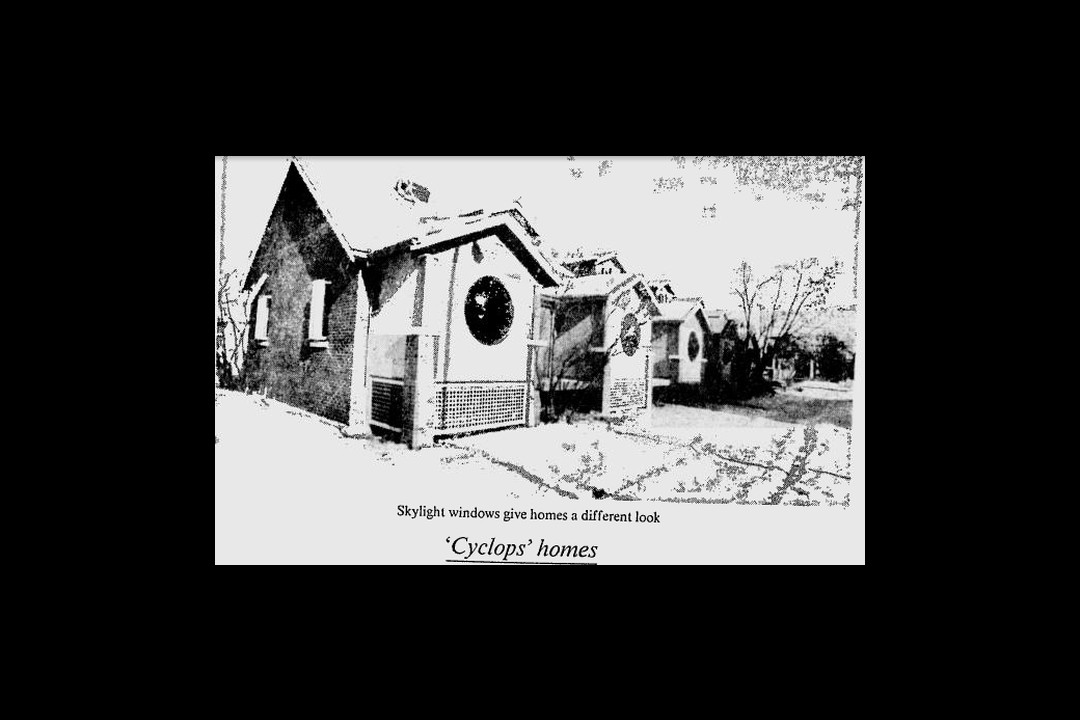
A moment in history: March 6, 1978
By Scott Lilwall
On this day in 1978, the now-iconic "bubble houses" in Wîhkwêntôwin were making their public debut.
The seven brick townhouses, dubbed "cyclops houses" by the Edmonton Journal at the time, had quite a bit of public interest. The homes, "standing like mysterious sentries on the north side of 102nd Avenue," as the paper put it, were built in the 1920s. The plastic bubble windows that turned them into Edmonton landmarks were part of a $100,000 renovation by Lorden Wolfe Development Corporation. Rent was $500 a month for 1,200 square feet.

The renovations were described as an attempt to preserve the rowhouses' past while introducing a modern idea. One could see that as a microcosm of the neighbourhood formerly known as Oliver, one of Edmonton's oldest and most architecturally diverse neighbourhoods.
The neighbourhood is now a central one, connected directly to downtown. But in Edmonton's early years, it was considered part of the west end, somewhat isolated from the core. There are about nine blocks of empty land between the neighbourhood and downtown — a sizeable distance at a time when most trips were made on foot. Urban development started in the 1880s. Many of the first buildings in the neighbourhood were religious, such as St. Joachim Catholic Church, giving the area a distinct French Catholic character compared to other parts of Edmonton.
The isolation made the neighbourhood a less attractive place to build in. But that would change with the introduction of the streetcar in 1908. With an easy way to get to the offices and businesses downtown, the neighbourhood's population skyrocketed. New houses quickly went up; the flood of new Foursquare-style homes and bungalows, as well as new Protestant churches, somewhat diluted the French Catholic flavour. In 1911, Oliver School was opened, named after politician and newspaper owner Frank Oliver. This would lead the area to be referred to informally as "Oliver," and the name would become official in 1937.
By the 1920s, the neighbourhood had become a fashionable place to live. The residents spanned a wide range of income levels. Wealthy families built large, single-family homes with river valley views along the southern and western boundaries, while more modest rowhouses and apartments housed labourers and office workers.
Oliver experienced another population boom in the 1950s, as did most of the city. This led to a demand for more housing. In 1961, the eight-storey Valleyview Manor was built at 12207 Jasper Avenue NW, becoming one of Edmonton's first high-rise apartments. This signalled another change to Oliver's architectural identity, as single-family homes would be replaced with many high-rises and walk-ups in the International style, while the area also became more car-centric.
The 1980s saw further densification, with more mid- and high-rise buildings appearing in the neighbourhood. That trend has continued to the current day, with several new towers in various stages of construction over the past few years. In 2025, the neighbourhood's name was changed to Wîhkwêntôwin, Cree for "circle of friends," in response to the community's desire to cease being associated with Frank Oliver's racist legacy.
The neighbourhood now has the highest density in the city, and its mix of historic buildings, walk-ups, and residential towers provides an architectural timeline of Edmonton's growth. The city is pursuing a neighbourhood renewal project for Wîhkwêntôwin, which would include adding more green space and traffic calming measures.
This clipping was found on Vintage Edmonton, a daily look at Edmonton's history from armchair archivist Rev Recluse of Vintage Edmonton.
Share